
Training Teams: 5 Hiring Checks for Corporate Training Voice Over
Hire a vetted professional human voice actor with real corporate training experience. Skip the guesswork by writing a short brief and requesting a few demo reads first. A marketplace like VoiceBros makes this fast: post the project, compare demos side by side, and book someone whose tone, pacing, and delivery already fit training content.
TL;DR:
- Most corporate training voice overs should be recorded by talent with experience in e-learning, compliance, and onboarding content to ensure clarity and technical accuracy.
- It is crucial to request a custom demo read using your script to accurately assess the voice actor's ability to handle technical terms, pacing, and language matching.
- Standard pricing models for training voice overs are based on finished minutes, with additional costs for localization, union status, and rush requests, making upfront budgeting essential.
- When working with remote actors, always specify technical requirements such as file format, sample rate, and delivery standards, and plan localization early for multi-region projects.
- Utilizing vetted marketplaces like VoiceBros simplifies hiring, reduces risk, and speeds up the process by filtering candidates based on language, accent, and training experience before booking.
Table of Contents
- What a Corporate Training Voice Over Actually Does
- How Do You Choose the Right Voice Talent for Training?
- Running an Audition and Reviewing Deliverables
- What Does Corporate Training Voice Over Cost?
- Working With Remote Talent Across Regions and Languages
- Why a Vetted Marketplace Cuts Real Hiring Risk
- Getting Started on VoiceBros
- Sources
- FAQ
What a Corporate Training Voice Over Actually Does
A corporate training voice over narrates the modules employees sit through when they onboard, learn compliance rules, or work through a safety course. The narrator's job is to make dense material sound clear enough that someone half paying attention on their lunch break still absorbs the point.
The applications are wider than most L&D teams expect:
- Onboarding walkthroughs and new-hire orientation
- Compliance and regulatory training
- Software or process explainer modules
- Microlearning snippets under five minutes
- Safety and procedural training on the floor or in the field
Professional narration improves clarity and keeps tone consistent across a whole course library, which matters more than it sounds. Clear, consistent communication also correlates with stronger engagement outcomes in workplace settings. Pairing audio with captions helps accessibility and gives non-native speakers a second way to follow along. Studio recording still delivers the cleanest sound, but plenty of working voice actors record remotely from treated home booths at a fraction of the cost. If your workforce spans regions or languages, plan for localization early rather than bolting it on after launch.
How Do You Choose the Right Voice Talent for Training?
Picking a voice is not about finding the most pleasant-sounding person on a demo reel. It's about matching a voice to how adults actually learn from audio.
Five criteria matter most:
- Tone and brand fit. Does the voice sound like a colleague explaining something, or like a movie trailer? Training needs the former.
- Clarity and pacing. Rushed narration kills comprehension. Look for a natural, unhurried cadence with clean enunciation.
- E-learning experience. A voice actor who has narrated compliance or onboarding content understands how to handle technical terms, acronyms, and script pauses for on-screen text.
- Accent and language match. If your workforce is regional or global, the accent needs to match the audience, not just the brand.
- Accessibility awareness. Talent familiar with captioning workflows and pacing for screen readers saves your production team a round of rework.
Before booking anyone, request a targeted demo read using your own script, not just their stock reel. Ask for references tied specifically to training projects, and request a short sample master so you can hear final audio quality, not just a raw take.
Come prepared with pointed questions: What's your turnaround time? How many revision rounds are included? What file formats do you deliver? Who owns usage rights, and will you sign an NDA if needed? If localization is on the table, how do you handle in-country casting?
Watch for red flags. No corporate or e-learning samples in a portfolio is a warning sign. So is vague or evasive talk about licensing terms, or a turnaround estimate that keeps shifting when you ask for specifics.
Pro Tip: Ask every finalist the same technical question, like "What sample rate and bit depth do you deliver?" The ones who answer instantly, without checking, are the ones who record for a living and know their gear.
Running an Audition and Reviewing Deliverables
Set a custom audition script between 30 and 60 seconds, pulled straight from your actual training content rather than a generic sample. This gives you a true side-by-side comparison instead of an apples-to-oranges guess between different demo reels. Sample scripts built for corporate and e-learning auditions work well as a starting template if you need one.
On the technical side, ask for:
- WAV files at 48kHz/24-bit as the delivery standard
- A consistent mic chain across all modules in a series, so voice tone doesn't shift between lesson three and lesson ten
- Final mastered files plus an editable, unmixed track if your team handles its own audio post-production
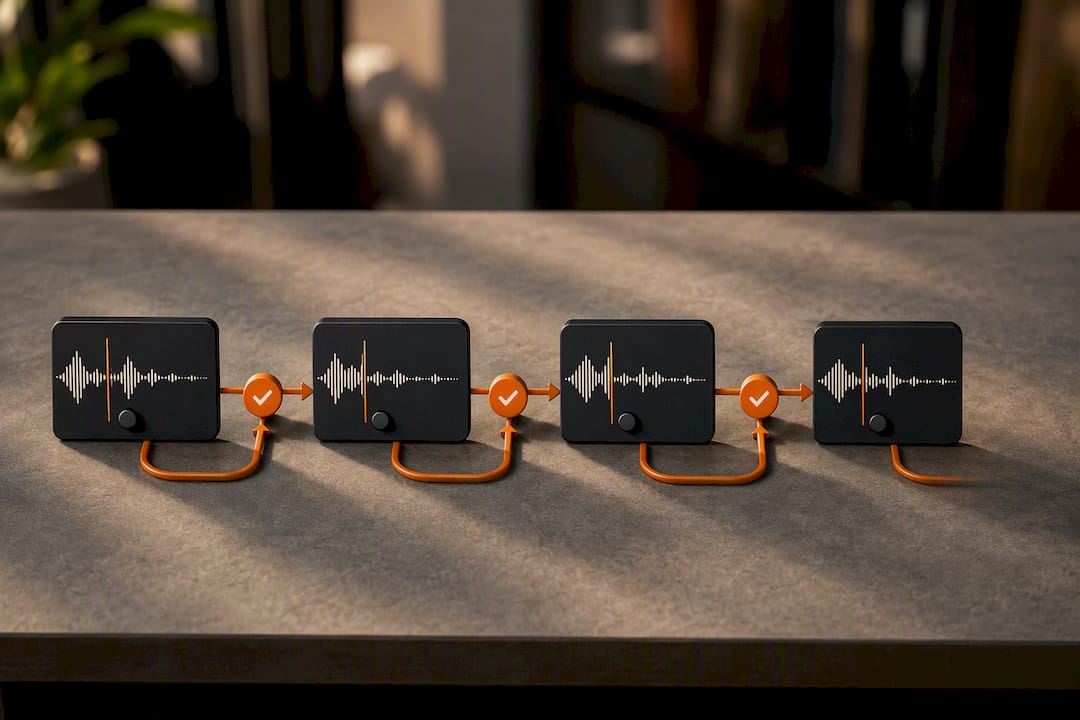
Following a clear technical spec and mixing workflow up front cuts down on rework later, since inconsistent formats are one of the most common causes of delayed handoffs.
Most training projects run one to two revision rounds. Budget a business day or two per round for turnaround, longer if the project spans multiple languages. On final handoff, confirm you're receiving caption files, timestamp sheets for syncing to video, and clean file naming that matches your module structure. Skipping this step is how teams end up scrambling to match audio to slides three weeks before launch.
What Does Corporate Training Voice Over Cost?
Pricing runs on a few different models, and none of them is universally "correct." Per finished minute is the most common for training modules, since it maps directly to how L&D teams budget content. Flat project fees work well for a fixed set of modules. Per-word and hourly session rates show up more often for scripts still in flux or live-directed sessions.
Rates shift based on a handful of factors:
- Union versus non-union talent
- Usage rights: internal training only costs less than content distributed publicly or used in paid marketing
- Localization into additional languages, which adds casting and proofing time
- Rush fees for compressed turnaround
VoiceBros publishes a per-word rate calculator that gives buyers a concrete starting estimate before they even post a project, which is useful for anyone building a first-pass budget for finance approval.
A few budgeting habits save real money over a training year. Batch multiple modules with the same voice actor instead of hiring separately for each one. Lock down usage rights before recording starts, not after, since expanding rights later usually costs more than negotiating them up front. And write a clean, final script before the session. Every mid-project change costs time and, often, a rush fee.
Working With Remote Talent Across Regions and Languages
Most corporate training voice over work happens remotely now, and that's fine as long as direction is clear. You have three main options: a live-directed session over video call, recorded direction notes the talent works from independently, or a reference read you record yourself just to demonstrate pacing and tone.
Localization adds a layer of complexity worth planning for early:
- Cast a native speaker from the actual target region, not just someone fluent in the language
- Have an in-country reviewer proofread the script before recording, since idioms and formality levels don't always translate directly
- Adjust cultural tone where needed. What reads as friendly in one market can sound overly casual in another
For post-production handoff, ask for caption files synced to the final audio, a timing sheet if the narration needs to match on-screen visuals, and clear version control so nobody accidentally builds a module around draft audio.
Pro Tip: When localizing into multiple languages, record one language at a time and get sign-off before moving to the next. Catching a tone problem in language one saves you from repeating that mistake across four more.
Why a Vetted Marketplace Cuts Real Hiring Risk
Corporate training procurement usually breaks down at the same point: too many demo reels, not enough way to tell who actually understands training content versus who just sounds nice. That's the real value of a platform built around filtering and vetting rather than a raw talent directory.
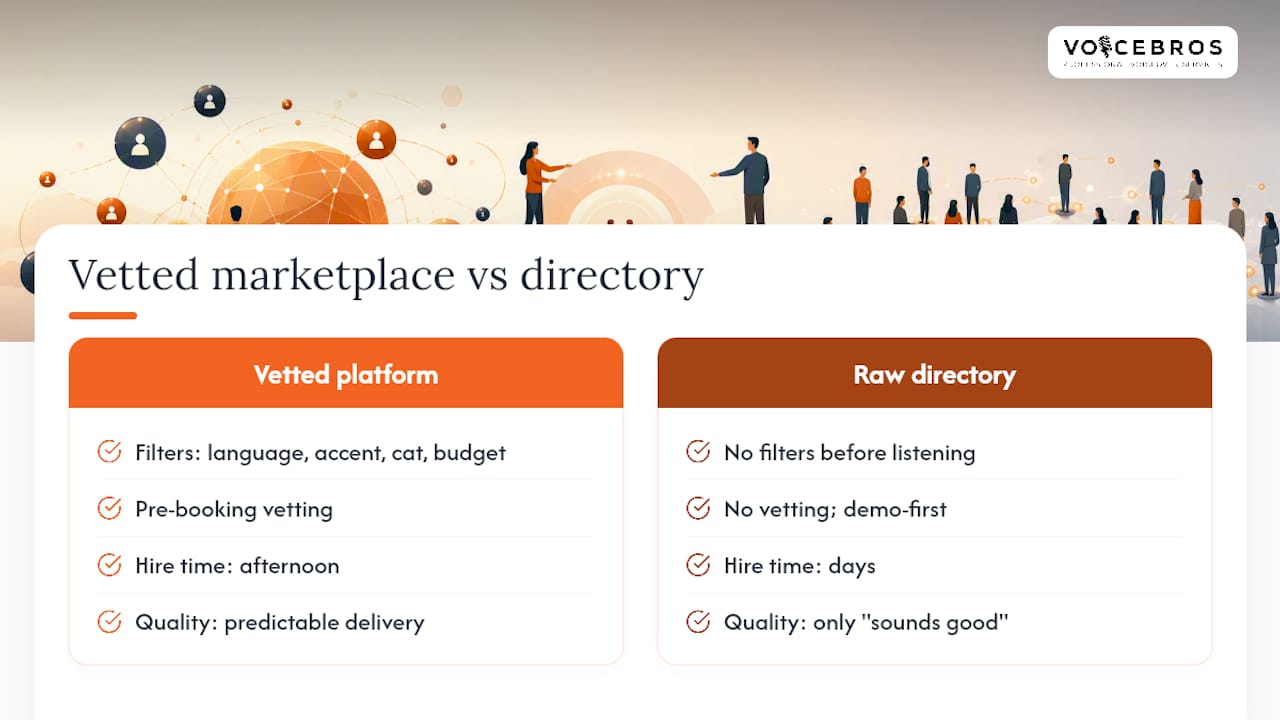
VoiceBros connects clients with more than 1,500 professional voice actors and lets you filter by language, accent, category, and budget before you ever listen to a single demo. That narrows a search that could take days down to an afternoon. The platform's vetting process exists precisely because "sounds good" and "delivers a clean, usable master on deadline" are two different skills, and training content punishes teams that only checked for the first one.
The reported high client satisfaction rate isn't the interesting part on its own. What it reflects is a hiring process where quality control happens before booking, not after a rushed edit reveals a mismatch. For procurement and L&D teams, that maps directly to what actually matters: speed to hire, predictable quality, and rights that are clear from day one.
— Onur
Getting Started on VoiceBros
The fastest way to move from "we need training narration" to "we have a finished module" is to post your brief, filter demos by language, accent, and budget, and book directly. No back-and-forth over email, no waiting on an agency to get back to you with a shortlist.
Start by browsing vetted voice artists with corporate and e-learning experience listed on their profiles, or check the service categories if your project also touches IVR prompts or internal podcast content. If you need a number for a budget approval before you commit to anything, run your script through the pricing calculator to get a realistic per-minute estimate. Either way, the next step is the same: post the brief, listen to a few demos, and book the voice that fits your training, not just your ear.
Sources
For deeper technical grounding beyond this guide: the CIPD engagement factsheet covers how clear communication ties to workplace engagement, Trevor O'Hare's corporate voiceover page outlines typical training narration services and turnaround norms, and this audio mixing workflow guide walks through the technical steps that keep training audio clean and consistent.
- Corporate Voiceover | Training & Explainer Video Narration | Trevor O'Hare
- Engagement factsheet | CIPD
- Audio Mixing For Video: A Practical Workflow That Works
FAQ
How Much Does a One-Minute Voice Over Cost?
Pricing depends on usage rights, talent experience, and whether the project is union or non-union, but per-finished-minute rates are the most common structure for training content. Use a rate calculator to get a specific estimate based on your project's scope.
How Much Do Voice Over Artists Get Paid?
Pay varies widely by project type, usage rights, and experience level, with corporate training and e-learning typically priced differently than commercial or broadcast work due to internal-only usage rights. Rates on marketplaces are often transparent upfront, which helps buyers and talent agree on scope before recording starts.
Is Voice Over Being Replaced by AI?
AI-generated voice has grown for certain low-stakes uses, but human narration still leads for training content that needs nuance, pacing judgment, and cultural sensitivity. VoiceBros breaks down the tradeoffs between AI and human voice actors directly if you're weighing the choice for a specific project.
Who Is the Highest-Paid Voice Over Artist?
Top earners in the voice over industry tend to work in animation, video games, and major commercial campaigns rather than corporate training, where budgets and usage rights are structured very differently. Corporate training rates are typically far more modest and predictable than headline entertainment figures.
Do I Need a Union Voice Actor for Training Content?
Most corporate training projects don't require union talent, since internal training usage rights are narrower than broadcast or commercial distribution. Non-union voice actors with e-learning experience are usually the more practical and cost-effective choice for this kind of project.
Recommended
Need a voice over for your project?
Browse 1,500+ professional voice artists in 50+ languages, hear real demos and get instant word-based pricing on VoiceBros.
Related Posts
 General
Say 10 Botched Brand Names Right: Brand Pronunciation for Voice Pros
Learn brand name pronunciation for 10 commonly botched brands, with language origin rules, quick drills, and where to get native audio.
 General
Cut Studio Time: Directing a Voice Actor With 30–60s Clips and Vetting
Prep scripts, 30–60 second reference clips, and session-ready phrases that speed live and remote sessions. Hire vetted talent to cut studio time and friction.
 General
4 Questions Voice Actors Must Answer on Union vs Nonunion Voice Over
Decide whether to join SAG-AFTRA or stay nonunion. A four question checklist, timing advice, and VoiceBros options to keep earning now.
VoiceBros Team
The VoiceBros team is dedicated to providing high-quality voice over services and industry insights. With years of experience connecting voice artists with clients worldwide, we're passionate about helping you find the perfect voice for any project.
Back to Blog →