
4 Projects Hiring Managers Should Hire a Neutral Accent Voice Over
A neutral accent voice over is a delivery that prioritizes international clarity over regional coloring, built for audiences that include non-native English speakers. It maximizes comprehension across markets rather than signaling a specific place or culture. Choose it whenever your project reaches a mixed or global audience: e-learning, corporate training, IVR systems, and international ads all fit the case.
TL;DR:
- Clear consonant articulation, consistent vowel sounds, and appropriate sentence stress are essential for evaluating a neutral accent voice over.
- Neutral delivery supports faster comprehension in international audiences by emphasizing intelligibility over regional accent authenticity.
- Testing with non-native English speakers on technical paragraphs helps identify pronunciation issues that could interfere with understanding.
- Specifying clarity on technical details and providing concrete sample scripts improves casting accuracy and reduces costly re-records.
- Using vetted marketplaces with side-by-side demo comparisons streamlines finding talent who can deliver true neutrality aligned with your target audience.
Table of Contents
- What Do Good Neutral Accent Demo Clips Sound Like?
- What Does "Neutral" Actually Mean in a Voice Over?
- Where Does Neutral Accent Narration Actually Pay Off?
- How Do You Specify and Hire the Right Voice?
- How Does a Vetted Marketplace Source Neutral Accent Talent?
- The Real Skill Isn't Finding "Neutral." It's Specifying It.
- Hire a Vetted Neutral Accent Voice Actor Today
- Sources
What Do Good Neutral Accent Demo Clips Sound Like?
A strong demo does three things at once: shows a short conversational line, a scripted narrative read, and a technical paragraph full of numbers or jargon. That third one matters more than clients expect. Plenty of talent sound clean on casual dialogue but stumble on compound words, decimals, or acronyms, which is exactly where a corporate training module or IVR script will test them.
When you listen, run through a short checklist rather than trusting your gut:
- Consonant clarity: are "t," "d," and "th" sounds crisp, or do they blur together?
- Vowel consistency: does the same vowel sound stay stable across words, or does it shift depending on the sentence?
- Sentence stress: does the speaker emphasize the right words to carry meaning, or does stress fall randomly?
- Intonation: does the pitch stay level and professional, or does it swing in a way tied to one region?
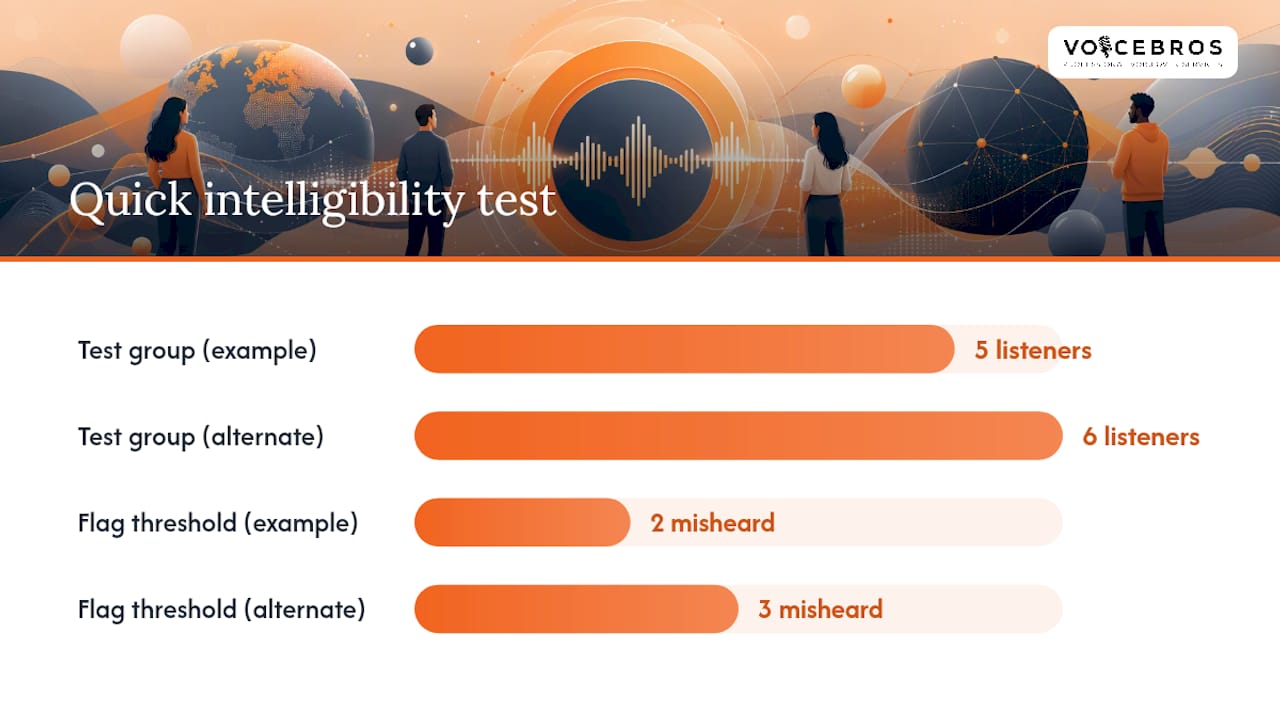
A quick intelligibility check costs almost nothing and tells you more than a trained ear can. Play the technical paragraph for five or six non-native English speakers on your team and ask them to repeat back what they heard. If two or three mishear the same word, that's a pronunciation flag worth raising with the talent before you book the full project.
Pro Tip: Ask for the technical paragraph read at normal pace, not slowed down. A voice actor who sounds neutral at a deliberate pace can still drift into regional patterns once they speed up for a natural-sounding ad or explainer.
What Does "Neutral" Actually Mean in a Voice Over?
"Neutral" is not the absence of accent. It is the presence of pronunciation habits that a global, largely non-native audience can decode with the least effort. International English treats this as a practical, teachable target rather than a fixed dialect, and that framing matters: neutrality is something a coach can train toward, not a birthright some talent has and others lack.
In practice, clients use two reference points. General American (GenAm) functions as a broad umbrella for accents perceived as less regionally marked, and it's the default many producers reach for in commercial and e-learning work. Received Pronunciation, the historically standard British register, gets treated as neutral in some markets, but it carries social and educational associations British listeners pick up on instantly, even when international listeners don't.
The phonetic features that actually drive clarity are narrower than most briefs specify:
- Full articulation of consonants, especially at the end of words
- Consistent vowel length rather than clipped or drawn-out variation
- Clear word and sentence stress that mirrors how meaning is built in English
Here's the caveat clients skip past too often: even a well-trained "neutral" voice sits on a continuum. Oxford's guidance on English as an international language argues that clear pronunciation matters more than erasing every regional trace, since total neutrality is closer to an ideal than a deliverable. Expect subtle signals to remain. Your job as a buyer is to make sure those signals don't interfere with understanding, not to chase an accent-free fiction.
Where Does Neutral Accent Narration Actually Pay Off?
Neutral delivery earns its keep in projects where the listener's native language isn't English, or where the audience spans multiple countries at once.
- E-learning and corporate training: Learners absorb material faster when pronunciation doesn't force them to decode an unfamiliar rhythm on top of new content.
- IVR and phone systems: Callers hang up or misdial when a menu prompt is hard to parse in one listen, and there's no replay button on a phone tree.
- Global advertising and product demos: A single voice track that plays across regions saves the cost of localizing narration market by market.
- Audiobooks and documentary narration for mixed audiences: Long-form listening rewards a voice that doesn't demand extra concentration to follow.
The scale here is bigger than most clients assume. English functions as a working second language for a majority of its global users, and Oxford notes that clarity, not native-accent authenticity, is what actually serves that audience. Practitioners in the voiceover industry echo the same pattern: neutral-accent narration has become standard practice for business content meant to travel outside native-English markets.
The practical upside is fewer revision rounds. A script that gets misread or mispronounced in review triggers a retake cycle that costs both time and money, and that risk drops sharply when the original casting choice was built for broad intelligibility instead of regional flavor.
How Do You Specify and Hire the Right Voice?
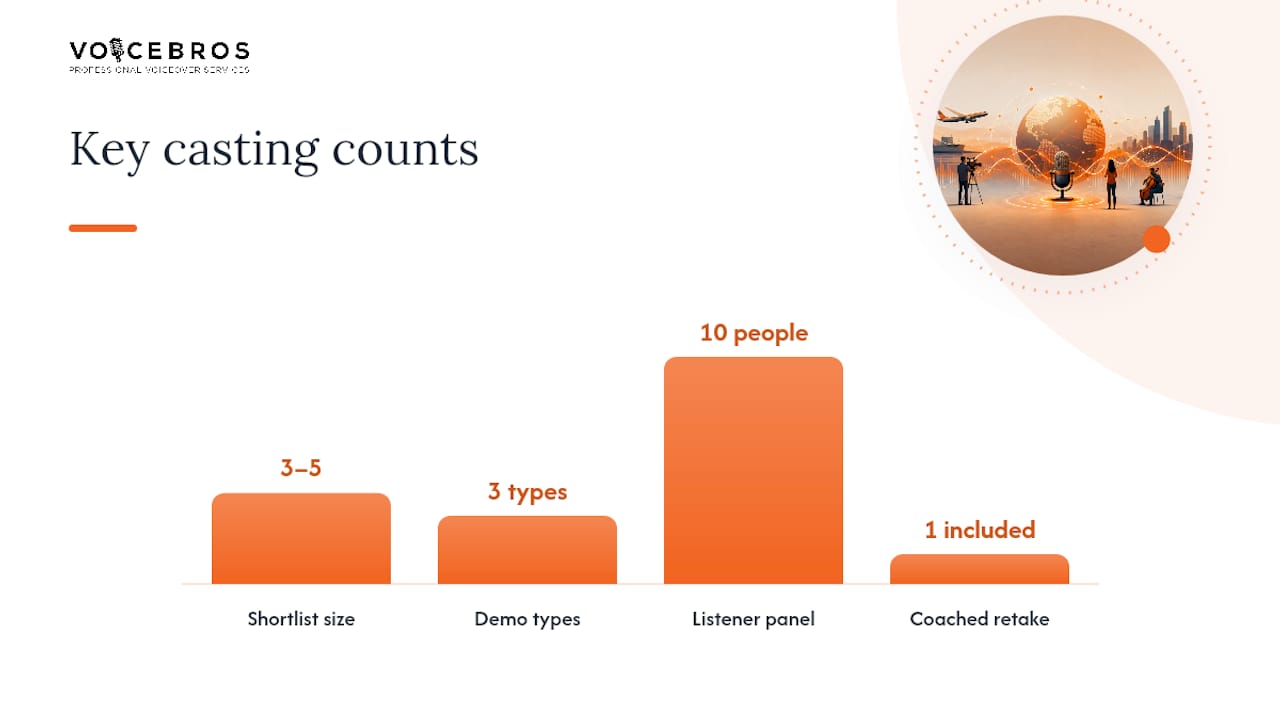
Start with criteria, not vibes. A candidate worth shortlisting should show clarity on cold reads, consistency across multiple takes, real experience on international projects, and delivery speed that matches your deadline. Ask for three sample types before you commit: a conversational line, a formatted script read, and a technical paragraph with numbers or acronyms.
Run the casting process in this order:
- Shortlist three to five candidates based on demo reels that already sound close to neutral.
- Request the three demo styles above from each, recorded fresh rather than pulled from an old reel.
- Play the technical paragraph for a small group of listeners (ten works well) and log how many words get misheard.
- Ask your top pick for a coached retake on any line that scored poorly, and judge how fast they adjust.
Watch for these red flags during that process:
- Pronunciation drift between the first minute of a read and the last, a sign of fatigue or inconsistent training.
- Over-stylized delivery, where the performer leans into a "broadcast voice" that sounds polished but pulls attention away from the message.
- Vague answers about pacing when you ask for a specific words-per-minute target.
Pro Tip: Always negotiate one coached retake into the quote up front. It costs less than a full re-record and gives you leverage if the first pass drifts from the brief.
Paste this into your casting brief or messaging thread to keep expectations aligned:
Project: [e-learning module / IVR script / commercial]. Tone: neutral, warm, clear. Pace: [140 to 160] words per minute. Deliverable: WAV, 48kHz, with one coached retake included. Reference: please match the clarity of [sample script link] rather than a regional reference voice.
A sample script library makes this step faster since you can point candidates to a concrete reference instead of describing tone from scratch. For technical delivery specs, best practices for exporting audio deliverables cover file format and loudness targets worth locking in before you hire, not after.
How Does a Vetted Marketplace Source Neutral Accent Talent?
A marketplace built around filtering solves the exact problem this article has been walking through: how do you find a demo that actually sounds neutral instead of taking a talent's self-description at face value? Filtering by accent, language, and category lets you build a shortlist in minutes rather than combing through hundreds of unsorted reels.
A marketplace runs on that model, with many vetted voice actors filterable by accent, language, category, and budget. Every artist goes through a vetting step before landing on the platform, which is part of why the marketplace reports a 98% client satisfaction rate across completed projects.
The audition workflow maps directly onto the casting steps above:
- Filter by neutral or international accent tags to build your shortlist.
- Compare demos side by side instead of switching between separate reels and tabs.
- Message shortlisted artists directly to request the technical-paragraph read before you commit budget.
That side-by-side comparison step is where most of the guesswork disappears. Instead of guessing from a general reel, you're judging the exact material your project needs.
The Real Skill Isn't Finding "Neutral." It's Specifying It.
Most briefs fail before casting even starts, because the client asks for "neutral" without defining what that means for their specific audience. Neutral for an e-learning platform serving Southeast Asian professionals isn't the same target as neutral for a European B2B software demo, even though both briefs might use the identical word.
The conventional advice, "just hire someone with no accent," gets the whole thing backwards. Nobody has no accent. What you're actually hiring for is a trained, controllable clarity that holds up under technical vocabulary and normal speaking speed, not just on a polished demo reel recorded at half pace.
If I had to tell a producer one thing to prioritize first, it's the intelligibility check over the ear test. Five minutes with real listeners catches that before it becomes a costly re-record. Everything else in the hiring process, the pacing negotiation, the coached retake, the file format spec, matters far less than getting that first comprehension signal right.
— Onur
Hire a Vetted Neutral Accent Voice Actor Today
This platform gives you filtering and side-by-side demo comparison this whole hiring process depends on, without the back-and-forth of sourcing talent through cold outreach or agency retainers.
Search the voice artist directory by accent and language, pull up two or three neutral-accent candidates, and play their demos next to each other before you spend a dollar. Every artist has passed the platform's vetting process, and project types ranging from e-learning to IVR to commercials are covered under one workflow. Check the pricing calculator to budget your project by word count, then message your shortlist directly to request the technical-paragraph read covered earlier in this guide. That one extra step, before you commit, is what separates a smooth delivery from a costly re-record.
Sources
For deeper background on the linguistic reasoning behind this guide, Oxford's overview of English as an international language covers why clarity outranks native-accent authenticity. The Wikipedia entry on International English and Britannica's page on Received Pronunciation both offer useful context on how neutrality gets defined and contested across English varieties. For pronunciation coaching techniques, see Linda Mandarin's guide on accent reduction.
- English as an international language - Learning English with Oxford
- International English — Wikipedia
- Received Pronunciation (RP) | Britannica
- Exporting Audio Deliverables: Best Practices for Clients – Audome
Recommended
Need a voice over for your project?
Browse 1,500+ professional voice artists in 50+ languages, hear real demos and get instant word-based pricing on VoiceBros.
Related Posts
 General
British vs American Accent: 3 Drills to Fix Rhoticity and Vowels
Understand key phonetic contrasts, including rhoticity, trap bath, LOT vowel and t-flapping, with IPA examples and three practice drills to improve...
 General
Audiobook Narrator Rates for Authors: PFH Math & 40k–120k Sample Budgets
Learn the PFH formula, see 40k–120k sample budgets, and get vetted VoiceBros narrator quotes so authors can estimate audiobook production costs quickly.
 General
Marketers: 5 Questions to Choose Translation vs Transcreation for VO
Five quick questions for marketers to choose translation or transcreation, with hybrid workflows and voice over guidance for ads and scripts.
VoiceBros Team
The VoiceBros team is dedicated to providing high-quality voice over services and industry insights. With years of experience connecting voice artists with clients worldwide, we're passionate about helping you find the perfect voice for any project.
Back to Blog →