

British vs American Accent: 3 Drills to Fix Rhoticity and Vowels
The single biggest split between British and American English is rhoticity: General American pronounces the /r/ sound after vowels (as in "car" or "hard"), while Received Pronunciation typically drops it. Beyond that, the two systems diverge on the trap–bath split, the LOT vowel, and how they treat the letter T. General American and Received Pronunciation serve as the two reference models here, though many regional exceptions exist.
TL;DR:
- Most comprehension issues stem from unfamiliarity with combined accent features rather than individual sounds, especially vowel shifts and consonant processes.
- Practice should focus on key differences like rhoticity and vowel splits through minimal pairs, rather than trying to master every regional variation at once.
- Regional accents often diverge due to local mergers and historical developments, making specific target models crucial for accurate imitation.
- Familiarity with an accent, not its complexity, determines how easily it is understood, so learners should expose themselves to their intended audience's speech patterns.
- Vocabulary differences, such as "flat" versus "apartment" or pronunciation variations like "schedule," significantly contribute to an accent's distinctiveness and audience perception.
Table of Contents
- British vs American Accent: A Quick Comparison Chart
- What Actually Causes the Phonetic Differences?
- How to Practice Hearing and Producing Each Accent
- Why Regional Accents Complicate the GA vs RP Model
- Does Accent Difficulty Depend on the Listener, Not the Accent?
- Common Word Differences That Shape How Accents Sound
- Choosing an Accent: A Practical Framework
- Sources
British vs American Accent: A Quick Comparison Chart
Before getting into the mechanics of each sound, it helps to see the contrasts side by side. General American (GA) and Received Pronunciation (RP) diverge on five features that account for most of what listeners actually notice.
| Feature | General American | Received Pronunciation | Example word (IPA) |
|---|---|---|---|
| Rhoticity | Rhotic (pronounces /r/ after vowels) | Non-rhotic (drops /r/ unless followed by a vowel) | "car": /kɑr/ vs /kɑː/ |
| Trap–bath split | No split; "bath" uses the short /æ/ | Split present; "bath" uses the long /ɑː/ | "bath": /bæθ/ vs /bɑːθ/ |
| LOT vowel | Rounded, often merges toward /ɑ/ | Rounded, distinctly back /ɒ/ | "hot": /hɑt/ vs /hɒt/ |
| /t/ realization | Often flapped between vowels | Often a clear /t/ or glottal stop | "water": /ˈwɑɾər/ vs /ˈwɔːtə/ |
This side-by-side breakdown of common contrasts between American and British English covers dozens of similar word pairs beyond these four.
A few listening habits speed up recognition faster than memorizing rules:
- Listen for the /r/ first. If it disappears after vowels, you're likely hearing something closer to RP.
- Pay attention to "bath," "class," and "dance." A longer, darker vowel signals the trap–bath split typical of southern England.
- Notice how "butter" or "better" sounds. A soft "d" sound in the middle usually means General American.
What Actually Causes the Phonetic Differences?
Rhoticity is the clearest dividing line between the two systems, and it works exactly as it sounds. In General American, the tongue curls back for /r/ any time that letter appears in a word, including after vowels, so "car" comes out as /kɑr/. Received Pronunciation drops that same /r/ unless a vowel follows it directly, giving "car" the transcription /kɑː/. This is why "car alarm" sounds different in the two accents: RP speakers often insert a linking /r/ before the vowel in "alarm," a quirk phoneticians call "linking r," even though they'd never pronounce it in "car" alone.
The vowel system carries almost as much weight. The trap–bath split means words like "bath," "laugh," and "class" take the short front vowel /æ/ in American speech but a long back vowel /ɑː/ in RP, so "bath" is /bæθ/ in the US and /bɑːθ/ in southern England. The LOT vowel adds another wrinkle: American English tends to merge LOT with PALM and part of THOUGHT, so "hot," "father," and sometimes "caught" all cluster around a similar open vowel, while RP keeps LOT distinctly rounded and back as /ɒ/.
Consonants finish the picture. General American speakers regularly turn a /t/ between vowels into a quick tap, so "water" becomes something close to /ˈwɑɾər/, which sounds almost like "wadder" to untrained ears. Many British varieties, especially working-class London speech, replace that same /t/ with a glottal stop instead, so "water" becomes /ˈwɔːʔə/. H-dropping, where words like "house" lose their initial /h/, shows up in several regional British dialects but rarely in either GA or RP.
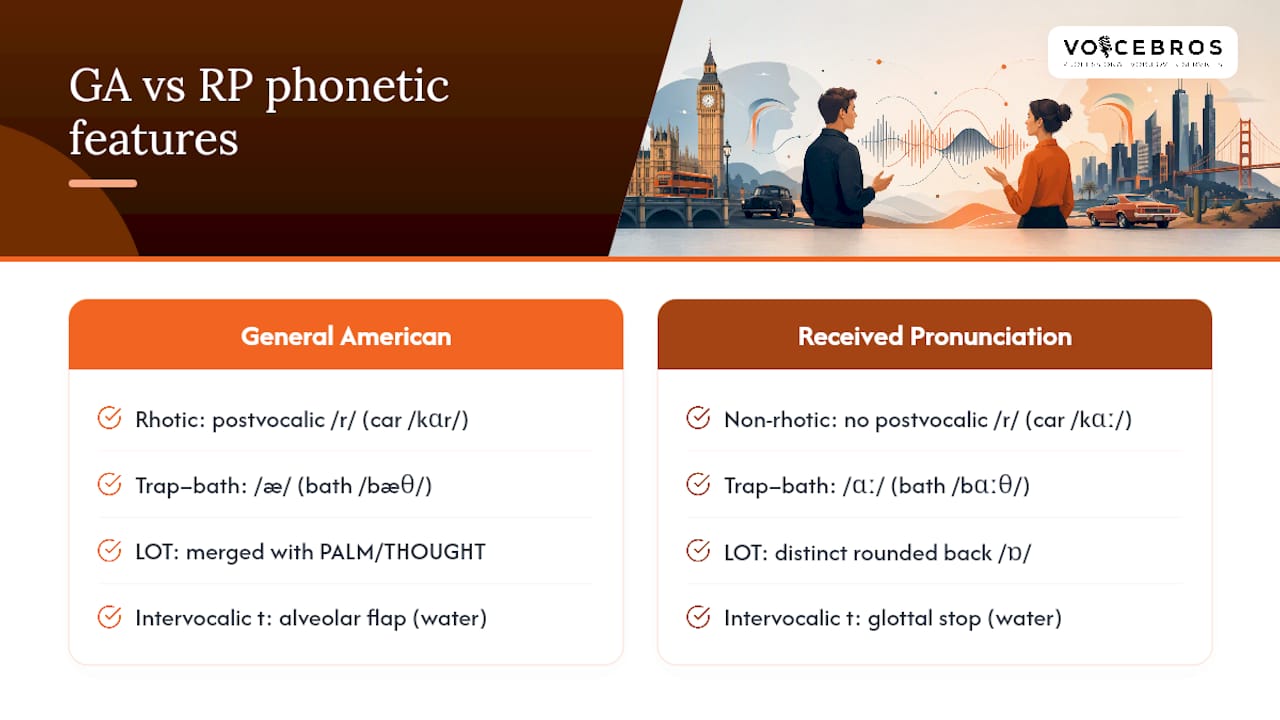
None of these features exist in isolation, and that matters more than most guides admit: a significant part of the perceived difficulty in cross-accent comprehension traces back to unfamiliarity with a specific combination of features, not any single sound. A listener who has never heard t-flapping will stumble on "water" even if every vowel is textbook GA.
How to Practice Hearing and Producing Each Accent
Minimal pairs make the differences concrete. Try these side by side:
- "Car": GA /kɑr/ versus a more RP-like /kɑː/
- "Bath": GA /bæθ/ versus RP /bɑːθ/
- "Hot": GA /hɑt/ versus RP /hɒt/
- "Better": GA /ˈbɛɾər/ versus RP /ˈbɛtə/
A short, structured drill sequence works better than random mimicry:
- Rhoticity drill. Record yourself saying "car," "hard," "start," and "farmer" first with a full /r/, then without one. Play both back and note which feels more natural to say quickly.
- Trap–bath substitution practice. Take a list of ten "bath"-class words (dance, class, half, laugh, plant) and say each one twice, once with /æ/ and once with /ɑː/. This builds muscle memory for the split rather than just recognition.
- T-flapping repetition drill. Repeat "water," "better," "little," and "city" at a natural conversational speed, alternating between a flapped /ɾ/ and a crisp /t/.
This sequence mirrors advice from linguistics educators: tune your ear on minimal pairs first, then tackle rhoticity and vowel shifts, and save consonant processes like flapping for last since they vary the most by region.
Pro Tip: Don't try to master every contrast at once. Prioritize the /r/ and the major vowel splits, since those affect intelligibility the most. Flapping and glottal stops are more about sounding authentic than being understood.
Practicing with real scripts speeds up the process considerably, and running through sample scripts built for voice-over auditions gives you material that forces you to hit these contrasts in context rather than in isolated word lists.
Why Regional Accents Complicate the GA vs RP Model
General American and Received Pronunciation are teaching tools, not the full picture. Scotland has its own rhotic tradition that predates and differs from GA's. Parts of New England, including eastern Massachusetts, drop the /r/ in ways that sound closer to RP than to the rest of the United States. Estuary English, spoken around London and the southeast of England, blends RP-like vowels with more flapping and glottal replacement than textbook RP would predict.
Mergers complicate things further. The cot–caught merger, where "cot" and "caught" sound identical, is common across the western United States and Canada but largely absent from RP and from many East Coast American accents. The marry–merry–Mary merger shows similar unevenness, present in some regions and sharply distinct in others.
The practical rule: pick your target model based on the specific region or media you're trying to match, not a generic idea of "British" or "American." A historical look at how the divide happened shows why so many pockets of exception exist. Colonial-era speech patterns froze in some American communities while British English kept evolving, so a few American dialects preserve older pronunciations that Britain itself has since abandoned.
Does Accent Difficulty Depend on the Listener, Not the Accent?
Neither accent is inherently harder to understand. Perceived difficulty tracks almost entirely with what a listener has been exposed to.
Comprehension differences between accents come down to familiarity, not any built-in complexity in the sounds themselves. A listener raised on American media will find RP harder to parse at first, and the reverse holds just as strongly for someone raised on British television.
That finding, drawn from linguistic research on accent perception, has direct implications. Learners should expose themselves to whatever accent their target audience actually speaks, rather than assuming one version of English is the "clear" default. For media and voice-over decisions, this means casting an accent your specific audience already recognizes usually beats optimizing for some abstract idea of clarity.
Common Word Differences That Shape How Accents Sound
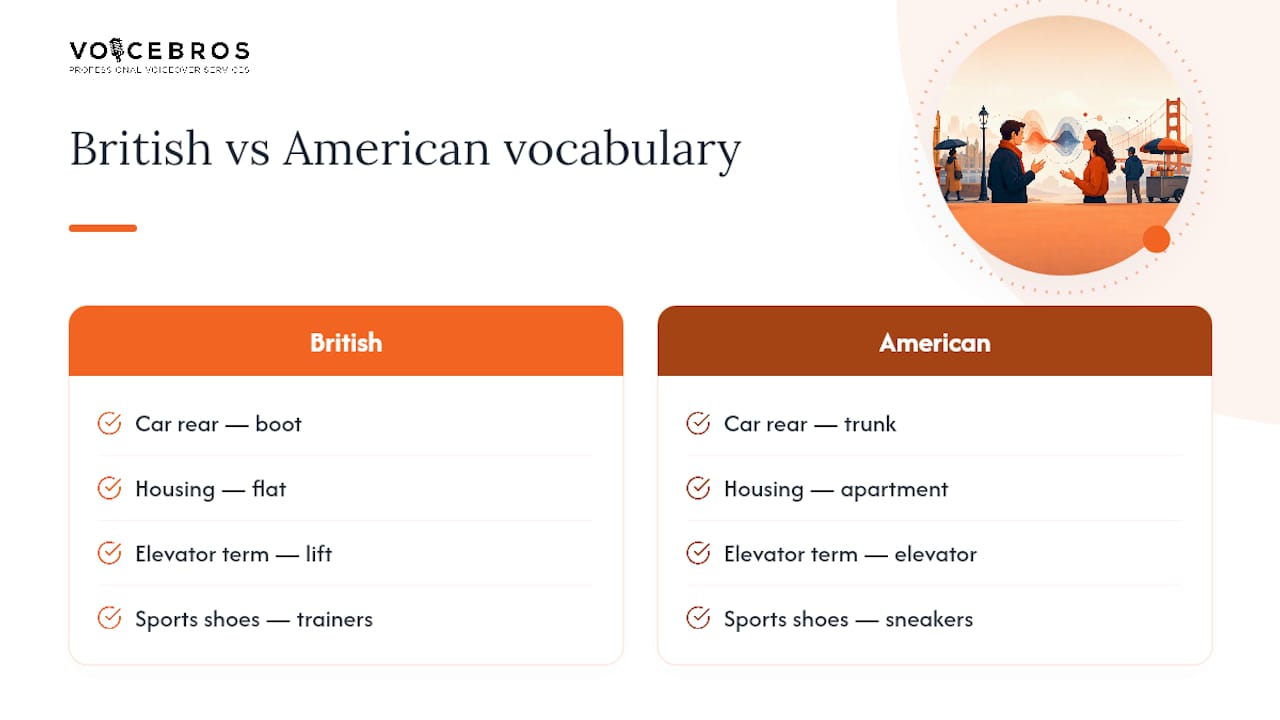
Pronunciation gets most of the attention, but vocabulary choices shape how an accent registers with listeners almost as much as the sounds themselves. Say "trunk" to a British listener and they picture a piece of luggage or a tree; they'd expect "boot" for the back of a car. "Apartment" versus "flat," "elevator" versus "lift," "sneakers" versus "trainers": these word swaps often tip off a listener's ear before a single vowel difference registers.
Word choice also interacts with pronunciation in ways that surprise a lot of learners. "Schedule" is a good example: Americans typically say /ˈskɛdʒuːl/, while RP speakers often say /ˈʃɛdjuːl/, so the same six letters produce a genuinely different first sound. "Aluminum" versus "aluminium" isn't just a spelling difference either; the extra syllable in the British version shifts the stress pattern entirely.
Cambridge Dictionary's comparison of British and American English catalogs dozens of these lexical splits, and they matter for anyone doing voice work: a script written with British vocabulary read in an American accent (or the reverse) creates a jarring mismatch that audiences notice even when they can't name why. Getting the accent right without matching the vocabulary to it undercuts the whole effort.
Choosing an Accent: A Practical Framework
Start with your audience, not your ear for authenticity. Figure out who's actually listening, then work backward: purpose (ad, audiobook, corporate training) narrows the accent further, and only then does fine-grained authenticity matter. A Texas ad campaign doesn't need RP precision; a London-set audiobook probably shouldn't run on flat GA.
Intelligibility beats perfect imitation almost every time. On VoiceBros, filtering talent by accent and region lets you match a voice to an audience directly rather than guessing. Recognition matters more than technical purity.
— Onur
Choosing between these two systems for a real project, whether that's a training video, an audiobook, or a commercial, comes down to matching your listener's expectations rather than chasing textbook precision. VoiceBros connects you with vetted voice actors who can deliver General American, Received Pronunciation, or a specific regional variety, filtered by language, accent, and budget so you can compare demos side by side before booking. If accent authenticity affects how your audience receives the message, browsing actual talent beats guessing from an IPA chart.
Sources
Need a voice over for your project?
Browse 1,500+ professional voice artists in 50+ languages, hear real demos and get instant word-based pricing on VoiceBros.
Related Posts
 General
Marketers: 5 Questions to Choose Translation vs Transcreation for VO
Five quick questions for marketers to choose translation or transcreation, with hybrid workflows and voice over guidance for ads and scripts.
 General
4 Projects Hiring Managers Should Hire a Neutral Accent Voice Over
Hire the right neutral accent voice over: demo check criteria, a ready to paste brief, and a filtered marketplace to find vetted talent fast.
 General
Creators: 150 WPM Timing and Formatting for Voice Over Script Writing
Concise guide for creators: 150 WPM timing, script formatting templates, a prewriting checklist, and how prep cuts studio revisions.
VoiceBros Team
The VoiceBros team is dedicated to providing high-quality voice over services and industry insights. With years of experience connecting voice artists with clients worldwide, we're passionate about helping you find the perfect voice for any project.
Back to Blog →