2026 update for Creators & Platforms: 3 Legal Anchors for Voice Cloning
Voice cloning is not categorically legal or illegal. It sits in a gray zone shaped by consent, use case, and jurisdiction, so the same cloned voice can be a harmless parody in one state and a civil or criminal liability in another. Tennessee's ELVIS Act, the federal court ruling in Lehrman & Sage v. Lovo, and GDPR's treatment of voice as biometric data are the three anchors defining that risk today. If you plan any commercial use, get explicit, written, scoped consent, or hire licensed human talent instead.
TL;DR:
- Voice cloning laws vary widely by state and often extend existing rights of publicity to digital and AI-generated voices, especially for commercial use.
- Legal claims most likely to succeed involve recognizable voices used without consent, with copyright protecting recordings but not voice's inherent qualities.
- Federal legislation like the NO FAKES Act is pending, but currently, a patchwork of state laws and GDPR governs international voice cloning regulation.
- Privacy laws such as GDPR and BIPA impose additional restrictions on processing and using voice data, requiring explicit consent and proper data handling.
- Hiring vetted human voice actors with clear licensing agreements remains the safest, simplest method to avoid legal and ethical risks associated with voice cloning.
Table of Contents
- Voice Cloning Legality: The Legal Doctrines That Actually Apply
- Key Court Cases and Statutes Shaping Voice Cloning Laws
- Which States and Countries Regulate AI Voice Replicas?
- How GDPR and BIPA Treat Cloned Voice Data
- Who Gets Sued and What Are the Legal Consequences?
- Practical Compliance Steps to Avoid Voice Cloning Liability
- What Should Voice Consent Agreements Actually Include?
- The Ethical Debate Behind Voice Cloning Technology
- How AI Advancements Are Reshaping Legal Standards
- Voice Cloning Around the World: A Patchwork With No Single Standard
- Where Voice Cloning Law Is Headed Next
- A Compliant Way Forward: Hiring Vetted Human Voice Talent
- Sources
- FAQ
Voice Cloning Legality: The Legal Doctrines That Actually Apply
No single law governs synthetic voices in the United States. Instead, four overlapping legal doctrines determine whether a specific use of a cloned voice creates liability, and understanding which one applies to your situation matters more than knowing the general legality question.
Right of publicity is the strongest and most commonly triggered claim. It protects a person's name, likeness, and voice from unauthorized commercial exploitation, and courts have long recognized voice as protectable even without a visual element. If a synthetic voice is recognizable as a specific real person and used to sell a product, endorse a service, or imply that person said something they didn't, a right-of-publicity claim is likely to succeed.
Copyright protects less than most people assume. A recorded performance can be copyrighted, but the abstract qualities of a voice, its timbre, cadence, and pitch, generally cannot be. That distinction became central in a recent federal decision and shapes how plaintiffs frame their claims.
Defamation, false light, and fraud apply when the cloned voice puts false words in someone's mouth. A fabricated statement that damages reputation supports defamation; a statement that's merely misleading or embarrassing, even if not false, can support a false light claim, according to a law review analysis of voice-cloning torts.
Claims that tend to succeed involve identifiable individuals, commercial use, and demonstrable harm. Claims that struggle involve generic or unrecognizable synthetic voices, parody protected by fair use, or purely private, noncommercial experimentation.
- Right of publicity: strongest claim for unauthorized commercial impersonation
- Copyright: protects the recording, not the voice's inherent qualities
- Defamation/false light: covers fabricated or misleading cloned speech
- Fraud: applies when a clone is used to deceive for financial gain
Key Court Cases and Statutes Shaping Voice Cloning Laws
The single most important case to read is Lehrman & Sage v. Lovo, Inc. Two voice actors sued an AI company after their recordings, originally licensed for limited use, were allegedly repurposed to train a commercial voice-cloning product. The court's reasoning did three things that matter beyond this one case: it confirmed that copyright protects the original sound recording but not the voice's abstract characteristics, it let New York right-of-publicity claims move forward, and it accepted a continuing-harm theory suggesting that each new synthetic output generated from unlicensed training data can restart the clock on limitations periods. That last point is significant for anyone with older or vaguely worded voice licenses, according to the Skadden analysis of the ruling.
On the statutory side, Tennessee's ELVIS Act, effective July 1, 2024, was the first law to explicitly extend publicity protections to simulated voices, and it reaches beyond the person who made the clone to distributors of tools whose primary purpose is producing unauthorized voice replicas, according to RecordingLaw's survey of state statutes.
- Illinois has added digital-replica language to its publicity statute
- California has expanded protections around unauthorized digital voice and likeness use
- Pennsylvania took a different route, criminalizing certain AI audio fraud rather than treating it purely as a civil publicity matter
At the federal level, the NO FAKES Act (S.4591) would create a nationwide right against unauthorized digital replicas. It has cleared the Senate Judiciary Committee but had not become law as of mid-2026, leaving a fragmented state-by-state system in place for now, per reporting on the bill's status.
Which States and Countries Regulate AI Voice Replicas?
The United States currently regulates voice cloning through a patchwork of state laws rather than one federal standard, and the differences between them matter for anyone operating across state lines.
Tennessee, California, Illinois, Montana, Arkansas, Washington, and Pennsylvania have each passed some form of AI voice or digital-replica law, but the structures diverge sharply. Most extend existing right-of-publicity statutes to cover simulated voices. Pennsylvania stands apart by treating certain unauthorized AI audio impersonations as criminal fraud rather than a private tort. Tennessee's ELVIS Act stands apart too, reaching not just the person who made a clone but distributors and toolmakers whose primary purpose is producing unauthorized replicas, according to Recording Law's breakdown of state approaches.
- Tennessee: broadest reach, covers distributors and cloning tools
- California and Illinois: extend publicity/likeness statutes to digital replicas
- Pennsylvania: criminal exposure for certain fraudulent AI audio use
- Montana, Arkansas, and Washington: newer entrants with narrower or evolving language
If the NO FAKES Act eventually passes, it would create a federal floor for digital replica rights and could raise preemption questions about how it interacts with stronger state laws like Tennessee's. Until then, a project that's compliant in one state can still expose a company to liability the moment it distributes content into a stricter jurisdiction.
Outside the U.S., the European Union's GDPR treats voice recordings as biometric personal data in many contexts, which means cloning someone's voice can trigger data-protection obligations entirely separate from publicity or copyright law, regardless of whether the person is a public figure.
How GDPR and BIPA Treat Cloned Voice Data
Privacy and biometric-data laws create a second, independent layer of legal exposure that many creators overlook because they're focused on publicity rights instead.
Under GDPR, voice recordings that can identify a specific person qualify as biometric personal data in many use cases, which means processing them, including for training a voice-cloning model, requires a valid legal basis such as explicit consent. Legal scholars increasingly frame voice this way, and enforcement has followed: a Hungarian regulator issued a €650,000 fine for unlawful processing of voice data, according to a Berkeley Law paper on vocal identity and legal responses to cloning.
Pro Tip: Public availability of an audio clip on YouTube or a podcast doesn't imply a license to train a commercial voice model on it. Treat "publicly posted" and "legally usable" as two separate questions, always.
- Illinois's Biometric Information Privacy Act (BIPA) and similar statutes impose statutory damages per violation, independent of proof of actual harm
- COPPA adds another layer when voice technology touches anyone under 13, requiring verifiable parental consent
- Enforcement isn't limited to the cloner; regulators can target platforms and data processors in the distribution chain
Who Gets Sued and What Are the Legal Consequences?
Liability in voice cloning cases doesn't stop at the person who generated the clone. Vendors, distributors, and platforms can face direct exposure too, particularly under statutes like Tennessee's ELVIS Act, which was written specifically to reach tools and services whose primary purpose is producing unauthorized replicas.
Remedies vary by claim type and jurisdiction. Right-of-publicity and BIPA-style claims often carry statutory damages that don't require proof of financial loss. Courts can also award actual damages, issue injunctions blocking further distribution, and in states like Pennsylvania, prosecutors can pursue criminal charges for fraudulent AI audio.
The continuing-harm theory accepted in Lehrman v. Lovo matters here too: if a model trained on unlicensed voice data keeps generating new outputs, each output can arguably be treated as a fresh injury, which extends how long a plaintiff has to sue well beyond a standard limitations window.
- Individual creators: liable for unauthorized use of a specific person's voice
- Vendors and distributors: liable under Tennessee-style laws targeting cloning tools
- Platforms: increasingly expected to enforce takedown policies, though this doesn't guarantee legal immunity
Pro Tip: Don't assume platform terms of service protect you from liability. A takedown policy manages platform risk, not yours.
Practical Compliance Steps to Avoid Voice Cloning Liability
Reducing legal exposure comes down to documentation, scope, and honest labeling, not clever legal language.
- Get explicit, written, scoped consent. Vague boilerplate isn't enough. Consent language should specify that AI synthesis is permitted, for how long, across which channels, and whether sublicensing to third parties is allowed, according to analysis of AI voice cloning legal risk.
- Audit your training data sources. License what you use, document where recordings came from, and avoid scraping publicly available audio without a clear legal basis.
- Label AI-generated content and build a takedown process. Platforms including YouTube, TikTok, and Twitch already require disclosure frameworks for AI-generated impersonations, according to reporting on creator rights under the pending NO FAKES Act.
- Default to licensed human talent when rights are unclear. It sidesteps publicity and biometric-privacy risk entirely for commercial projects.
Pro Tip: Keep provenance records for every voice asset you use, consent forms, license terms, and dates. If a dispute arises years later, that paper trail is your best defense.
What Should Voice Consent Agreements Actually Include?
A signature on a generic release form isn't the same as informed consent for AI synthesis, and courts are starting to treat that distinction seriously.
Effective consent language names the specific use: commercial voice-over, IVR prompts, audiobook narration, or AI model training, rather than a catch-all "any and all purposes" clause that a court could later find too broad to enforce. It should also define duration (a one-year license reads very differently from a perpetual one), specify the exact channels where the voice can appear, and address whether the rights holder can revoke consent or negotiate renewal terms.
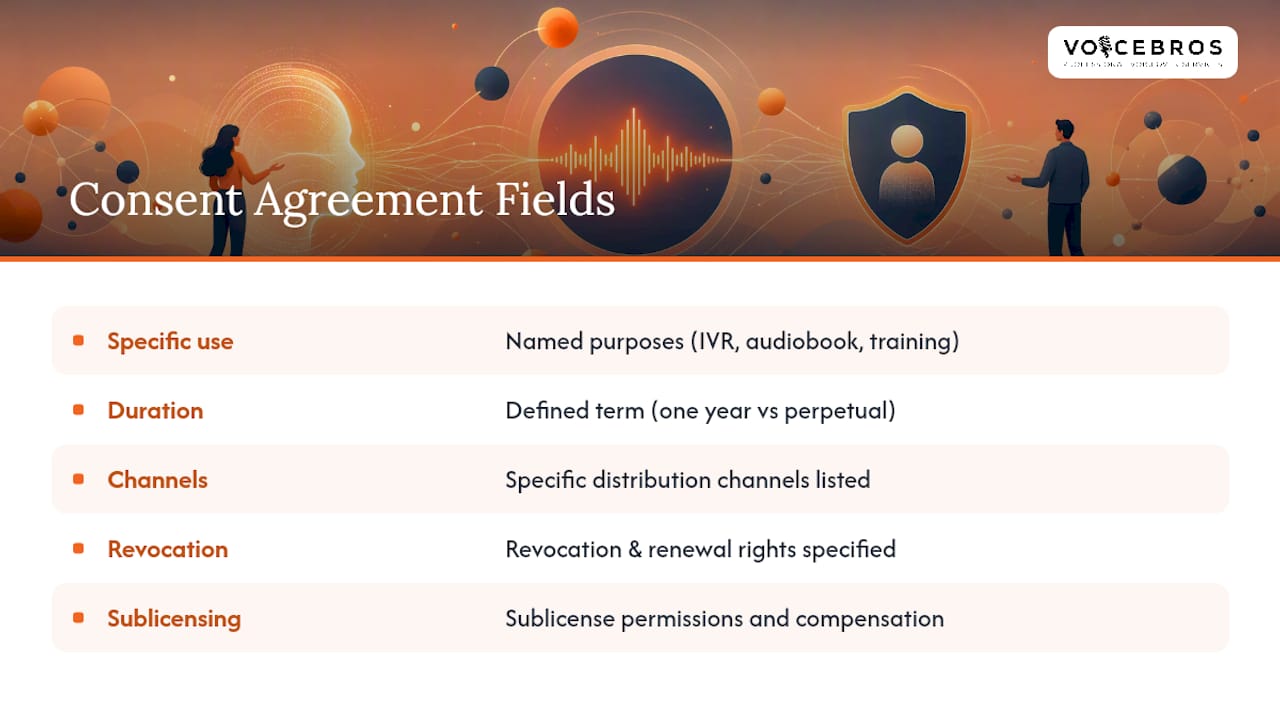
Sublicensing deserves its own clause. If a company plans to license a cloned voice to third-party clients or advertisers, the original talent needs to know that upfront and be compensated accordingly. This is exactly the kind of scope creep that led to the dispute in Lehrman & Sage v. Lovo, where recordings licensed for one purpose allegedly ended up training a commercial product never contemplated in the original agreement.
For union talent, existing collective bargaining agreements may already restrict AI use of recorded performances, so any new licensing arrangement should be checked against those terms before signing. Addenda specifically addressing synthetic voice rights are becoming standard practice in professional voice-over contracts, and any company skipping that step is negotiating on outdated assumptions about what a decade-old release form actually covers.
The Ethical Debate Behind Voice Cloning Technology
The legal questions get most of the attention, but the ethical debate runs deeper and touches situations the law hasn't caught up to yet.
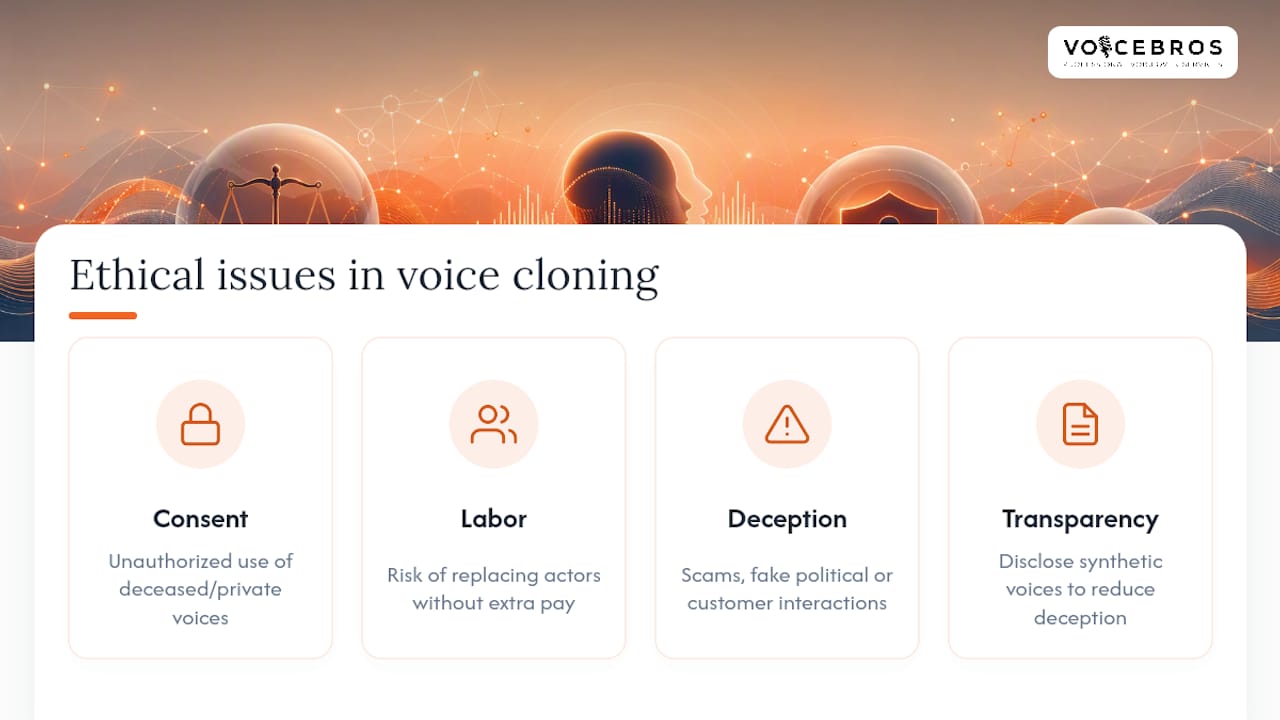
Consent is the center of almost every ethical objection. Even when cloning a voice is technically legal, replicating a deceased performer's voice without clear authorization from an estate, or cloning a private individual's voice from a few seconds of social media audio, raises questions about dignity and autonomy that statutes weren't written to answer. There's also a labor dimension: professional voice actors have raised concerns that AI cloning trained on their own past work could eventually be used to replace them on future projects, without additional compensation for that secondary use.
Deception is the other major thread. A cloned voice used in a scam call, a fabricated political statement, or a fake customer service interaction causes real harm even in jurisdictions where no specific statute yet criminalizes that exact conduct. That gap between what's currently illegal and what's clearly wrong is where much of the ethical debate lives.
Transparency is emerging as the practical middle ground. Disclosing when a voice is synthetic, rather than passing it off as human, addresses much of the deception concern without requiring a ban on the underlying technology. It's a distinction increasingly reflected in platform labeling requirements, even where the law itself stays silent.
How AI Advancements Are Reshaping Legal Standards
Legal standards for voice cloning are being written in reaction to the technology, not ahead of it, and that lag creates most of the uncertainty professionals face today.
A few years ago, cloning a convincing voice required substantial audio samples and technical expertise. Now it can happen from seconds of source material, which has collapsed the practical barrier between "theoretical risk" and "routine occurrence." That shift is precisely why courts are showing more willingness to accept continuing-harm theories, as seen in Lehrman v. Lovo: when a trained model can generate unlimited new outputs indefinitely, treating each one as a fresh act with its own legal consequences starts to make more sense than treating the original training event as the only actionable moment.
Regulators are adjusting too. The FTC has published research and policy guidance specifically on harms from AI-enabled voice cloning, urging platforms and developers to build in mitigation measures rather than waiting for after-the-fact enforcement, according to the FTC's advocacy research on the issue. Expect that pattern to continue: as cloning tools get better and cheaper, statutes will keep expanding to cover distributors and toolmakers, not just end users, following the model Tennessee already established.
Voice Cloning Around the World: A Patchwork With No Single Standard
Cross-border voice-cloning projects run into a legal problem that domestic-only work doesn't: there's no international treaty establishing a common baseline, so a company operating across multiple countries has to satisfy the strictest applicable regime rather than the most convenient one.
The European Union's approach through GDPR treats voice as biometric personal data in relevant contexts, requiring a valid legal basis, typically explicit consent, before that data can be processed or used to train a model. That standard applies regardless of where the company processing the data is headquartered, so a U.S. company cloning the voice of an EU resident can find itself subject to GDPR even without a physical presence in Europe.
The United States, by contrast, has no comparable federal privacy floor for voice data and instead relies on the state-by-state publicity and biometric statutes already outlined. That divergence creates real friction for global platforms: content compliant under Tennessee's ELVIS Act might still violate GDPR's consent requirements if it involves an EU resident's voice, and vice versa. Companies operating internationally generally need to build compliance around the strictest jurisdiction they touch rather than assuming a single national standard covers global operations.
Where Voice Cloning Law Is Headed Next
More states will pass digital-replica statutes before Congress settles on a federal floor, and litigation like Lehrman v. Lovo will keep shaping how courts read consent and harm. For any commercial project, documented consent or licensed human talent remains the safer path. Onur has spent years watching the voice-over industry navigate exactly this shift firsthand.
— Onur
A Compliant Way Forward: Hiring Vetted Human Voice Talent
If you don't have clear, documented consent to clone a specific person's voice, the simplest way to sidestep publicity, biometric-privacy, and copyright risk entirely is to not clone a voice at all. A platform like VoiceBros can connect clients with many vetted professional voice actors, filterable by language, accent, category, and budget, so producers can source a real, contracted human performer for commercial work without wondering whether a consent clause will hold up in court.
Every actor on the platform works under clear terms for the project you're hiring them for, which removes the ambiguity that got the defendants in Lehrman v. Lovo into trouble in the first place. VoiceBros reports high satisfaction across many completed projects, spanning commercials, e-learning, IVR systems, and audiobook narration. If your next project involves a script that needs a real, rights-clear voice behind it, browse vetted voice actors or explore voice-over services built for commercial, educational, and corporate use, and get a quote before you commit to any synthetic alternative.
Sources
- New York Court Tackles the Legality of AI Voice Cloning
- AI Voice Cloning Laws: The ELVIS Act and the States That Followed (2026) | Recording Law
- Preventing the Harms of AI-enabled Voice Cloning
- Vocal identity under siege: legal responses to voice cloning (Berkeley Law paper)
FAQ
Is Human Cloning Legal Anywhere?
Human reproductive cloning is banned or heavily restricted in most countries and is not related to voice cloning technology, which involves synthesizing audio rather than genetic replication.
Has a Human Ever Been Cloned?
No verified human reproductive cloning has occurred; claims of successful human cloning have never been substantiated by credible scientific evidence.
In What States Is Human Cloning Illegal?
Most U.S. states restrict or ban human reproductive cloning through separate legislation unrelated to the AI voice statutes discussed here, such as Tennessee's ELVIS Act, which addresses voice replicas, not genetic cloning.
Is Phone Cloning Illegal?
Phone cloning, duplicating a device's identity to intercept calls or commit fraud, is illegal under federal telecommunications law in the United States and treated separately from AI voice replication statutes.
Is Voice Cloning Legal for Commercial Projects?
Voice cloning legality for commercial use depends on consent, jurisdiction, and whether the voice is identifiable as a real person; without documented consent, hiring licensed human talent through a platform like Voicebros avoids most of that risk entirely.
Recommended
Need a voice over for your project?
Browse 1,500+ professional voice artists in 50+ languages, hear real demos and get instant word-based pricing on VoiceBros.
Related Posts
 General
Cut Studio Time: Directing a Voice Actor With 30–60s Clips and Vetting
Prep scripts, 30–60 second reference clips, and session-ready phrases that speed live and remote sessions. Hire vetted talent to cut studio time and friction.
 General
Hire Securely: 7 Point Voice Actor NDA Checklist & Template for Hirers
Practical hiring playbook for businesses and agencies: clauses, timing, a 7 point checklist and starter NDA template to protect scripts, release dates,...
 General
Training Teams: 5 Hiring Checks for Corporate Training Voice Over
Training teams: vet corporate training voice over talent with five hiring checks, audition specs, pricing guidance, and localization tips.
VoiceBros Team
The VoiceBros team is dedicated to providing high-quality voice over services and industry insights. With years of experience connecting voice artists with clients worldwide, we're passionate about helping you find the perfect voice for any project.
Back to Blog →