
Hire Securely: 7 Point Voice Actor NDA Checklist & Template for Hirers
A voice actor NDA must name the confidential items (scripts, plot details, release dates), pair with an explicit IP assignment, set a term tied to a release date or milestone rather than "forever," and get signed before the actor sees the full script. Skip any of those four and you're either exposed to leaks or stuck with an actor who never actually transferred you the rights.
TL;DR:
- An NDA must clearly define confidential items such as scripts, plot, and release dates, and tie its duration to a specific milestone or release date.
- Send the NDA after shortlisting candidates but before sharing the full script, and use e-signature platforms to ensure proper tracking and enforceability.
- "Work for hire" language alone does not guarantee ownership for independent contractors; include a detailed IP assignment clause that specifies transfer timing and rights.
- For international hires, add explicit IP language, consider local legal counsel, and use governance clauses to address jurisdiction and enforcement issues.
- Avoid perpetual confidentiality clauses, and instead tie the NDA’s term to project milestones or public release to attract better talent and ensure enforceability.
Table of Contents
- What Is a Voice Actor NDA and What Must It Cover?
- When Should You Send the NDA During Hiring?
- Does Work for Hire Cover Voice Acting IP?
- How Do You Handle NDAs for International Voice Actors?
- What Should You Negotiate, and What's a Red Flag?
- Checklist and Starter Template for a Voice Actor NDA
- Why Trust and Protection Aren't Opposites
- Hire Vetted Voice Actors Without the Paperwork Headache
- Where to Go Next for Templates and Legal Context
- Sources
- FAQ
What Is a Voice Actor NDA and What Must It Cover?
A voice actor NDA is a confidentiality agreement a hiring business signs with a performer before sharing scripts, character details, or unreleased project information. It's a narrower cousin of a standard non-disclosure agreement voice talent contracts often bundle into a broader voice over agreement, and it typically travels alongside the IP terms rather than replacing them.
Voiceover-industry guidance treats NDAs as standard practice specifically because leaks of scripts, plot elements, cast involvement, or release timing can cause real marketing and financial damage once a title or story detail surfaces early. Your NDA needs five working parts.
- Definition of confidential information. Name the actual categories: full script, character breakdowns, plot summaries, release date, client identity if undisclosed, and any reference audio or video.
- Term. Tie it to a release date or project milestone, not an open-ended clause. "Until 90 days after public release" beats "in perpetuity" almost every time.
- Purpose limitation. State the material may only be used to prepare and record the performance, not for the actor's demo reel or portfolio until you clear it.
- Permitted disclosures. Carve out disclosures to the actor's agent, accountant, or in response to a legal subpoena.
- Return or destruction of materials. Require deletion of scripts and reference files once the project wraps, and note how this clause interacts with your main voice actor contract.
Pro Tip: Keep the confidential-information list specific. A generic "all information shared" clause is harder to enforce than one that names scripts, plot points, and release dates directly.
When Should You Send the NDA During Hiring?
Timing determines whether the NDA actually protects anything. Send it too late and the leak risk already passed; send an over-restrictive one too early and you scare off strong auditionees.
- Post job listing with a redacted brief. Share genre, tone, and rough word count. No full script yet.
- Send the NDA before the full script goes out. Once you've shortlisted candidates or made a hiring decision, the NDA goes out first, script second.
- Use e-signature tools for tracking. Platforms like DocuSign or PandaDoc timestamp signatures and keep an audit trail if enforcement ever becomes necessary.
- File the signed copy against the project ID. Store it in the same folder or system as the contractor agreement and purchase order, not as a stray email attachment.
- Link the NDA to your main services contract. Reference the NDA by date and project number inside the primary voice acting contract so the two documents reinforce each other rather than existing as orphaned files.
Good recordkeeping matters more than most hirers expect. If a dispute ever surfaces, a dated, signed NDA tied to a specific project ID is what separates an enforceable claim from a "he said, she said" argument.
Does Work for Hire Cover Voice Acting IP?
Not automatically, and this is the clause hirers get wrong most often. "Work for hire" language works cleanly for employees, but independent contractors, which is what most freelance voice actors are, fall into a legal gray zone in many jurisdictions. Without explicit assignment language, you may end up with a license to use the recording rather than outright ownership.
The fix is a standalone IP assignment clause, separate from or layered on top of any "work for hire" boilerplate.
- State the transfer happens "upon creation" or "upon final payment," whichever your workflow requires, so there's no ownership gap mid-project.
- Specify exactly which rights transfer: copyright in the recording, sync rights for pairing with video, and rights to create derivative edits or translations.
- Confirm the actor's legal name and business status (sole proprietor, LLC, loan-out corporation) before finalizing, since assignment language needs to match the actual signing entity.
- Flag anything unusual, a co-writing credit, a profit-share arrangement, an actor working through a foreign loan-out company, for legal review before you sign.
Get this clause reviewed by a contracts attorney if your project has any complexity beyond a standard commercial or e-learning voice over agreement.
How Do You Handle NDAs for International Voice Actors?
A governing-law clause tells a court which jurisdiction's rules apply if a dispute lands in front of a judge. It does not guarantee enforcement in the actor's home country, and that gap trips up more hirers than any other part of a cross-border voice over agreement.
Civil-law jurisdictions often handle IP transfer differently than the U.S., where "work for hire" carries specific statutory meaning. Assume nothing translates automatically.
- Add explicit, unambiguous IP assignment language rather than relying on U.S.-style work-for-hire assumptions.
- Consider an Employer of Record for ongoing or high-value international hires, since EORs handle local compliance you likely aren't equipped to track yourself.
- Loop in local counsel for any recurring hiring in a specific country rather than reusing a domestic template as-is.
- Pull sample governing-law language from a practitioner clause library rather than drafting jurisdiction clauses from scratch.
What Should You Negotiate, and What's a Red Flag?
Voice actors negotiate NDA terms more than most hirers expect, and pushing back on a reasonable request usually costs you talent rather than protection.
Perpetual confidentiality is the biggest red flag on either side of the table. Practitioner guidance on voice acting confidentiality consistently recommends tying the term to a release date or specific milestone instead, because open-ended clauses are both harder to enforce and more likely to scare off strong candidates.
- Avoid gagging clauses that bar an actor from ever mentioning the project existed, even after release; scope the restriction to pre-release confidential details only.
- Skip sweeping voice talent non-compete language unless you have a genuine business reason (direct competitor voicing a rival product, for instance).
- Explain the "why" behind confidentiality plainly. Actors respond better to "this hasn't been publicly announced yet" than to boilerplate legal language with no context.
- Note that large studios often issue standardized, largely non-negotiable NDAs, while independent clients and agencies usually have room to tailor terms to the actual project.
Pro Tip: If an actor pushes back on term length, offer to tie confidentiality to your official release announcement instead of a fixed calendar date. It's an easy concession that costs you nothing once the project is public.
Checklist and Starter Template for a Voice Actor NDA
Before sending anything, run through this list. Miss one line item and you're either under protected or handing over a document nobody can actually enforce.
- Parties named correctly — full legal name of your business and the actor's legal name or loan-out entity.
- Project identified — internal project name or ID, referenced consistently across the NDA and the main contract.
- Confidential information defined — script, plot details, release date, client name if undisclosed.
- Term set — tied to release date or milestone, with a clear end point.
- IP assignment included — either inside the NDA or cross-referenced to the main services agreement.
- Governing law stated — your jurisdiction, plus a note on cross-border limits if the actor is overseas.
- Signatures captured — dated, ideally through an e-signature platform with a stored audit trail.
A compact starter clause might read: "Actor agrees to keep confidential all Project Materials, including but not limited to the script, character details, and release date, disclosed by [Company Name] for the purpose of preparing and recording voice-over performance for [Project Name]. This obligation continues until [release date / milestone] and does not apply to information already public through no fault of Actor."
Treat this as a starting point, not a final document. Run it past legal counsel before using it on anything beyond a low-stakes commercial or corporate training project.
Why Trust and Protection Aren't Opposites
Most hirers overcorrect toward legal armor when a simpler conversation would work better. The actors I've seen push back hardest on NDAs aren't objecting to confidentiality itself, they're reacting to vague, one-sided paperwork sent with zero context.
Tell the actor plainly what you're protecting and why, then give them a real announcement window once the project ships. That single courtesy resolves more friction than another clause ever could. On the platform side, a vetting process and built-in contract support exist precisely so hirers spend less time drafting from scratch and more time actually making the project.
— Onur
Hire Vetted Voice Actors Without the Paperwork Headache
A voice-over platform gives you a shortcut most hiring workflows are missing: access to a large pool of vetted voice actors who already understand confidentiality expectations, so you're not explaining NDA basics to someone hired off a random casting post. You filter by language, accent, category, and budget, compare demos side by side, and move straight into a project without chasing down an actor's legal status or business structure yourself.
That vetting matters more than it sounds. A platform that has already confirmed an actor's professional standing cuts down the back and forth you'd otherwise spend verifying legal names, business entities, and reliability before you even get to the NDA. Whether you're recording a commercial, an IVR script, an audiobook, or e-learning content, the voice over services page breaks down project types so you can match the right talent to the right confidentiality level. Ready to hire? Browse vetted voice actors and start your project today.
Where to Go Next for Templates and Legal Context
The sources behind this guide are worth bookmarking if you're building out a repeatable NDA process rather than a one-off document.
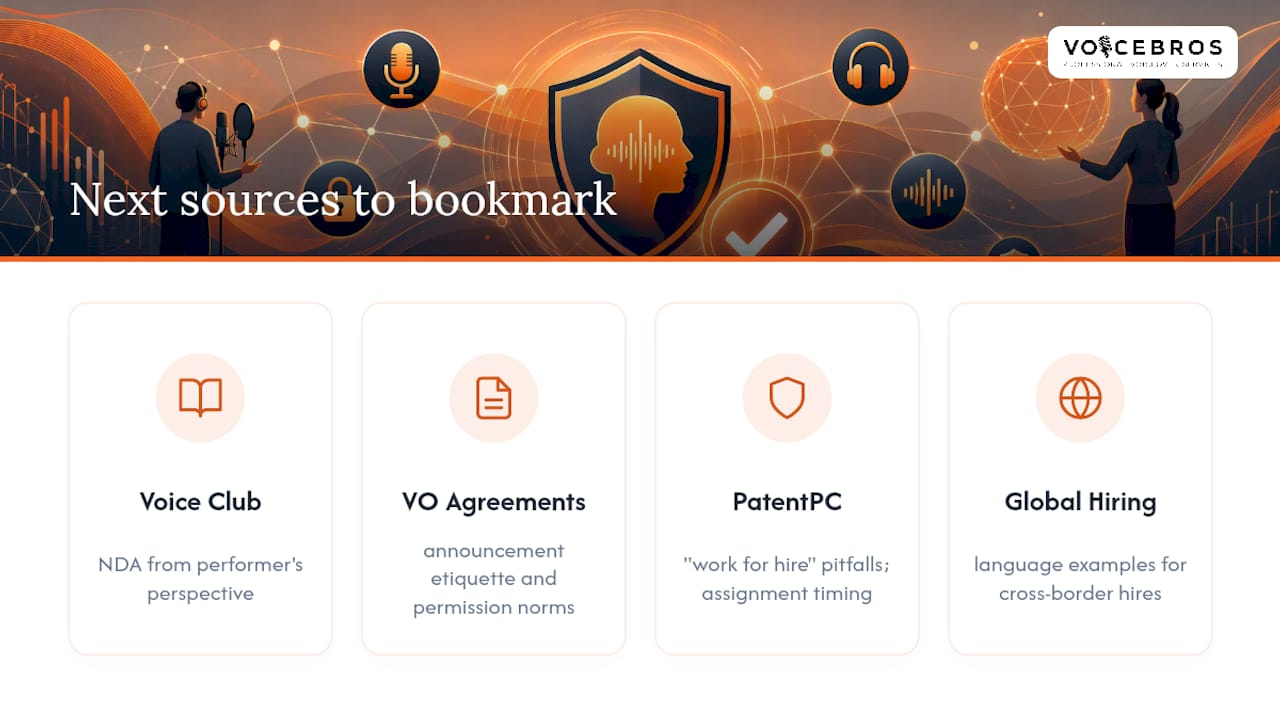
Voice Acting Club's NDA breakdown explains why confidentiality matters from the performer's side, useful context if you want to understand what actors are actually worried about when they read your paperwork. Its companion piece on VO agreements and contracts covers announcement etiquette and permission norms across the voiceover community.
For the IP assignment language itself, PatentPC's contractor ownership guide walks through why "work for hire" alone often fails and what assignment timing to specify. If you're hiring across borders, Toku's guide to hiring global creatives and the governing-law clause library both offer language you can adapt.
None of these replace an actual attorney reviewing your specific contract, especially once international hires or unusual royalty terms enter the picture.
This article is general information, not a substitute for advice from a qualified lawyer. Consult a qualified legal professional about your own circumstances before acting on anything here.
Sources
- NDAs: What are they, and why are they so important? – Voice Acting Club
- What Voiceover Artists Need to Know About Contracts + Confidentiality – Backstage
- How to Prevent IP Ownership Disputes with Contractors and Freelancers | PatentPC
- How to Hire Global Designers & Creatives Legally – Toku
FAQ
What Is a Voice Actor NDA?
It's a confidentiality agreement a hiring business signs with a voice actor before sharing scripts, plot details, or release information, distinct from the broader voice actor contract that covers payment and deliverables.
Do I Need an NDA for Every Voice-Over Project?
Not always. Low-stakes projects like generic corporate training rarely need one, but anything involving unreleased scripts, character reveals, or embargoed release dates should have one signed before the full script goes out.
Is "Work for Hire" Enough to Own the Recording?
Often not for independent contractors. Pair any work-for-hire language with an explicit IP assignment clause that states when rights transfer, upon creation or upon payment.
How Long Should a Voice Actor NDA Last?
Tie the term to your release date or a specific milestone rather than making it permanent. Perpetual NDAs are harder to enforce and tend to discourage strong talent from signing.
Can I Use the Same NDA for a Freelancer Hired Overseas?
Not without changes. Add clear IP assignment language and a governing-law clause, and consider local counsel or an Employer of Record for hires in jurisdictions where work-for-hire assumptions don't apply the same way.
Where Can I Find Vetted Voice Actors Who Already Understand NDAs?
Voicebros connects hirers with a large pool of vetted professional voice actors, filterable by language, accent, category, and budget, which reduces the vetting work before an NDA even goes out.
Recommended
Need a voice over for your project?
Browse 1,500+ professional voice artists in 50+ languages, hear real demos and get instant word-based pricing on VoiceBros.
Related Posts
 General
2026 update for Creators & Platforms: 3 Legal Anchors for Voice Cloning
2026 update for creators & platforms: three anchors, ELVIS Act, Lehrman v. Lovo, GDPR, decide voice cloning liability and next steps.
 General
Paste Ready Voice Over Brief: 8 Fields to Prevent a Second Session
Paste ready checklist of eight fields commissioning teams must include in a voice over brief to avoid a second session and speed casting.
 General
Cut Studio Time: Directing a Voice Actor With 30–60s Clips and Vetting
Prep scripts, 30–60 second reference clips, and session-ready phrases that speed live and remote sessions. Hire vetted talent to cut studio time and friction.
VoiceBros Team
The VoiceBros team is dedicated to providing high-quality voice over services and industry insights. With years of experience connecting voice artists with clients worldwide, we're passionate about helping you find the perfect voice for any project.
Back to Blog →