Choose Human, AI, or Hybrid Voice Over Translation in Days, Not Weeks
Voice-over translation records a translated voice track over the original audio, which stays audible underneath at a lower volume. It's the go-to choice for documentaries, news segments, interviews, and training or marketing content where the speaker's original delivery and visuals still need to carry weight. Later sections walk through human, AI, and hybrid production routes, real pricing, and a vendor checklist.
TL;DR:
- Voice-over translation is faster and less costly than dubbing because it does not require lip-sync, making it suitable for documentaries and corporate videos.
- Quality depends heavily on accurate transcription, proper adaptation for tone and pacing, and high-quality voice talent, whether human, AI, or hybrid.
- Relying on AI alone risks losing nuance and brand voice, so hybrid workflows or native review are recommended for sensitive content.
- For multi-language projects, expect timelines to stretch with each added language, and automated workflows start around $5 to $10 per audio hour.
- Choosing a provider requires clear demand for native speakers, adaptation approach, revision policies, and sample review before committing.
Table of Contents
- How Does Voice-Over Translation Differ From Dubbing and Subtitling?
- How Does the Voice-Over Translation Process Actually Work?
- Should You Choose Human, AI, or Hybrid Voice-Over Translation?
- What Should You Ask a Voice-Over Translation Provider Before Hiring?
- What Does Voice-Over Translation Cost, and How Long Does It Take?
- Where Does VoiceBros Fit Into a Voice-Over Translation Project?
- Get Native Voice Talent for Your Translation Project
- Sources
How Does Voice-Over Translation Differ From Dubbing and Subtitling?
Voice-over translation layers a translated track on top of the source audio rather than replacing it, which is exactly what separates it from dubbing. Dubbing swaps the original dialogue out entirely and syncs the new performance to lip movement. Subtitling skips a recorded voice altogether and puts translated text on screen. Each method solves a different problem.
Voice-over translation tends to win when the original speaker's voice, tone, or on-camera presence matters to the story: a journalist's field interview, a founder's keynote, a survivor's testimony in a documentary. In some markets, including Russia and Poland, a single "lektor" voice narrating over the entire program is standard broadcast practice, not a budget shortcut. That regional preference shows how much viewer expectations shape the right format.
The tradeoffs come down to a few factors:
- Cost and speed: Generally cheaper and faster than full dubbing since there's no lip-sync work.
- Viewer experience: Some audiences find the original audio bleeding through distracting; others find it more authentic.
- Authenticity: Preserves the speaker's real inflection and emotion, which dubbing can flatten.
- Best fit: Documentaries, news, corporate training, and marketing where the visual and vocal identity of the original speaker still needs to read as genuine.
How Does the Voice-Over Translation Process Actually Work?
A reliable production workflow runs through five stages, and skipping any of them is usually where quality problems start.
- Transcribe the source audio. Every word gets converted to text with accurate timecodes, since later steps depend on knowing exactly when each line starts and stops.
- Translate and adapt, not just translate literally. A good adapter shapes the line for phrase-sync and register, meaning it fits the pacing of the original clip and sounds like something a real person would say in that language, not a textbook.
- Cast the voice and prep materials. This means selecting a native voice actor (or an AI voice) and building a showguide with pronunciation notes, especially for names, brands, or technical terms that don't translate cleanly.
- Record and align. Sessions happen in a studio or remotely, then the recorded track gets edited and timed against the source so it lands where it needs to.
- Mix, QC, and deliver. Final deliverables usually include mixed stems, a merged file, and sometimes a burned-in version, plus a review round where the client flags anything off.
Pro Tip: Clean, single-speaker source audio dramatically improves both transcription accuracy and the final translation quality, since background noise and overlapping speech throw off automated tools and slow down human transcribers alike. If you're recording original content that you know will need translation later, invest in a decent lavalier mic on the interview subject.
Should You Choose Human, AI, or Hybrid Voice-Over Translation?
The right approach depends less on budget alone and more on how much brand voice and nuance the project can't afford to lose. Human talent wins when tone, humor, or emotional delivery is central to the message, think brand campaigns, audiobooks, or anything where a flat or robotic read would undercut the content. AI voice generation makes sense for high-volume, lower-stakes content like internal training modules or rapid social clips where speed and per-language cost matter more than performance nuance. Hybrid workflows, AI-generated drafts with native-speaker review, split the difference: faster and cheaper than a full studio process, with a human catching anything that sounds wrong or culturally off.
| Approach | Best for | Voice source | Pricing model | Turnaround | Quality controls |
|---|---|---|---|---|---|
| Human | Brand-critical, emotional, or lip-sync-sensitive content | Human | Per finished minute or per word | Days to weeks | Native-speaker review, multiple revision rounds |
| AI | High-volume, low-stakes, rapid localization | AI | Subscription or per-minute | Hours | Automated QA, optional spot-check review |
| Hybrid | Cost-conscious projects that still need polish | AI draft + human review | Per minute, often discounted vs. full human | 1 to a few days | Native-speaker review layered on AI output |
A few signals should push a project up the ladder from AI toward hybrid or fully human: sensitive or legal content, any requirement for lip-sync, and anything tied directly to brand reputation. Automated transcription and translation tools genuinely excel at speed and scale, but native review is what catches the phrase that technically translates correctly and still sounds wrong to a native ear.
What Should You Ask a Voice-Over Translation Provider Before Hiring?
A strong brief or RFP should demand specifics, not vague promises. Before signing anyone, confirm they can hand over the following:
- Demo samples in the exact language and accent you need, not a generic reel.
- Native-speaker coverage for every target language, confirmed by name, not just "we have translators."
- Adaptation approach, meaning they explain how they handle phrase-sync and register instead of running literal, word-for-word translation.
- Revision policy spelled out in writing: how many rounds, what counts as a revision versus a new request.
- Rights and licensing terms for the recorded voice track, especially if the content will run in paid media.
Ask directly: "What's your turnaround for five languages simultaneously?" "Can I hear a sample before final delivery?" "What file formats and stems do you deliver?" Vendors who dodge these questions, or who can't produce a sample without a signed contract first, are a warning sign.
Pro Tip: A provider who can't explain their revision policy in one clear sentence probably doesn't have one. Push for it before you pay a deposit.
What Does Voice-Over Translation Cost, and How Long Does It Take?
Pricing generally follows one of four models: per finished minute (most common for video), per word (common for scripts before recording), hourly for studio time, or a subscription for platforms handling recurring volume. Rarer languages, tighter adaptation requirements, and studio versus remote recording all push cost up or down.
What drives the number most is language rarity and volume. A single common-language project turns around fast, often within a few days. Adding multiple languages increases both cost and coordination efforts such as casting, scheduling, and review rounds, which all scale with each additional language.
For rough budgeting:
- Single language, standard turnaround: days, not weeks.
- Five to ten languages: expect the timeline to stretch as casting and QA scale with each new track.
- Automated workflows can run as low as $5 to $10 per audio hour, a useful floor for budgeting rapid, lower-stakes content, though native review adds cost back in when accuracy matters.
That per-hour AI figure is worth sitting with: it's a floor, not a finished product, once you factor in review and adaptation for anything client-facing.
Where Does VoiceBros Fit Into a Voice-Over Translation Project?
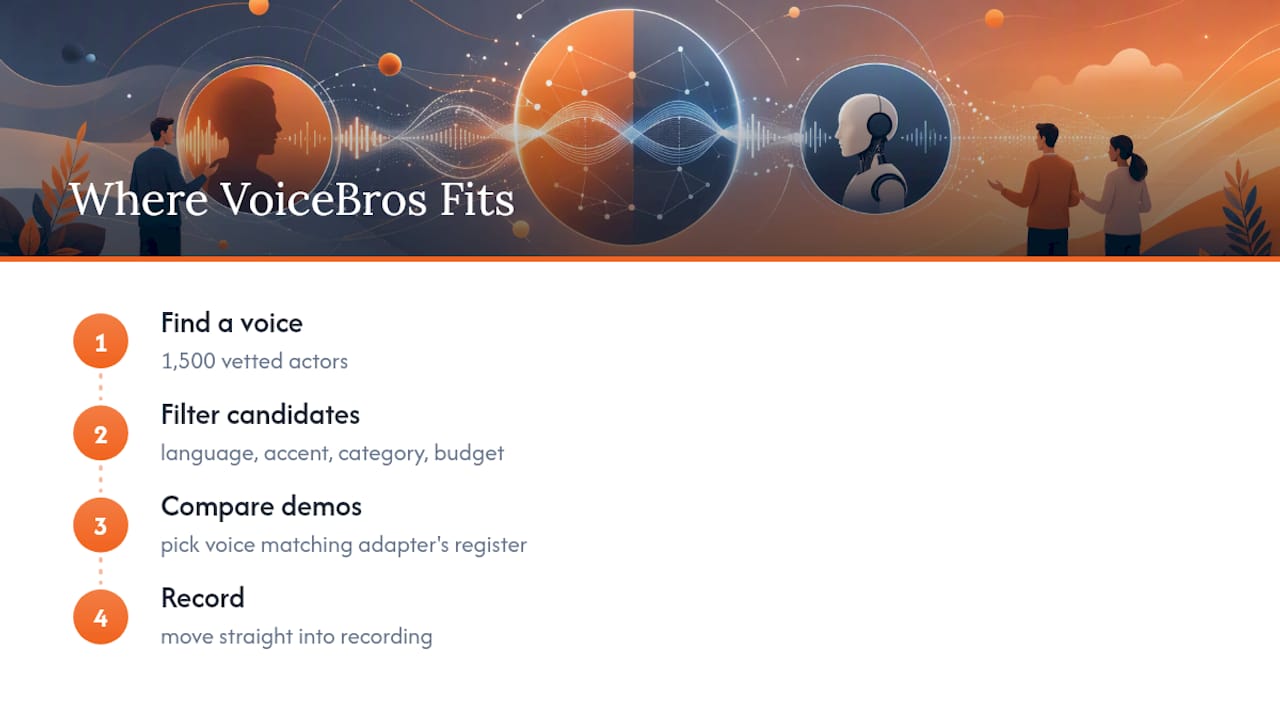
Most of the friction in voice-over translation comes down to one thing: finding a voice that actually fits the language, accent, and tone the project needs, then trusting the person behind it. Voicebros built its marketplace around solving that specific problem, with over 1,500 vetted voice actors filterable by language, accent, category, and budget, backed by a 98% client satisfaction rate across thousands of completed projects.
That structure maps directly onto the production steps covered earlier. Once your script is translated and adapted, you're not stuck negotiating with a single agency's roster. You compare demos side by side, pick a voice that matches the register your adapter wrote for, and move straight into recording. The vetting process exists precisely because casting the wrong voice, one that sounds off for the market or the material, is the most common way these projects go sideways.
Get Native Voice Talent for Your Translation Project
Voicebros gives you direct access to native-speaker voice actors across dozens of languages, without the back-and-forth of a traditional agency quoting process.
Instead of waiting on agency emails, you filter by language, accent, and budget, then compare demo recordings from real candidates before you commit. That side-by-side listening step alone solves the biggest risk in this process: hiring a voice that reads well on paper but doesn't land right once it's recorded. Browse the voice actor directory to compare native talent for your target language, or check the pricing calculator to budget your project before you brief a translator. If your project spans multiple formats, from e-learning to commercials, the voice-over services overview breaks down what's included at each tier. Start by requesting a quote and listening to a few demos, no commitment required until you find the voice that fits.
Sources
- Voice-over translation — Wikipedia
- Dubbing script translation and adaptation for lip-sync | Lipsie
- Translate Audio & Video | Sonix
Recommended
Need a voice over for your project?
Browse 1,500+ professional voice artists in 50+ languages, hear real demos and get instant word-based pricing on VoiceBros.
Related Posts
 General
48kHz/24 Bit Voice Over Specs Pros Use for Podcast and Broadcast
Compact, platform-aware spec sheet with copy paste session settings (48kHz/24 bit), LUFS and true peak targets, gain staging guidance, and an export...
 General
Nail 3 Brief Details Before Hiring a Voice Actor
Define audience, placement, and rights first. Follow a five-step workflow and use a vetted marketplace for targeted auditions and delivery protection.
 guides
English Voice Over: How to Pick the Right English Voice for Your Business
Going global? Why native English voice matters, how to choose between American, British and neutral accents, working across other foreign languages, and how the process and pricing work.
VoiceBros Team
The VoiceBros team is dedicated to providing high-quality voice over services and industry insights. With years of experience connecting voice artists with clients worldwide, we're passionate about helping you find the perfect voice for any project.
Back to Blog →