5 Factors That Set Voice Over Usage Rights for Hirers and Talent
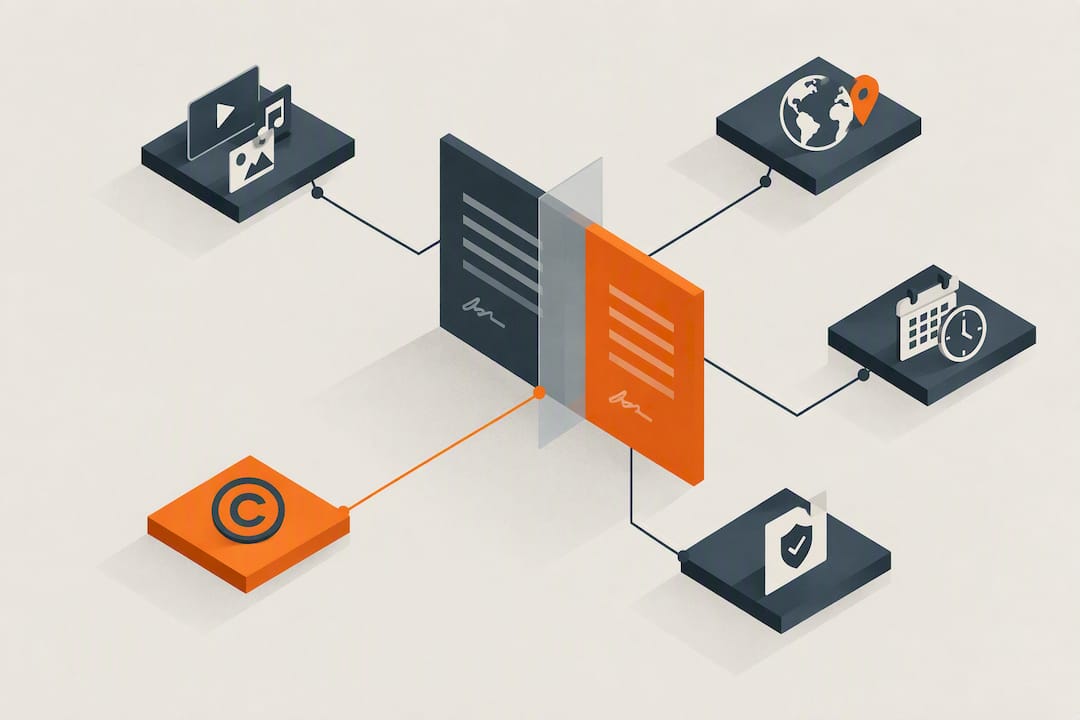
Voice over usage rights are a license to use a recorded performance, not a transfer of ownership, and the fee you pay (or charge) depends entirely on how that license is scoped. The single most important action for either side of the deal: put medium, territory, duration, and exclusivity in writing before anyone hits record. Skip that step and you're negotiating after the fact, which almost always favors whoever has the recording.
TL;DR:
- Always specify medium, territory, duration, and exclusivity in writing before recording to avoid disputes over usage rights.
- Voice over fees depend mainly on usage scope—such as platform, market size, and license length—rather than recording length alone.
- Clarify contract terms around renewal, transferability, derivatives, and AI training restrictions upfront to prevent legal conflicts later.
- Volume and reach significantly influence pricing, with national or multi-year licenses costing notably more than local or short-term uses.
- Use platforms that track expiration dates and prompt renewals to prevent accidental unauthorized use and reduce post-delivery disputes.
Table of Contents
- What Are Voice Over Usage Rights, Exactly?
- What Actually Drives Voice Over Usage Fees
- Buyout vs. Usage License vs. Work-for-Hire
- The Voice Over Contract Checklist Nobody Reads Until It's Too Late
- Why AI Voice Cloning Changes the Consent Conversation
- How Smart Platforms Prevent License Disputes Before They Start
- A Straight Answer for Both Sides of the Table
- Hire Vetted Talent With Usage Terms Set at Checkout
- Sources
- FAQ
What Are Voice Over Usage Rights, Exactly?
A voice over license grants specific, limited permission to use a recorded performance. It is not the same as buying the recording outright, and it is definitely not the same as owning the performer's voice.
Three terms get thrown around loosely, and mixing them up causes most contract disputes:
-
License: permission to use the recording for defined purposes, in defined places, for a defined time.
-
Buyout: a single upfront payment that covers a broad (but still bounded) set of usage rights, often for a set term rather than forever.
-
Work-for-hire: a legal arrangement where the hiring party is treated as the author of the recording from the moment it's created, which shifts ownership rather than just licensing use.
Under Title 17 of the U.S. Copyright Law, performers generally retain rights in their performances unless a valid work-for-hire agreement or a written transfer says otherwise. The United Kingdom takes a similar stance: the Copyright, Designs and Patents Act 1988 treats performers as retaining rights unless they assign them by contract. Rules shift by country, so a hirer working across borders needs to check local statute rather than assume one framework applies everywhere.
Can a voice itself be copyrighted? Not exactly. Copyright protects the recording, not the vocal instrument. But a distinctive voice can still carry legal weight: the landmark Midler v. Ford Motor Co. case established that a recognizable voice can be protected under right-of-publicity claims, even when the underlying performance isn't copyrighted, if someone imitates it to sell a product without consent. This is separate from trademark, which the U.S. Patent and Trademark Office governs under its own statutory framework entirely.
What Actually Drives Voice Over Usage Fees
Price a voice over the same way you'd price a licensed photo or a piece of stock music: usage, not runtime, sets the number. Five factors do almost all the work.
- Medium. A radio spot costs less than a national TV commercial partly because broadcast carries far heavier weight than a corporate training video or an internal onboarding module.
- Territory or market. A voice cleared for one city market costs a fraction of the same voice cleared nationally or across multiple countries.
- Duration. A three-month digital campaign license costs less than a two-year or perpetual license for the identical script.
- Reach and platform. "Web only" is not one category. Practitioner guides point out that paid social, organic posts, and YouTube pre-roll each carry different value, because paid placement can reach audiences far beyond an organic post.
- Exclusivity. A non-exclusive license, where the performer can still voice a competitor's ad, costs less than an exclusive one that locks the voice to your brand within a category.
Volume matters too: a single 30-second spot prices differently than a 40-episode e-learning series using the same voice.
Statistic callout: A common industry approach, outlined by RealVOTalent, calculates buyouts using a multiplier formula: session fee × media multiplier × territory multiplier × duration multiplier. A typical session fee for a local radio spot might multiply significantly once it's cleared for national broadcast and a multi-year term. Broadcast usage runs on renewal cycles tied to actual air time; digital and internal uses run on flat license windows instead, which is why the two need entirely separate contract language.
Buyout vs. Usage License vs. Work-for-Hire

Choosing between a one-time buyout and an ongoing usage license shapes everything from cash flow to future leverage, and the three models are not interchangeable.
A buyout collapses all future usage payments into a single upfront fee. That's attractive for hirers who want to stop tracking renewal dates, but RealVOTalent's guide warns that "buyout" itself is a loose, often ambiguous term. One vendor's buyout might mean one year of national usage; another's might mean perpetuity across every platform. Always ask: buyout of what, exactly, and for how long.
- A limited-term buyout typically covers one year of usage across agreed media, then requires renewal or renegotiation.
- A multi-year buyout extends that window, usually at a higher upfront cost that reflects the extended exposure.
- A perpetual buyout removes the expiration date entirely, which is the most expensive tier because the talent gives up all future negotiating leverage on that piece of work.
- Work-for-hire transfers authorship itself to the hiring party, which is a different legal event than any buyout and typically requires explicit, signed agreement to be enforceable.
Renewal mechanics matter as much as the initial term. If a contract doesn't pre-agree renewal pricing, you're negotiating from scratch every time the license lapses, usually with less goodwill than you started with.
The Voice Over Contract Checklist Nobody Reads Until It's Too Late
Most usage disputes trace back to a contract that never specified the terms clearly. A short checklist, borrowed loosely from SAG-AFTRA's own contract guidance, covers the clauses that actually prevent fights.
- Medium — TV, radio, web, IVR, e-learning, audiobook, or some combination, named specifically.
- Territory — city, national, or specific countries, not "worldwide" by default.
- Term — an exact start date and end date, not "one year from delivery."
- Exclusivity — whether the talent is barred from competitor work in the same category.
- Edit and derivative rights — whether the hirer can cut, remix, or repurpose the audio beyond the original script.
- AI and model-training consent — explicit language on whether the recording can train a synthetic voice model.
- Transferability — whether the license can be sold or assigned to another company.
- Renewal terms — pricing and process agreed upfront, not negotiated cold.
- Fees and invoicing — payment schedule, late fees, and what happens if usage expands mid-contract.
Red flags worth rejecting outright: a "use in all media, in perpetuity" clause with no added fee, or vague "digital" language that never defines platforms. Those phrases usually mean someone forgot to specify the deal, or is hoping you won't ask.
Pro Tip: Write your usage terms into the creative brief before you ever request a quote. A vague brief produces a vague price, and vague prices are what turn into disputes six months later.
Why AI Voice Cloning Changes the Consent Conversation
A recording made for a single radio spot can, without explicit restriction, become training data for a synthetic voice model. That's the new risk layer usage contracts didn't have to address a decade ago. Journalistic coverage has documented voice actors' growing concern about recordings being used to train AI systems without their knowledge or consent.
The fix is contractual, not technical. Add explicit language covering:
- A flat prohibition on using the recording to train any voice model or synthetic clone, unless separately negotiated.
- A requirement for written, standalone consent before any synthesis use, distinct from the original recording license.
- A separate fee structure for synthetic use, since a cloned voice can generate unlimited output at near-zero marginal cost, a very different value proposition than a single recorded read.
Hirers who genuinely want a synthetic voice should get explicit consent in writing and negotiate that fee independently. Guides comparing AI voice over against human talent generally agree the consent question, not the technology itself, is where most disputes start. Partner resources like Virtualship lay out a useful framework for testing and revoking synthetic consent over time.
How Smart Platforms Prevent License Disputes Before They Start
Most usage disputes aren't malicious. They're the result of nobody tracking when a license window actually closes. A platform that flags expiring usage terms and prompts a renewal conversation before the deadline turns a legal risk into a routine calendar task.
Practical habits worth adopting regardless of platform:
- Log the license start date, end date, and covered media in one place both parties can see.
- Set an automatic reminder 30 days before any usage window expires.
- Let talent define their own usage terms upfront, rather than negotiating them after delivery.
VoiceBros built its marketplace around that same logic: with more than 1,500 vetted voice actors, filterable by language, accent, category, and budget, usage terms are surfaced during the ordering process rather than buried in a follow-up email. That transparency is what reduces post-delivery disputes in the first place.
A Straight Answer for Both Sides of the Table
If you're hiring, define your usage scope and budget for it before you post the job, not after you've fallen in love with a demo. If you're the talent, get every term in writing before you record a single word, and don't accept "we'll figure out usage later" as an answer.
Most usage questions can be settled with a clear contract and a five-minute conversation about medium, territory, and term. Bring in a lawyer only when the deal involves perpetual buyouts, cross-border rights, or AI/synthetic consent, where the stakes and ambiguity both run higher.
— Onur
Hire Vetted Talent With Usage Terms Set at Checkout
Voicebros is the alternative to guessing your way through a licensing conversation after the fact. Every project runs through more than 1,500 vetted human voice actors, filterable by language, accent, category, and budget, with no AI voices mixed into the pool unless you specifically choose that route.
Usage terms get set at the point of ordering, not renegotiated in a follow-up email once the invoice is already sent. That structure matters most for the exact scenarios this article covers: broadcast versus digital reach, buyout duration, and renewal timing. Voicebros takes a platform fee of 20% on paid transactions, and every order comes with automatic invoicing so there's no hidden markup buried in the quote. Browse commercial voice over talent or check the full service categories, from IVR to e-learning to audiobooks, and set your usage scope before you request your first demo.
Sources
For legal certainty beyond this guide, consult Title 17 of the U.S. Copyright Law and SAG-AFTRA's voiceover contract resources. Usage law varies by country. Talk to local counsel before signing a cross-border deal.
- Title 17, United States Code (U.S. Copyright Law)
- SAG-AFTRA — Contracts & industry resources: Voiceover
- Voiceover Licensing & Usage: A Guide for Hirers — Gravy For The Brain
FAQ
Are Voices Copyrighted?
Not directly. Copyright covers the recorded performance under U.S. law, not the voice itself, but a distinctive voice can still gain protection under right-of-publicity claims, as established in the Midler v. Ford Motor Co. case.
How Much Does a One-Minute Voice Over Cost?
Cost depends far more on usage than on runtime. The same one-minute script can cost several times more once it moves from a single local radio spot to national broadcast with a multi-year term, following the multiplier structure common across the industry. Current rate ranges for specific project types are listed on Voicebros's rate guide.
Do Voice Actors Get Royalties?
Union voice actors working under SAG-AFTRA contracts can receive residual-style payments tied to usage cycles, particularly for broadcast work, as outlined in SAG-AFTRA's contract guidance. Non-union work is typically structured around flat session fees plus separate usage fees rather than ongoing royalties.
Are AI Voices Illegal?
AI-generated voices are not illegal on their own, but using someone's actual voice or a close imitation of it to train or generate a synthetic clone without consent raises real legal exposure, especially under right-of-publicity law. The safer path is explicit written consent and a separate fee for any synthetic use, a distinction Voicebros's comparison of AI and human voice over lays out directly.
Recommended
Need a voice over for your project?
Browse 1,500+ professional voice artists in 50+ languages, hear real demos and get instant word-based pricing on VoiceBros.
Related Posts
 General
48kHz WAV Masters Prevent Rework in Remote Voice Over Recording for Producers
Use a one paragraph brief, choose live or asynchronous workflow, and require a 48kHz WAV master. Hire vetted actors and avoid costly rework.
 General
Ship Ads Faster: 24 Hour Commercial Voice Casting for Marketing Teams
Production first commercial voice casting for marketers. Nail the brief, get editor ready auditions, lock rights, and book 24 hour delivery.
 General
Book Better Voices in 20 Minutes: Voice Over Casting Brief for Producers
Draft a voice over casting brief in 20 minutes using a production tested checklist and two copy paste templates to attract auditions that actually fit...
VoiceBros Team
The VoiceBros team is dedicated to providing high-quality voice over services and industry insights. With years of experience connecting voice artists with clients worldwide, we're passionate about helping you find the perfect voice for any project.
Back to Blog →