

Book Better Voices in 20 Minutes: Voice Over Casting Brief for Producers
A voice over casting brief works when it names five things: the role and its emotional subtext, exactly how the performance should sound, the lines actors will read, the technical and submission logistics, and the usage or budget tied to the job. Skip any one of those and you get a pile of auditions that miss the mark. The checklist and templates below let you draft a working brief in the next twenty minutes.
TL;DR:
- Clear briefs include a specific role and relationship description, not just vague adjectives, to ensure actors understand the scene context.
- Reference tracks should always include a timestamp to precisely communicate pacing and tone, rather than relying on generic adjectives.
- Audition excerpts should be short, with clear context and contrasting takes, to efficiently evaluate actor range and interpretation.
- Submitting technical specifications, deadlines, and usage details explicitly reduces delays and mismatched applications.
- Precise language about usage scope and budget in the brief attracts suitable actors and minimizes follow-up negotiations.
Table of Contents
- Voice Over Casting Brief Checklist: What Every Section Needs
- Writing the Role and Tone So Actors Actually Get It
- Choosing Audition Lines and Asking for the Right Takes
- Audition Logistics: Specs, Labels, and Deadlines That Prevent Chaos
- Stating Budget and Usage So the Right Actors Apply
- A Copy-Paste Template and Two Filled Examples
- Target Audience and Project Context
- How the Casting Process Actually Runs, Start to Finish
- Setting Clear Criteria for Choosing the Final Voice
- Confidentiality and NDA Terms Actors Expect to See
- Why Most Weak Auditions Trace Back to a Weak Brief
- Let Voicebros Turn Your Brief Into Booked Talent
- Sources
- FAQ
Voice Over Casting Brief Checklist: What Every Section Needs
A casting brief is only as good as its weakest section. Actors read briefs fast, decide fast, and audition based on what's actually written down, not what you meant to say. Aura Casting's guidance for producers makes the case plainly: a thorough brief that includes shoot dates, rates, usage, and character description speeds up casting and improves the quality of the match. Here's what belongs in every brief you write.
- Role and character description. Who is speaking, to whom, and why. A one-line persona beats three vague adjectives.
- Performance direction. Energy, pace, and tone, ideally backed by a reference track or comparable voice.
- Script excerpt. The actual lines, or a representative excerpt if the full script isn't locked yet.
- Technical specs. File format, sample rate, and any home-studio requirements.
- Submission details. Deadline, file naming, and where the audition goes.
- Usage and budget. Where the audio will run, for how long, and what it pays.
Production tip for each: write the role field last. You'll word it more precisely once the performance direction and script are already down on the page. Skipping the usage field is the most common failure, and it's the one that costs the most time later, since actors quote rates based on where and how long their voice will run.
Writing the Role and Tone So Actors Actually Get It
"Warm and friendly" tells an actor almost nothing useful. Every voice actor alive can sound warm. What they can't guess is who they're supposed to be warm to, or why. Role based framing solves this: instead of an adjective, give a job and a relationship. CJ Emerson's breakdown of the voice acting pipeline makes the point directly. Role definition is the step that determines whether the rest of the casting process runs smoothly or turns into a slog of rejected takes.
Here's the difference in practice:
- ✗ "Warm, trustworthy voice." → ✓ "A reassuring financial consultant, calm under pressure, speaking to a first-time homebuyer who's nervous about the process."
- ✗ "Energetic and fun." → ✓ "A camp counselor pumping up ten-year-olds on the last day before parents arrive. Loud, but never shouting."
- ✗ "Professional and clear." → ✓ "An airline gate agent delivering a delay announcement. Apologetic but composed, no drama, no sing-song cadence."
Each rewrite gives the actor a relationship and a stake in the scene, not just a mood.
Reference tracks close the gap adjectives leave open. Pick a commercial, film clip, or even a song that captures the pacing or energy you want, and note the specific timestamp where it lands. Practitioner guidance on casting consistently points to reference tracks as more reliable than adjectives for communicating pace and tonal shifts, since energy is something people recognize by ear far faster than they can describe in words.

Pro Tip: Never send a reference track without a timecode. "Listen to this whole two-minute ad" wastes an actor's time. "Listen to 0:14 to 0:22, that clipped, dry delivery" gets you exactly what you want back.
Choosing Audition Lines and Asking for the Right Takes
- Keep the excerpt short. Fifteen to thirty seconds of finished audio, or three to five lines of script, is plenty. Long excerpts slow down review without adding useful information, since most casting decisions get made in the first ten seconds anyway.
- Annotate for context, not just content. Add a one-line scene setup above the excerpt ("She's just been told the shipment is delayed, and she's trying to keep the customer calm") plus emphasis marks on words that carry the meaning.
- Ask for at least two contrasting reads. One natural, conversational pass and one pushed version, whether that's more energetic, more comedic, or more clipped. Word the request specifically: "Please give us a grounded, conversational read, then a second take with 20% more energy and a slight smile in the voice."
- Name what you're listening for in each take. If the natural read is about believability and the pushed read is about range, say so. Actors calibrate better when they know which quality is being judged.
This structure gives you range to compare without asking anyone to record five minutes of throwaway material.
Audition Logistics: Specs, Labels, and Deadlines That Prevent Chaos
Most audition delays trace back to specs nobody wrote down. Fix that with four fields.
- Audio format: request WAV, 48kHz, 24-bit for anything headed to broadcast or final production; a high-quality MP3 (256kbps or higher) is a fine fallback for early-round auditions.
- Slate: ask for name, city, and contact info at the top of the file, spoken plainly, no character voice.
- Home studio confirmation: if the job requires broadcast-quality home recording, say so and ask actors to confirm their setup. A real posting for a home-recording rush job made this explicit, right down to noting the turnaround window, which is exactly the level of detail that avoids last-minute surprises.
- File naming and delivery: something like
LastName_RoleName_Take1.wav, delivered through a shared drive link or direct upload to your casting platform.
A workable deadline timeline gives actors 48 to 72 hours for a standard audition window and flags anything shorter as a rush job, since same-day turnarounds change who's available and sometimes what they charge.
Pro Tip: Put your file naming convention in bold in the brief itself. Actors skim; a buried instruction in paragraph four gets missed constantly.
Stating Budget and Usage So the Right Actors Apply
Usage decides who shows up to audition, more than any other field in the brief. A voice actor pricing a two-week social media clip and one pricing a two-year national broadcast campaign are different people with different rate cards, and a vague brief mixes their applications together. The IPA's casting brief template, built with industry partners including APA, Equity, and ISBA, exists partly to fix this: it pushes producers to state fees and usage clearly up front rather than leaving them for a negotiation after the actor is already invested.
State three things: territory (local, national, global), duration (weeks, months, in perpetuity), and exclusivity (can this actor voice a competing brand during the term). If your budget is locked, give a range. If it isn't, say "request quotes" and mean it.
- ✗ "Competitive pay, usage TBD."
- ✓ "$450 flat for a 30-second national radio spot, 12-month term, non-exclusive within the category."
Vague usage terms are the single fastest way to attract mismatched auditions, since actors who'd charge appropriately for the real scope simply won't bother applying to something that reads as underspecified.
A Copy-Paste Template and Two Filled Examples
Here's a compact structure you can paste into any brief, followed by two filled versions.
- Role: who's speaking and to whom
- Tone: performance direction plus a reference track
- Audition lines: excerpt and requested takes
- Tech specs: format, sample rate, home studio note
- Submission: deadline, file naming, delivery link
- Usage & budget: territory, duration, exclusivity, rate or range
| Field | Commercial (30 sec) | E-learning module |
|---|---|---|
| Role | Friendly neighbor giving a product recommendation | Patient corporate trainer walking new hires through a compliance module |
| Tone | Casual, upbeat, reference: local car dealership spot | Warm but efficient, no filler words, reference: onboarding video for a mid-size tech company |
| Audition lines | Full 30-second script, natural take plus a more animated take | Two-paragraph excerpt from module intro, natural take only |
| Tech specs | WAV, 48kHz, 24-bit | MP3 high quality acceptable |
| Submission | 48-hour window, upload via casting platform | 5-day window, email link |
| Usage & budget | $500, national digital, 6-month term | $0.15 per word, internal use only, perpetual |
Role, tone, and audition lines stay required on every brief. Usage terms and home-studio confirmation can shift depending on whether the job is broadcast-bound or strictly internal.
Target Audience and Project Context
The brief exists to answer one question for the actor: is this job for me? That means naming who ultimately hears the finished audio, not just who's hiring the voice.
A commercial brief should say whether the ad targets young parents, retirees, or a general audience, because that shapes vocal age, pacing, and even regional accent expectations. An e-learning brief should note whether the learners are new hires, seasoned technicians, or compliance officers renewing a certification, since a script written for nervous first-day employees reads very differently than one aimed at veteran staff running through an annual refresher.
Project context matters just as much. Is this a single deliverable or the first script in an ongoing series? Actors weigh availability differently for a one-off spot versus a recurring role that might mean monthly sessions for a year. State whether this is a pilot, a full campaign, or a evergreen library of content, since that shapes both who applies and what they'll quote.
If the brand has existing voice work, note it. A returning actor being asked to match an established tone needs to know that upfront, and a fresh casting search for a rebrand needs to say so too, so applicants don't submit takes modeled on a sound the brand is trying to move away from.
How the Casting Process Actually Runs, Start to Finish
A typical voice casting timeline runs in four stages, and knowing where you are in it helps you set realistic actor expectations.
Brief and posting comes first, usually a day or two of drafting and internal sign-off before the call goes out. Audition window follows, typically 48 hours to a week depending on urgency, during which actors submit reads against your script excerpt. Review and shortlist is the stage most producers underestimate for time, since narrowing forty auditions down to three finalists takes real listening, not a quick skim. Callback and booking closes the loop, sometimes with a second round of direction ("try that line again, but drop the energy 10%") before a final offer goes out.
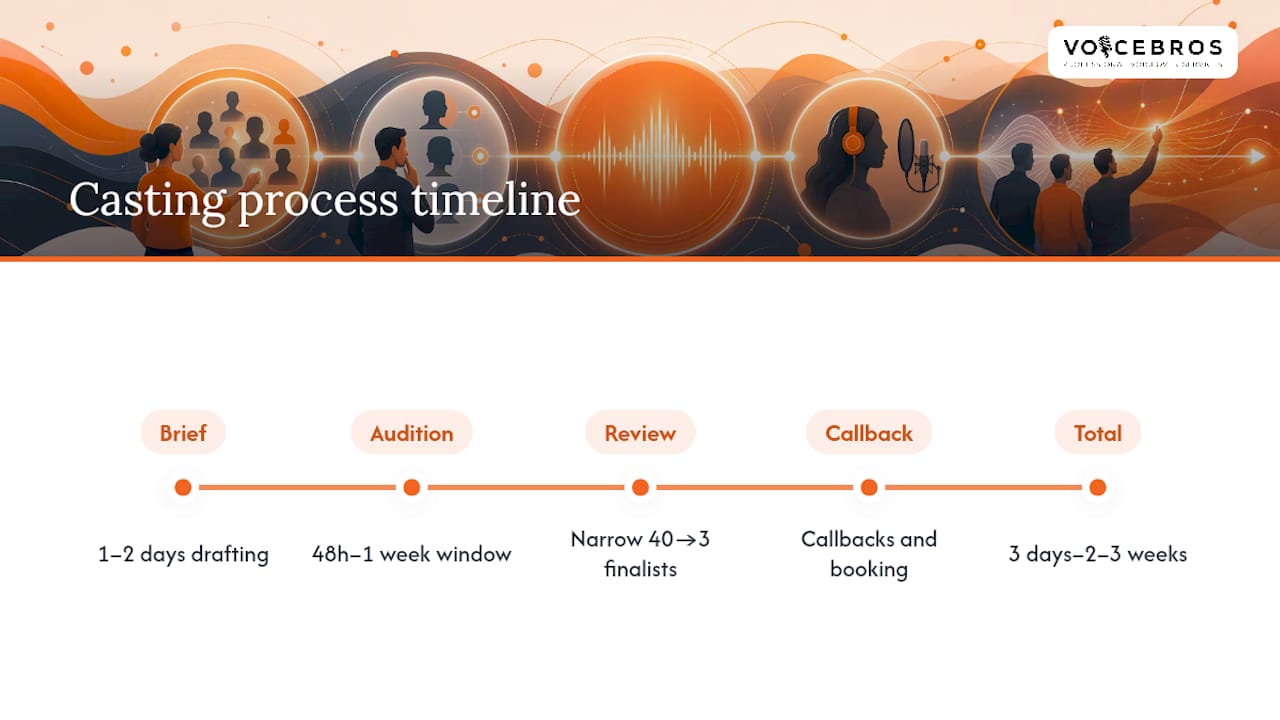
Total time from posting to booking runs anywhere from three days for a rush commercial to two or three weeks for a project with multiple stakeholders signing off on the final voice. The biggest lever you control is the audition window. Cut it too short and you lose strong candidates who had other commitments; leave it too long and momentum stalls while everyone waits.
Platforms built specifically for voice casting, where filtering by language, accent, and category narrows the pool before auditions even open, tend to compress this timeline meaningfully compared to an open casting call with no pre-screening.
Setting Clear Criteria for Choosing the Final Voice
Decide your evaluation criteria before auditions arrive, not after, or you'll end up picking based on whichever read you happened to hear last.
Three criteria matter more than the rest: accuracy to direction (did the actor deliver the role and tone you asked for, or a generic version of it), technical quality (is the recording clean, properly leveled, free of room noise), and range (can this actor handle a script revision or a tonal note without a full re-audition). Weight these based on the job. A one-off IVR prompt cares mostly about clarity and pronunciation. A recurring brand voice cares more about range and consistency across sessions.
Score auditions the same way for every candidate, even informally. Jotting a quick note like "strong accuracy, thin low end in the recording, unclear if she can push energy up" on each submission keeps your decision defensible and makes callback requests specific instead of vague. This also protects you from the common trap of favoring the audition you listened to first, simply because it set the bar before you'd heard the alternatives.
Confidentiality and NDA Terms Actors Expect to See
Unreleased products, unannounced campaigns, and pre-launch software all show up in casting briefs regularly, and actors expect you to flag it. If the script mentions a product name, character, or plot point that hasn't gone public, say so directly: "This project is confidential prior to launch. Please do not share script content or discuss this audition publicly."
For sensitive work, an NDA before script access is standard practice, not an unusual ask. Video game studios in particular often require a signed NDA before sending any audition material, since leaked character names or dialogue can spoil marketing timelines the studio has spent months building. If your project falls into that category, note in the brief that an NDA will be required and roughly how long it takes to process, so actors aren't caught off guard by an extra step between submitting and recording.
Keep the confidentiality note proportional to the actual risk. A generic corporate training module doesn't need the same NDA weight as an unreleased game trailer, and treating every brief like classified material trains actors to skim past the warnings that actually matter.
Why Most Weak Auditions Trace Back to a Weak Brief
Clear briefs don't just save time, they change who shows up to audition at all. A vague brief attracts a wide, mismatched pool because nobody can self-select out of something undefined. A specific one filters itself: actors who don't fit the role or the rate simply don't apply, which means the auditions that do land in your inbox are already closer to usable.
A robust network of vetted voice actors shows a consistent pattern: briefs with a defined role, a reference track, and stated usage produce auditions that need far less back-and-forth before a final pick gets made.
Before sending any brief, run it against a short gut check. Does the role description name a relationship, not just a mood? Is there a reference track with a timestamp? Does the usage field state territory and duration, not just "competitive pay"? Are the technical specs and deadline both explicit? If any answer is no, fix that field first. It's the cheapest edit you'll make in the entire casting process.
— Onur
Let Voicebros Turn Your Brief Into Booked Talent
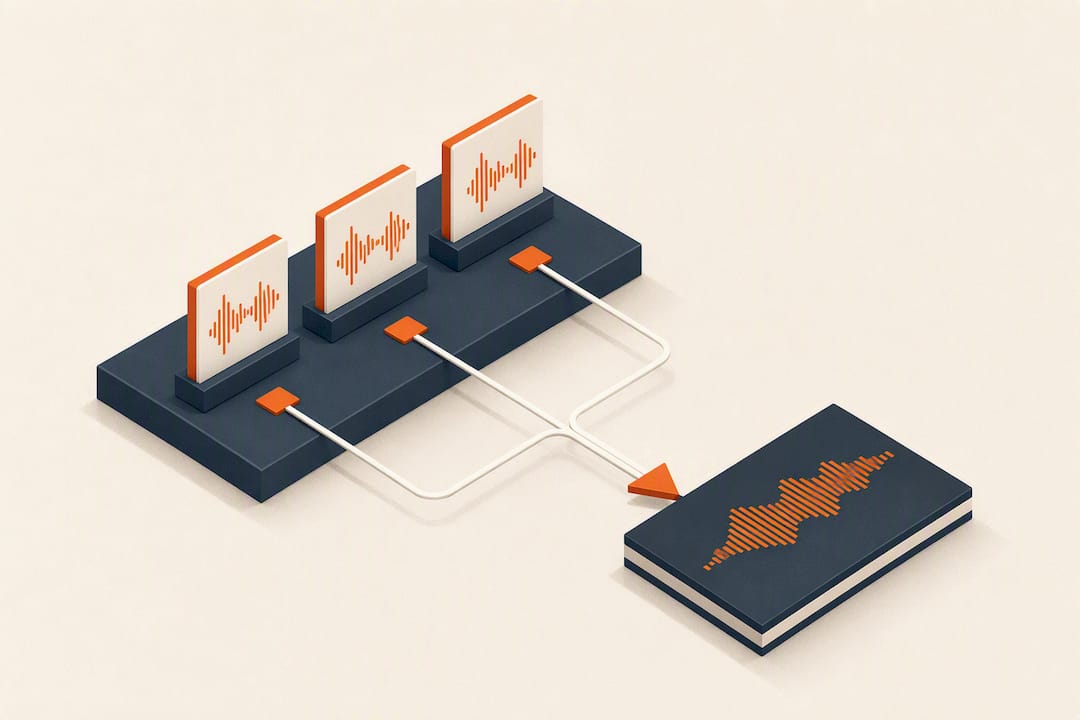
Writing the brief is half the job. Finding the right voice to match it is the other half, and that's where a marketplace built specifically for this beats sorting through cold outreach or agency waitlists. A specialized marketplace offers access to a large number of vetted voice actors, filterable by language, accent, category, and budget, so the brief you just wrote actually reaches performers who fit it.
Once your role description, tone reference, and usage terms are locked, upload the brief and compare demos side by side rather than waiting on a single agency submission list. Whether the job is a commercial, an e-learning module, or an IVR script, the filtering does the initial narrowing your brief was built to support.
Ready to see who's available? Browse voice artists and start your brief to get matched with talent that fits your project today.
Sources
- What Makes a Great Casting Brief: A Guide for Producers — Aura Casting
- Artist's Casting Brief — IPA
- The Video Game Voice Acting Process Explained | CJ Emerson
FAQ
How much does a 1 minute voice over cost?
Rates vary widely by usage, actor experience, and territory, so a locked national broadcast spot costs far more than an internal training video. Check current per-word and per-project rates to get a realistic estimate before you set your budget field.
What does a voice over script look like?
A voice over script is typically short, written in plain conversational language with stage directions in brackets for tone or pacing (e.g., "[pause] [warmer]"), and formatted with timestamps if it's tied to video. Browsing sample scripts across categories shows how formatting shifts between commercials, e-learning, and IVR work.
How do you get hired for voice overs?
Most actors get hired by submitting strong, well-targeted auditions against clear casting briefs, then building a demo reel and reputation through a casting platform or agency over repeated projects. Responding to specific, well-written briefs, rather than generic open calls, tends to produce better hit rates than mass-submitting to anything posted.
How much do voice actors get paid?
Pay depends entirely on usage terms; a local, limited-run project pays far less than a national campaign with a long exclusivity window, which is why the brief's usage and budget field matters so much for setting the right rate. Voice actors quote based on where the audio runs, for how long, and whether the client wants exclusivity within that category.
Recommended
Need a voice over for your project?
Browse 1,500+ professional voice artists in 50+ languages, hear real demos and get instant word-based pricing on VoiceBros.
Related Posts
 General
Paste Ready Voice Over Brief: 8 Fields to Prevent a Second Session
Paste ready checklist of eight fields commissioning teams must include in a voice over brief to avoid a second session and speed casting.
 General
48kHz WAV Masters Prevent Rework in Remote Voice Over Recording for Producers
Use a one paragraph brief, choose live or asynchronous workflow, and require a 48kHz WAV master. Hire vetted actors and avoid costly rework.
 General
Hire Securely: 7 Point Voice Actor NDA Checklist & Template for Hirers
Practical hiring playbook for businesses and agencies: clauses, timing, a 7 point checklist and starter NDA template to protect scripts, release dates,...
VoiceBros Team
The VoiceBros team is dedicated to providing high-quality voice over services and industry insights. With years of experience connecting voice artists with clients worldwide, we're passionate about helping you find the perfect voice for any project.
Back to Blog →