

Ship Ads Faster: 24 Hour Commercial Voice Casting for Marketing Teams
The fastest, lowest-risk way to handle commercial voice casting is to work through a vetted marketplace that offers broadcast-quality talent and fast custom auditions. Vetting removes guesswork about studio quality and professionalism, demo lanes let you hear multiple tonal options before you commit, and clear usage terms prevent rights disputes later. From here, the workflow is simple: write the brief, request auditions, then book the session.
TL;DR:
- Vetting marketplaces ensure broadcast-quality talent and provide multiple tonal options, making the audition and booking process faster and more reliable.
- Defining the role with specific emotional and functional instructions helps actors deliver targeted auditions, reducing the number of takes and re-briefings needed.
- Clearly stating media coverage, territory, and campaign duration upfront results in comparable quotes and avoids hidden costs or rights disputes.
- Insisting on live-directed sessions for exact cues or complicated terminology ensures precision, while remote recordings can suffice for standard ads when specs are confirmed.
- Emphasizing actors' ability to follow direction and provide flexible edits outweighs flashy demos, leading to smoother production and better final results.
Table of Contents
- Quick Commercial Voice Casting Checklist
- Step 1: Define the Role and Write the Brief
- Step 2: Where to Find Talent and Run Auditions
- Step 3: Pricing, Usage Rights, and Turnaround
- Step 4: Running Live Sessions and Remote Recording
- Producer Perspective: The Non-Obvious Priorities in Commercial Casting
- A Faster Path to Casting Your Next Commercial
- Sources
- FAQ
Quick Commercial Voice Casting Checklist
Before you post a role anywhere, get these five items nailed down. A vague request produces vague auditions, and you'll burn a week re-briefing talent who already sent you their best take on the wrong direction.
Brief essentials:
- The campaign's job for the voice (sell, reassure, entertain, warn)
- Tone and energy (warm, urgent, deadpan, aspirational)
- Target demo age and any celebrity voice comps
- Usage and licensing scope (media, territory, term)
- Hard deadline, including whether this is a rush job
Audition requirements to request:
- A slate (name, location, contact info)
- Two to three takes in different tonal lanes
- Confirmation the actor records in a broadcast-quality home studio
- A sample of how the actor handles direction notes, not just a raw read
Judge submissions on editability and pacing flexibility, not just the single best-sounding line. A rush campaign typically compresses this whole process into a few days; a standard campaign gives you about a week to compare a wider talent pool.
Step 1: Define the Role and Write the Brief
Skip "we need a cool voice" entirely. Commercial casting works when you define the job the voice performs in the ad: is it building authority, injecting warmth, creating urgency, landing a joke, or selling aspiration? Casting guidance from working professionals consistently points back to this same starting point: name the role before you name a sound.
Translate brand adjectives into direction an actor can actually perform. "Trustworthy" is not a vocal instruction. "Speak like a doctor explaining test results to a nervous patient, no rush, low pitch, warm but not soft" is. Celebrity comps help enormously here, not because you want an impersonation, but because "somewhere between Morgan Freeman's calm and a local news anchor's crispness" gives every auditioner the same target.
Your brief should also flag pacing needs (does this need to fit a 15-second cutdown later?), any mandatory legal disclaimer copy, and whether the read needs to survive heavy editing across multiple ad lengths.
Two brief starters you can adapt:
- Authority + warmth: "60-second B2B spot. Confident, unhurried, mid-30s to 50s voice. Think trusted financial advisor, not corporate narrator. Needs a 30-second and 15-second cutdown."
- Urgency + energy: "15-second retail promo. Fast, upbeat, slightly breathless excitement. Female voice, 20s to 30s. Comp: energetic morning-show host, not hard-sell auctioneer."
Pro Tip: Give talent a one-sentence character job, not just adjectives. Actors who get "you are the friend warning someone before they make a mistake" instead of "sound concerned" tend to nail the emotional target in fewer takes, the same principle voice performers use when prepping for character roles with mood boards.
Step 2: Where to Find Talent and Run Auditions
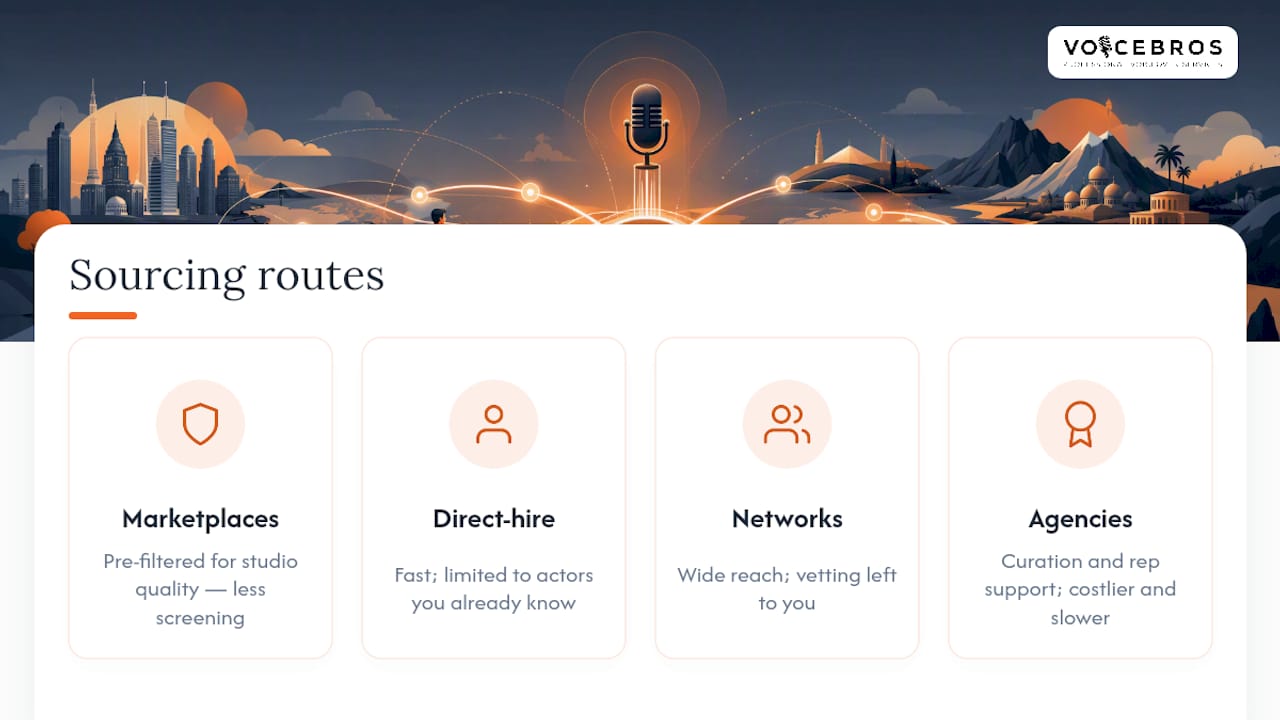
Your sourcing options generally fall into four categories, each with a real tradeoff. Vetted marketplaces filter for studio quality and professionalism upfront, so you spend less time screening. Direct-hire (going straight to an actor you've used before) is fast but limits you to who you already know. Casting networks and job boards reach a wide pool but leave the vetting work to you. Talent agencies bring curation and a hands-on rep, usually at a higher cost and slower turnaround.
Whichever route you pick, be specific about what you request in the audition itself. Casting notices for time-sensitive commercial work routinely require the same handful of items: a slate, two or three distinct tonal lanes, notes on tricky pronunciations, and explicit confirmation of recording setup, because rush specifications show these details prevent last-minute technical failures.
A custom audition, where talent records your actual script instead of sending a stock demo, is worth the extra day when the read depends on specific phrasing, a tricky brand name, or comedic timing that a generic demo can't demonstrate. Existing demos are usually enough when you're casting a straightforward category, like a standard e-commerce promo, where the tone is common and well-represented in most reels.
When you're evaluating submissions, listen past the "wow" take. Editability and category relevance matter more than a single showstopping line, because your editor needs options across pacing and emphasis once the spot goes into post.
Step 3: Pricing, Usage Rights, and Turnaround
Commercial voice-over quotes usually break into three components: a session or performance fee, a usage or buyout fee tied to how the spot will run, and any platform or agency fee layered on top. The session fee covers the recording itself. The usage fee is where most confusion happens, because it scales with media (broadcast TV, streaming, radio, digital), territory (local, national, global), and duration (a 3-month digital run costs less than a 2-year broadcast buyout).
Spell out media, territory, and term length in your brief before you ask for quotes, or you'll get numbers that aren't comparable to each other. A quote based on "digital only, 6 months, one country" isn't the same product as "broadcast plus digital, 2 years, national."
Rush turnaround costs more than standard turnaround, and it should. One real casting notice for a same-day home-recording rush job included pricing and usage terms right in the listing, which is worth noting: rush jobs increasingly spell out cost and rights upfront rather than leaving buyers to negotiate blind.
Contract items to lock down before you book:
- Delivery file format (typically WAV for broadcast, MP3 acceptable for digital-only)
- Number of included revisions before extra charges apply
- Invoicing terms and payment timing
- Kill fee if the campaign gets pulled after booking but before delivery
Step 4: Running Live Sessions and Remote Recording
Insist on live-directed sessions when timing needs to hit an exact cue, when a brand name or technical term needs repeated correction, or when the client wants to hear options in real time. Accept pre-recorded remote deliverables for most standard commercial work, since a well-briefed actor in a proper home studio can deliver broadcast-ready files without anyone on a call.
- Confirm technical specs before recording starts: sample rate (typically 48kHz for broadcast), file type (WAV), a clean slate, and a noise floor free of hum or room echo.
- Ask for a minimum of three takes per line, varying pace or emphasis slightly on each.
- Give direction in short, specific notes between takes rather than one long paragraph of feedback.
- Require clear file labeling (script name, take number, date) so nothing gets lost in a shared folder.
- Run a delivery acceptance pass, checking for clipping, breath noise, and mouth clicks before archiving the final files.
Pro Tip: Archive raw takes, not just the final edit. When a client wants a 6-month refresh with a slightly different tag line, having the original session on file means you can often re-cut instead of re-booking.
Producer Perspective: The Non-Obvious Priorities in Commercial Casting
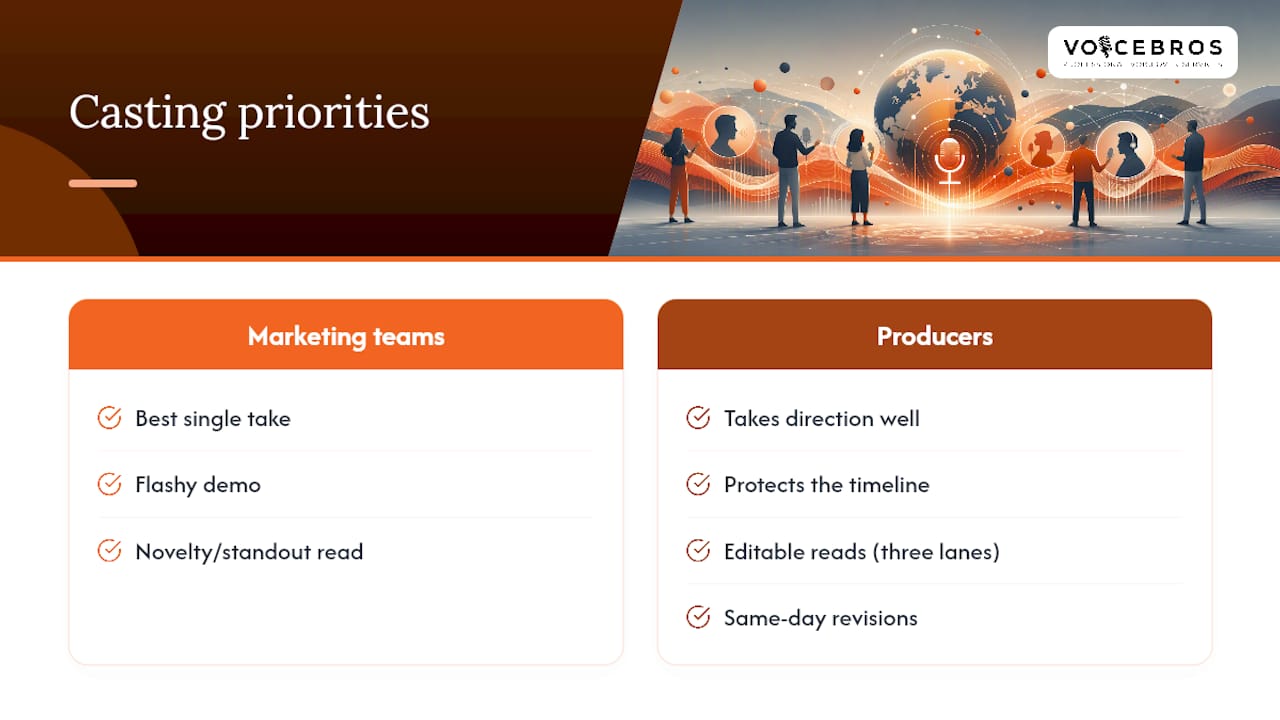
Most marketing teams cast for the best single take. Experienced producers cast for the actor who takes direction well and protects the timeline, because that trust factor determines whether a session runs smoothly or blows past its slot. A flashy demo means nothing if the actor can't adjust pacing on request or turn around a revision same day.
Editability beats novelty every time. The read that gives your editor three usable lanes is worth more than the one show-stopping line that only works in isolation. That's the real argument for a vetted marketplace: it removes the guesswork of whether an unknown actor can actually deliver under production conditions.
— Onur
A Faster Path to Casting Your Next Commercial
A vetted marketplace gets you past the guessing part of commercial voice casting. Instead of screening cold submissions or waiting on agency callbacks, you can filter vetted human voice actors by language, accent, category, and budget, then compare demos side by side before you spend a dollar.
Many talent profiles list usage terms upfront, reducing separate negotiation to clarify what a quote actually covers. Some marketplaces offer standard turnaround around 24 hours, which means a brief posted in the morning can come back with custom auditions the same day. Run your casting the way this guide laid out: write the role brief, shortlist actors on the commercial voice-over page, request custom reads, and book directly once you find the read that fits. Check current platform pricing before you build your budget, since fees are laid out plainly rather than buried in a negotiation.
Sources
- Commercial Voice Over Casting Guide | CJ Emerson
- VOICEOVER RUSH JOB (home recording tomorrow) - Casting Networks
FAQ
How Do You Get Into Voice Acting for Commercials?
Most actors start by building a short demo reel targeting one or two categories, like retail or corporate narration, then submitting to casting notices or joining a vetted marketplace where clients can find them directly. A broadcast-quality home studio is close to a requirement now, since most auditions happen remotely.
How Much Do Voice Actors Get Paid for a Commercial?
Pay varies widely based on usage scope. Session fees cover the recording itself, while usage or buyout fees scale up depending on media type, territory, and how long the spot runs, so a local digital-only ad and a two-year national broadcast campaign carry very different totals. Get an exact quote by specifying your media, territory, and term length before asking talent to bid.
Where Can You Get Voice Actors for a Commercial?
You can source talent through vetted marketplaces, direct-hire relationships, casting networks, or talent agencies, each with different speed and vetting tradeoffs. Voicebros lets you filter its roster of professional voice actors by language, accent, category, and budget, then compare demos before booking.
Who Are Some Famous Voice Actors Who Work in Commercials?
Many well-known commercial voices built recognition through long-running campaigns rather than screen credits, and plenty of working actors specialize almost entirely in ad work without seeking broader fame. Rather than chasing a recognizable name, focus your search on category experience and demo relevance to your specific brand tone.
What's a Realistic Timeline From Casting Brief to Final Delivery?
A rush commercial can move from posted brief to final delivered files in 24 to 48 hours if you request custom auditions and confirm technical specs upfront. A standard timeline typically runs about a week, giving you room to compare a wider set of auditions before booking the session.
Recommended
Need a voice over for your project?
Browse 1,500+ professional voice artists in 50+ languages, hear real demos and get instant word-based pricing on VoiceBros.
Related Posts
 General
5 Factors That Set Voice Over Usage Rights for Hirers and Talent
Practical, cross-audience guidance: the five factors that determine voice over usage rights and fees plus exact contract clauses for medium, territory,...
 General
Buyers: $250 to $3,500 Japanese Voice Over Rates and Line Item Budgets
See sample Japanese voice over budgets from $250 to $3,500, learn which license and production fees drive price, and get transparent line-item quotes from...
 General
48kHz WAV Masters Prevent Rework in Remote Voice Over Recording for Producers
Use a one paragraph brief, choose live or asynchronous workflow, and require a 48kHz WAV master. Hire vetted actors and avoid costly rework.
VoiceBros Team
The VoiceBros team is dedicated to providing high-quality voice over services and industry insights. With years of experience connecting voice artists with clients worldwide, we're passionate about helping you find the perfect voice for any project.
Back to Blog →