

48kHz WAV Masters Prevent Rework in Remote Voice Over Recording for Producers
Hire a vetted professional, send a one-paragraph voice brief, and require a raw WAV file at 48kHz before you commit. Decide upfront whether you need a live-directed session or an asynchronous turnaround, confirm usage and licensing in writing, and book through a platform like Voicebros that already screens its talent pool. That sequence, in that order, prevents nearly every costly re-record.
TL;DR:
- Using a vetted platform like Voicebros reduces the risk of costly re-recordings by ensuring talent screening and clear deliverables upfront.
- A detailed voice brief that states the goal, context, and technical requirements attracts quality talent and prevents misunderstandings during production.
- Choosing between live-directed or asynchronous recording depends on project scope, with hybrid options offering cost-effective flexibility and fewer revision cycles.
- Requesting WAV files at 48kHz/24-bit and confirming the setup beforehand guarantees audio quality suitable for broadcast or professional editing.
- VoiceBros' pre-screened talent pool and transparent pricing streamline hiring, cutting turnaround times and avoiding surprises in licensing or scope later.
Table of Contents
- Quick Hiring Checklist for Remote Voice Over Recording
- How Do You Write a Voice Brief That Attracts Pro Talent?
- Live-Directed or Asynchronous: Which Remote Workflow Fits?
- What Technical Specs Should You Require From Remote Talent?
- How Is Voice Over Pricing and Licensing Scoped?
- Directing a Remote Session Without Wasting Anyone's Time
- What Voicebros Brings to Remote Voice Over Hiring
- Hire a Vetted Voice Actor Through Voicebros
- Primary Sources for Hiring and Remote Recording
- Sources
- FAQ
Quick Hiring Checklist for Remote Voice Over Recording
Most bad hires trace back to a skipped step, not a bad actor. Before you post a casting call or message a voice artist directly, work through this list.
- Lock the script and confirm final runtime, since timed reads change the rate and the read.
- Write a one-paragraph brief covering audience, emotional goal, and a sample direction line.
- Decide live-directed or asynchronous recording before you request quotes.
- Spell out technical deliverables and ask for a raw, unedited sample first.
- Put usage and licensing terms in the brief, not in a follow-up email.
- Set turnaround expectations and define how many revision rounds are included.
- Confirm invoicing terms, payment schedule, and the cancellation policy before booking.
Pro Tip: Send the brief to two or three candidates before opening a public casting call. A tight, specific brief filters out mismatched talent faster than any audition round.
How Do You Write a Voice Brief That Attracts Pro Talent?
A thin brief gets thin auditions. Professional voice actors size up a job by how well the brief is written, and a vague one gets skipped or priced defensively. Industry guidance on hiring voice talent consistently points to the same fix: write more, not less, before you ever post the job.
- State the goal first. Say whether the read needs to sell, explain, reassure, or entertain. That single line shapes every performance choice that follows.
- Describe the listening context. A mobile pre-roll ad, a broadcast spot, and an in-store announcement all demand different pacing and energy.
- Give one paragraph of creative direction. Describe how the voice should relate to the listener, such as "a trusted neighbor explaining a repair" rather than "a friendly, professional tone."
- Confirm script status. Note whether the script is locked or whether you want custom audition reads against real lines from the project.
- List technical deliverables. Name the file format, sample rate, file naming convention, and delivery deadline.
- Spell out usage and licensing. State the media type, territory, and term so nobody discovers scope creep after delivery.
A strong brief attracts the right talent and repels the wrong ones, and professionals often return targeted auditions within a day of a well-written request. VoiceBros' sample scripts are a useful starting template if you're drafting a brief from scratch.
Live-Directed or Asynchronous: Which Remote Workflow Fits?
The workflow decision drives your budget, your timeline, and how much revision risk you're carrying. Get this wrong and you'll pay for it in rework, not in the original quote.
- Live-directed sessions matter most for animation, tight sync work, and high-stakes commercials where timing and tone need real-time adjustment.
- Live direction can eliminate several rounds of revisions, but it requires scheduling coordination and a low-latency connection such as Source-Connect if you want to give notes in real time.
- Asynchronous recording works well for e-learning modules, internal training, and lower-stakes explainer videos where speed matters more than moment-to-moment direction.
- Hybrid workflows are common: record async, then book a short directed pickup session only for the lines that need adjustment.
- Ask any candidate directly whether they support real-time remote direction before you assume it's available.
For a national broadcast spot with union constraints, agency or direct-hire routes make more sense than an open marketplace casting call; for most corporate and online projects, a marketplace approach gets you quality auditions faster.
What Technical Specs Should You Require From Remote Talent?
Post teams lose hours to mismatched files. Set the technical bar in the brief, not after the first delivery lands in your inbox.
- Request WAV masters at 48kHz/24-bit for anything headed to broadcast or professional editing; MP3 is acceptable only for quick web-only deliverables with no further post work.
- Ask for raw, uncompressed takes plus an edited master, and request split files by scene or line if your project needs it.
- Set clear file naming conventions and confirm mono versus stereo output before the session starts.
- Verify studio quality remotely by requesting a raw sample and asking about the actor's microphone, interface, and room treatment.
- If you need real-time direction, confirm the talent's low-latency setup in advance, since it affects scheduling on both ends.
Producer guides recommend requesting raw uncompressed files and confirming the recording setup before locking in a booking, and some also flag specific gear, like a Sennheiser MKH416 or comparable broadcast microphone, as a quick quality signal worth asking about.
How Is Voice Over Pricing and Licensing Scoped?
Two quotes for the "same" job rarely mean the same deliverable. Pricing tracks usage, turnaround, and post-production scope, not just script length.
- Base recording fee covers the performance itself, separate from everything else on this list.
- Usage license varies by media type, territory, term, and exclusivity, and this is often the biggest swing factor in price.
- Editing and mastering fees may be bundled or billed separately depending on the talent or platform.
- Rush fees apply for same-day or next-day turnaround requests.
- Pickup and revision charges should be defined before the session, not negotiated after.
Short commercial or explainer jobs typically deliver within 24 to 48 hours once the script and terms are final, while longer projects need a scheduled timeline agreed in advance. A low quote that skips editing or narrows the license scope can end up costing more once you request the missing piece later. Voicebros' pricing page breaks down how these factors interact for buyers comparing quotes.
Directing a Remote Session Without Wasting Anyone's Time
A well-run remote session feels almost boring, which is the point. Chaos in a session usually means someone skipped prep.
- Before the session, check levels, run a test read, and confirm the actor's room sound and mic position.
- During direction, give short, specific notes and approve work in small chunks rather than waiting until the end to react.
- Use reference reads sparingly to illustrate tone, not to make the actor imitate another performance line for line.
- Define pickups versus script changes before you start recording, so everyone agrees on what's billable later.
- After delivery, check file formats, naming, silence at head and tail, and match the final audio against the original brief.
If you don't have the bandwidth to manage auditions and direction internally, folding voice work into a managed production service often saves both time and money compared to running it ad hoc.
Pro Tip: Approve audio in chunks of three to five lines during a live session. Waiting until the full script is recorded to give feedback almost always triggers a costlier full re-record.
What Voicebros Brings to Remote Voice Over Hiring
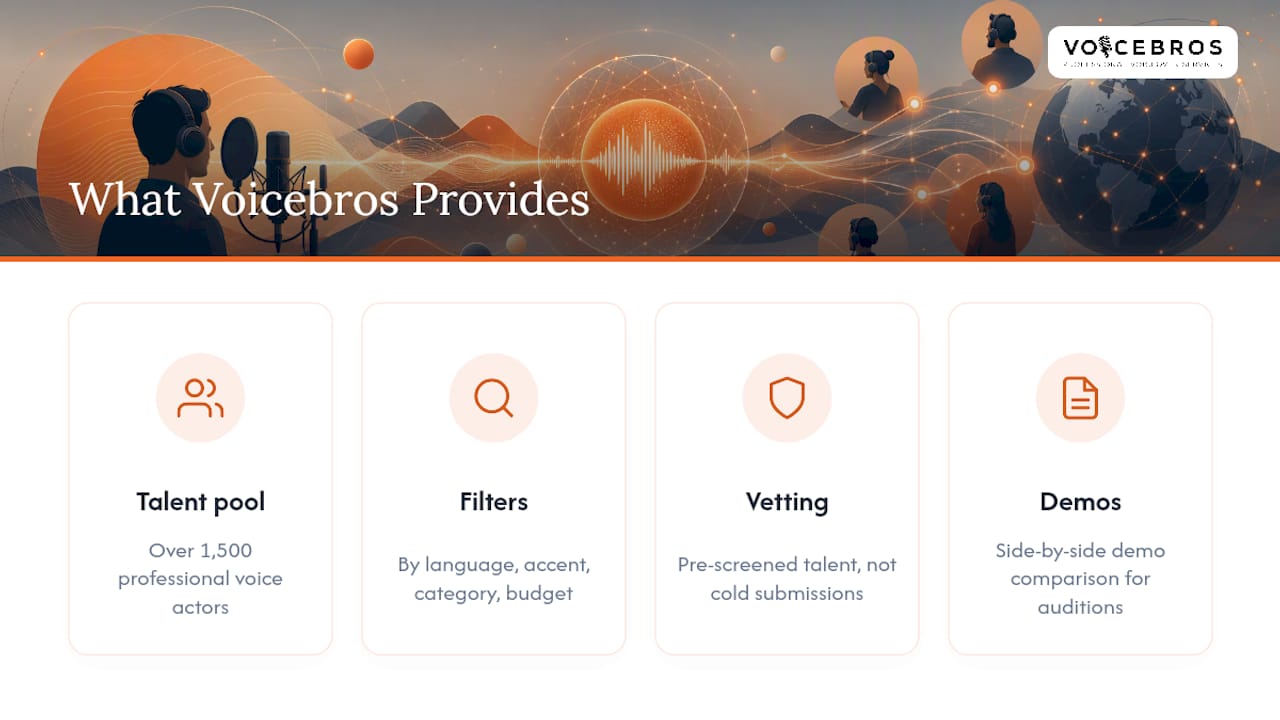
Voicebros connects clients with over 1,500 professional voice actors, which cuts casting time dramatically when you're working against a tight deadline. Filtering by language, accent, category, and budget narrows a large pool to a shortlist in minutes rather than days. The platform's vetting process and side-by-side demo comparison mean you're auditioning pre-screened talent, not sorting through cold submissions.
— Onur
Hire a Vetted Voice Actor Through Voicebros
Voicebros lists actors with transparent pricing and usage rights upfront, so you're not guessing what a quote actually includes.
Standard turnaround times are stated, and orders are invoiced automatically with no hidden line items added after the fact. You can preview and compare live demos before you commit a dollar, which shortens the decision cycle compared to waiting on cold outreach or agency scheduling. Browse the voice artist directory to compare demos by language, accent, and category, or check current voice over pricing to scope your project before you post a brief. If your project fits a specific category, from commercial spots to e-learning modules, the voice over services page breaks down what's available so you can match the right talent to the job and get a recording booked today.
Primary Sources for Hiring and Remote Recording
- BLARE Media's producer guide: technical specs, auditions, and directing remote talent.
- Marjan Design Store's hiring guide: writing briefs and scoping pricing.
- Trevor O'Hare's 2026 hiring outlook: turnaround times and session gear.
- Filmijob's remote interview guide: structuring remote sessions and technical checks.
Sources
- How to Work With Voiceover Talent: A Producer's Guide to Getting It Right the First Time - BLARE Media
- Finding Your Voice Actor for Hire: A Producer's Guide
- What to Expect When Hiring a Voice Actor in 2026 | Trevor O'Hare
FAQ
What File Format Should I Request for Remote Voice Over Recording?
Request WAV masters at 48kHz/24-bit for broadcast or editing work, since this preserves audio quality through post-production. MP3 is acceptable only for simple web-only deliverables that won't be edited further, and you should always request a raw, uncompressed sample before booking to check equipment quality.
How Long Does Remote Voice Over Turnaround Typically Take?
Short commercial or explainer projects usually deliver within 24 to 48 hours once the script and terms are locked. Voicebros lists a standard 24 hour turnaround for orders placed through the platform, with rush options available for tighter deadlines.
Should I Choose a Live-Directed Session or Async Recording?
Choose a live-directed session for animation, tight sync work, or high-stakes ads where real-time notes matter, and choose asynchronous recording for e-learning or lower-stakes projects where speed counts more than moment-to-moment direction. A hybrid approach, recording async and booking a short directed pickup, works well when budgets are tight but a few lines need fine-tuning.
What Should Be in My Voice Brief Before I Contact Talent?
Your brief should state the recording's goal, describe the audience and listening context, and include one paragraph of creative direction. It should also confirm script status, technical deliverables, and usage and licensing terms so the quote you receive is accurate and binding.
How Does Voicebros Vet Its Voice Actors?
Voicebros screens each of its over 1,500 voice actors before they're listed, and clients can compare live demo previews side by side before ordering. Filtering by language, accent, category, and budget lets you narrow the pool quickly, and every listing states pricing and usage rights upfront.
Recommended
Need a voice over for your project?
Browse 1,500+ professional voice artists in 50+ languages, hear real demos and get instant word-based pricing on VoiceBros.
Related Posts
 General
Book Better Voices in 20 Minutes: Voice Over Casting Brief for Producers
Draft a voice over casting brief in 20 minutes using a production tested checklist and two copy paste templates to attract auditions that actually fit...
 General
5 Factors That Set Voice Over Usage Rights for Hirers and Talent
Practical, cross-audience guidance: the five factors that determine voice over usage rights and fees plus exact contract clauses for medium, territory,...
 General
Paste Ready Voice Over Brief: 8 Fields to Prevent a Second Session
Paste ready checklist of eight fields commissioning teams must include in a voice over brief to avoid a second session and speed casting.
VoiceBros Team
The VoiceBros team is dedicated to providing high-quality voice over services and industry insights. With years of experience connecting voice artists with clients worldwide, we're passionate about helping you find the perfect voice for any project.
Back to Blog →