Ship Clean Dubs Fast: 4 Lip Sync Dubbing Steps for Producers
Lip sync dubbing is the process of recording dialogue in a target language and matching it, syllable by syllable, to an on-screen performer's mouth movements. It requires four hires and stages working together: script adaptation for viseme accuracy, casting for both timing and emotional range, a director-led recording session, and a mix that hides the seams. Skip any one of them and the dub reads as a dub.
TL;DR:
- Skipping adaptation or rushing through each dubbing stage significantly increases visible sync errors, especially in close-up shots requiring near-perfect lip matching.
- A viseme-aware script that considers mouth shape substitutions, condensation, padding, and reordering is crucial for natural-looking lip sync, with tight shot proximity needing stricter adherence.
- Casting must focus on timing, emotional range, and authentic native accents, while direction should prioritize sync with on-screen performance rather than original audio cues.
- Post-production techniques like pitch-safe stretching, resequencing, and beat alignment are essential for refining sync, especially when line lengths vary between languages.
- Comprehensive QA and clear revision plans prevent scope creep, ensuring that both technical alignment and emotional intent are preserved in the final dubbing.
Table of Contents
- What Is the Lip Sync Dubbing Process, Step by Step?
- How Do You Adapt a Script for Accurate Lip Sync?
- How Do You Cast and Direct Actors for Lip Sync?
- What Timing Tools and Techniques Lock In Sync?
- How Do You Mix and QA a Dub So It Feels Native?
- How Do You Review and Approve a Finished Dub?
- How Do You Choose a Lip Sync Dubbing Provider?
- How Do You Brief Voice Talent and Dubbing Directors?
- The VoiceBros Perspective on Hiring for Lip Sync Dubbing
- Getting Your Lip Sync Dubbing Project Moving
- Why Most Dubbing Complaints Trace Back to One Skipped Step
- Sources
What Is the Lip Sync Dubbing Process, Step by Step?
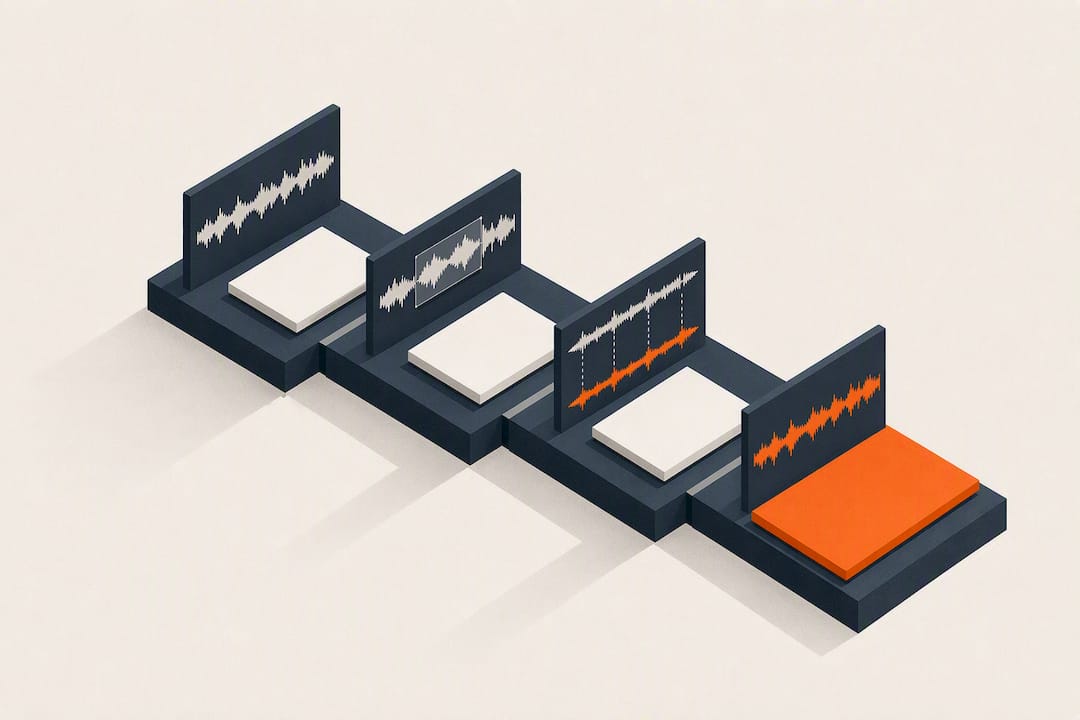
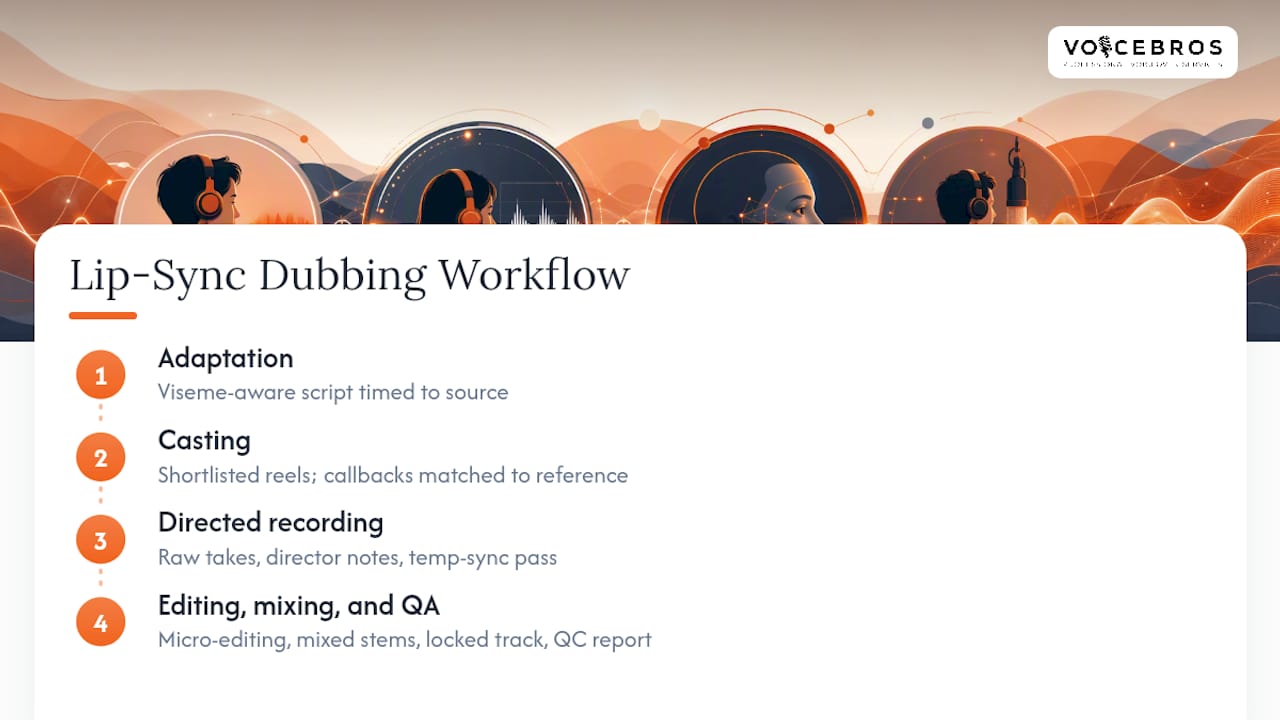
Every professional dub moves through the same four gates, and each one produces something the next stage depends on. Skipping a gate to save a week almost always costs two weeks in revisions later.
Adaptation. A bilingual adaptor rewrites the translated script with mouth shapes in mind, not just meaning. The deliverable is a viseme-aware script, timed line by line against the source dialogue.
Casting. Directors review actors for timing instinct, accent authenticity, and emotional range, not just vocal quality. This stage produces shortlisted audition reels and, often, a callback round matched against reference footage.
Directed recording. A session director runs actors through paced takes against picture, adjusting pacing and breath placement in real time. Deliverables here include raw takes, director's session notes, and a rough "temp sync" pass so producers can gut-check timing before the session ends.
Editing, mixing, and QA. Engineers tighten sync with micro-editing, then blend the new dialogue into the original ambient bed. The final deliverables are mixed stems, a locked dub track, and a QC report flagging any lines that missed frame-accurate sync. For detailed standards on these technical deliverables, see recording deliverables for engineers.
A large-scale academic study of dubbing practice found that skipping or rushing any of these stages, particularly adaptation, is one of the most common causes of visible sync failure.
Timelines vary widely. A 90-second commercial in one language might turn around in three to five business days. A feature-length e-learning series across six languages, with celebrity casting or a tight air date, can stretch past a month. The line items that push cost up fastest: name-brand talent, more target languages, and rush turnaround under 48 hours. Per-word pricing gives a clearer sense of how those variables stack before you commission a project.
How Do You Adapt a Script for Accurate Lip Sync?
A literal translation almost never fits the mouth. Viseme theory explains why: certain sounds, especially rounded vowels and bilabial consonants like p, b, and m, are visually obvious on screen, while others barely register. Viseme-based research on dubbed film shows that skilled adaptors treat these visible sounds as fixed points and build the rest of the line around them.
Four tactics do most of the work:
- Substitution. Swap a word for a synonym that shares the mouth shape of the original, even if it shifts the literal meaning slightly.
- Reduction and condensation. Trim a wordy phrase down to match a shorter mouth movement without losing the beat.
- Padding. Add a breath, a filler syllable, or a brief pause to stretch a line that would otherwise fall short.
- Reordering. Move clauses within the sentence so a stressed syllable lands on a visible mouth movement instead of a throwaway word.
Shot proximity changes how strict you need to be. Close-ups demand near-perfect labial matching, because the audience's eyes are locked on the mouth. Wide shots, quick cuts, or moments where a character's back is turned give the adaptor real room to prioritize meaning over mouth shape. This is a well-documented practice, not a shortcut: adaptors routinely favor visual match over exact gloss in tight shots and accept looser timing when the frame allows it.
Pro Tip: Build your script templates around this shot-proximity rule from the start. If you're preparing reference material for a translator, mark which lines are close-ups before the adaptation begins. Voicebros clients drafting their own scripts can pull structure ideas from sample script formats to see how professional layouts flag this.
How Do You Cast and Direct Actors for Lip Sync?
Casting for a dub is a different job than casting for a straight voice-over. Timing instinct matters as much as vocal quality. A caster needs to see whether an actor can hit a phrase inside a fixed window, land emotional beats without stretching the line, and, for multi-market projects, deliver a genuinely native accent rather than an approximation.
A tight casting brief covers:
- Language pair and required accent or dialect
- Emotional register across the full project, not just one sample scene
- Whether bilingual delivery is needed for any hybrid lines
- Availability for callback rounds against reference footage
Direction inside the booth is where sync actually gets made or lost. Netflix's published dubbing guiding principles recommend treating the on-screen image, not the original audio track, as the authority for timing decisions. That principle also extends to physical performance: live-action actors generally benefit from moving in the booth, mirroring the on-screen character's posture and gestures, while animation with pre-rendered mouth frames often demands stricter adherence to fixed timing.
Pro Tip: Ask any provider whether sessions are director-led in real time or handled as remote, deliverable-based takes. Live direction catches timing problems on the spot; remote workflows push that correction into a costlier revision round.
Set your retake and approval policy before the first session, not after you hear the first pass.
What Timing Tools and Techniques Lock In Sync?
Studios use a handful of physical and technical cues to keep every take frame-accurate. Actors record against a looping reference video with slate and roll markers visible, so both the actor and the director can call out timing drift the moment it happens.
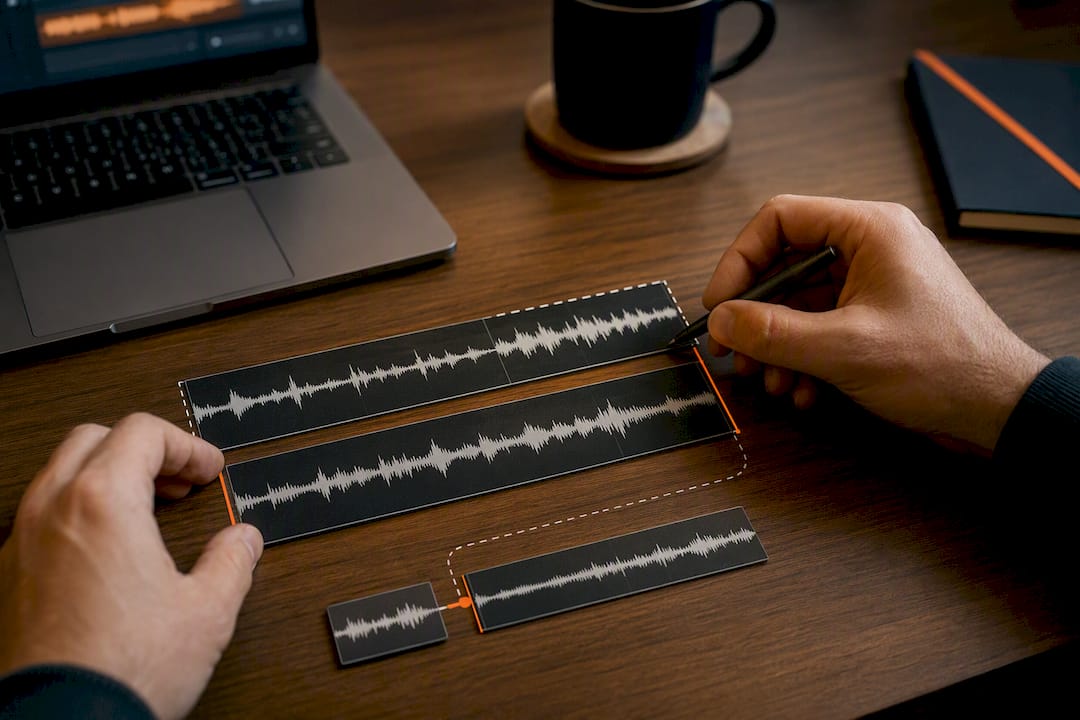
Once recording wraps, editors have several tools for tightening what the booth couldn't quite nail:
- Pitch-safe time-stretching, which speeds up or slows down a line slightly without changing the actor's pitch
- Cutting and resequencing, splicing together the cleanest segments from multiple takes into one continuous line
- Beat alignment, nudging a stressed syllable a few frames earlier or later so it lands on the matching mouth movement
Post-production guides for dubbed audio point to vowel extension and consonant compression as two of the most common micro-edits engineers reach for when a line runs long or short.
Automated stretching tools handle small timing gaps well, often anything under a few frames. Beyond that, the fix usually has to be manual. A director calling for a new take, or an editor resequencing footage by hand, catches problems that software alone will smooth over rather than solve. Industry troubleshooting guides list isochrony mismatch, meaning the translated line simply runs too long or too short, as the single most common technical cause of visible lip-sync error, and recommend exactly this mix of stretching, script revision, and manual editing as the fix.
How Do You Mix and QA a Dub So It Feels Native?
A mix that nails the words but ignores the room sounds worse than a slightly imperfect sync. The goal is matching reverb, room tone, and distance from the microphone so the new dialogue sits inside the original scene instead of floating on top of it. A line recorded in a dry booth and dropped into an echoing warehouse shot will always sound pasted in, no matter how tight the timing is.
A workable QA checklist before delivery:
- Review every close-up line frame by frame against the mouth
- Run a blind playback with someone unfamiliar with the project and ask if anything feels off
- Check ambient bed levels against the original scene's room tone
- Confirm stressed syllables land on visible mouth movements, not mid-word
There's a perceptual reason this level of scrutiny matters. The well-documented McGurk effect shows that viewers unconsciously process mismatched audio and visual speech cues as wrong, even when they can't articulate why. A dub that's off by a few frames doesn't just look sloppy; it triggers a low-grade sense that something is wrong with the whole scene. The most common failure mode is a line that's technically translated correctly but simply too long for the mouth movement. The fix is rarely a re-record. It's usually a script trim caught in QA before the client ever sees it.
How Do You Review and Approve a Finished Dub?
The revision process is where a lot of otherwise solid projects lose time, mostly because nobody defined what "approved" means before the first delivery. Set the review structure before recording starts, not after.
A workable review pass has three checkpoints. First, a technical QA pass, done by the studio, checking frame-accurate sync on close-ups and consistent ambient blending throughout. Second, a creative review, done by the client, checking that tone, emotional intent, and brand voice survived the translation and the timing compromises. Third, a combined sign-off round where both sides watch the final cut together, ideally with picture, not just the isolated audio track.
Build in one structured revision round as a default expectation, not an emergency measure. Vague feedback like "it doesn't feel right" wastes a round; timestamped notes tied to specific lines don't. Ask reviewers to flag exact timecodes rather than general impressions, and to note whether the issue is timing, performance, or translation, since each one routes to a different fix.
Watch for scope creep disguised as revision. A request to re-cast a role or rewrite a scene's tone is a new creative decision, not a sync fix, and it should be scoped and quoted separately from the technical revision round. Providers who blur that line tend to blow both budgets and deadlines on projects that started out perfectly reasonable.
How Do You Choose a Lip Sync Dubbing Provider?
The biggest red flag in a proposal is a flat per-minute rate with no mention of adaptation as a separate line item. If a quote doesn't distinguish translation from viseme-aware adaptation, the provider is likely treating dubbing as a translation job with a microphone attached, and the sync will show it.
Ask any provider these questions before signing anything:
- Who directs the session, and are they present in real time or reviewing takes after the fact?
- How many revision rounds are included, and what counts as a billable versus a covered fix?
- Can you hear a demo reel of dubbed work in the specific language pair you need, not just a general voice sample?
- What's the QA process before delivery, and does it include a review against picture?
A provider that can answer all four quickly, with specifics rather than general reassurance, is worth taking seriously. One that gets vague about who directs sessions or how revisions are scoped is telling you where the project will stall later. Platforms built around vetted talent pools, like Voicebros' voice artist directory, let you check actor demos and filter by language and accent before you commit to a full casting round, which cuts a lot of this guesswork out of the early stages.
How Do You Brief Voice Talent and Dubbing Directors?
A vague brief produces a vague performance, and directors can only work with what a script and reference notes give them. The strongest briefs give a director three things: the emotional arc of the scene, not just the literal line; explicit notes on which lines are close-ups requiring tight sync versus wider shots with more flexibility; and reference audio in the original language so the actor can hear pacing and tone before they read a single word.
Written notes matter more than a phone call you'll half remember later. Timecode every note. "Line 14, tighten the pause before the reveal" gets fixed in one take. "Make it feel more natural" gets a confused actor and a wasted round.
Give actors context beyond their own lines. An actor who understands why a character is lying in a scene delivers a different, better performance than one just matching mouth shapes to a script. If you're working across languages, note where a phrase in the original carries cultural weight that a direct translation would flatten, so the adaptor and director can solve it together rather than separately.
The VoiceBros Perspective on Hiring for Lip Sync Dubbing
Voicebros built its filtering system around exactly this problem: matching the right actor to a project's language, accent, category, and budget without weeks of blind outreach.
The platform's structure is designed to support the dubbing workflow by facilitating demo comparisons to speed casting, providing profiles to help assess accents, and including budget filters to inform quotes. A well-prepared brief, submitted through the voice-over services page, can help return a working shortlist of matched talent within a few days.
Getting Your Lip Sync Dubbing Project Moving
There are other ways to find dubbing talent, from full-service dubbing studios to freelance marketplaces built for generic voice-over work rather than sync-specific casting. What Voicebros offers instead is a direct route to vetted, sync-experienced actors without a lengthy studio onboarding process or a freelance search that leaves you guessing about accent quality.
Before you reach out, put together a brief with the essentials a casting team actually needs: your original video with locked picture, reference-language audio, the target language, notes on which moments are close-ups requiring tight sync, and any accent preferences tied to your audience. That single document turns a first-contact email into a working shortlist within days instead of a back-and-forth that eats a week.
Filtering by language, accent, category, and budget on the voice artist directory helps narrow a talent pool to realistic matches, and side-by-side demo comparison supports judging actual delivery rather than résumés. For teams juggling e-learning modules or IVR prompts alongside a dubbing project, the IVR voice-over page covers that adjacent need without a second vendor search. Check the pricing calculator for a budget range estimate, then submit your brief to begin receiving matched talent options.
Why Most Dubbing Complaints Trace Back to One Skipped Step
Most complaints about a "bad dub" aren't really about the actors. They're about a script adaptation step that got rushed or skipped, usually because someone treated the translation as the finish line instead of the starting point. I'd go further: the industry's obsession with AI dubbing tools has made this worse, not better, because it frames lip sync as a technical alignment problem when it's mostly a writing problem wearing a technical disguise.
The uncomfortable truth is that a great actor reading a badly adapted script will still produce a dub that feels wrong, no matter how many takes or how much time-stretching gets thrown at it in post. Conversely, a merely good actor working from a script that respects viseme timing and shot proximity will often outperform a flashier actor stuck fighting bad material. Producers who understand this stop shopping for "the best voice" and start shopping for the right adaptation-to-casting pipeline, which is a completely different hire.
The other pattern worth naming: teams that treat the revision round as damage control instead of a planned stage. Build the review checkpoints into the schedule from day one, and a dub that needs one clean revision pass looks like a smooth project. Bolt revisions on as an afterthought, and the exact same amount of fixing looks like a crisis. The work is identical. Only the planning changes how it feels.
— Onur
Sources
- Dubbing in Practice: A Large-Scale Study of Human Dubbing
- Dubbing guiding principles — Netflix
- Viseme-based analysis of lip synchrony (Koverienė et al., 2020)
- Mastering dubbed audio: techniques to sync sound seamlessly in post-production — SoundCy
Recommended
Need a voice over for your project?
Browse 1,500+ professional voice artists in 50+ languages, hear real demos and get instant word-based pricing on VoiceBros.
Related Posts
 General
Creators: When to Use Subtitles vs Dubbing for Reach or Immersion
Decide whether subtitles or dubbing suit your next video. Learn how accessibility, Gen Z sound off habits, budget, platform, and turnaround should steer...
 General
Audio Description or Voice Over: 3 Questions Producers Must Ask
Learn when to choose audio description or voice over, follow WCAG and broadcast rules, and brief describer-trained talent so your accessibility pass succeeds.
 General
Audiobook Narrator Rates for Authors: PFH Math & 40k–120k Sample Budgets
Learn the PFH formula, see 40k–120k sample budgets, and get vetted VoiceBros narrator quotes so authors can estimate audiobook production costs quickly.
VoiceBros Team
The VoiceBros team is dedicated to providing high-quality voice over services and industry insights. With years of experience connecting voice artists with clients worldwide, we're passionate about helping you find the perfect voice for any project.
Back to Blog →