Creators: When to Use Subtitles vs Dubbing for Reach or Immersion
Choose subtitles when you need speed, low cost, and broad accessibility. Choose dubbing when immersion and a native listening experience matter more than budget. Most creators split the difference by market and platform: subtitles for social and e-learning, dubbing for theatrical releases and premium narrative content, and AI-assisted dubbing when you need both scale and a natural voice.
TL;DR:
- Subtitles support language learning, accessibility, and higher engagement, but they are limited by reading speed and may lose nuance with dense dialogue.
- Dubbing provides better immersion, especially for children’s and action content, but involves higher costs, longer turnaround, and variable quality.
- AI-assisted dubbing offers a middle ground by reducing costs and production time while maintaining some vocal characteristics, but it’s less precise than full studio dubbing.
- Platforms with vetted voice talent simplify adding professional dubbing or voiceover, especially for multiple languages or quick turnaround projects.
- The choice between subtitles and dubbing depends on audience, platform, budget, and content complexity, with subtitles being the default for speed and reach.
Table of Contents
- Subtitles vs Dubbing at a Glance
- Why Subtitles Help—and Where They Fall Short
- Why Dubbing Can Be Better—and Its Trade-offs
- Production Notes: Workflows, Costs, and Turnaround
- What the Research Says About Subtitles and Viewing Habits
- How to Choose Between Subtitles and Dubbing
- Final Verdict: Matching Method to Content Type
- What Subtitles and Dubbing Actually Are
- A Publisher's View on Choosing the Right Method
- Get Professional Voice Talent for Your Next Project
- Sources
Subtitles vs Dubbing at a Glance
The core trade-off comes down to how a viewer processes the content: subtitles ask the eyes to do extra work, dubbing asks the ears to accept a substitute voice. That single difference drives almost every downstream decision about cost, speed, and audience fit.
- Viewer experience: Subtitles require reading while watching; dubbing replaces the original audio track entirely, so the viewer just listens.
- Immersion: Dubbing generally wins here, since the audience never has to look away from the visuals to follow dialogue.
- Cost and turnaround: Subtitles are the cheapest and fastest localization method, while traditional dubbing is the costliest and slowest because of casting, direction, and studio mixing.
- Accessibility: Subtitles serve deaf and hard-of-hearing viewers directly; dubbing does not, though it can pair with subtitles for full coverage.
- Learning value: Subtitles support vocabulary and listening comprehension in a second language; dubbing offers no equivalent benefit.
- Best use cases: Social clips, e-learning, and documentaries lean subtitles. Feature films, kids' content, and character-driven series often lean dubbing.
For corporate training and IVR-style content, the choice usually comes down to whether the material needs to feel local or just needs to be understood.
Why Subtitles Help—and Where They Fall Short
Subtitles are not just a budget fallback. The evidence for their cognitive benefits is substantial: a synthesis of over 100 empirical studies found captions and subtitles improve comprehension, attention, and memory across a wide range of viewers, not only those who are deaf or hard of hearing.
Where subtitles clearly win:
- Accessibility reach. Subtitles are the baseline requirement for deaf and hard-of-hearing audiences and a legal expectation on many broadcast and streaming platforms.
- Sound-off viewing. Commuters, office workers, and gym-goers watch video muted constantly, and subtitles are the only way that content lands.
- Language learning. Subtitled content supports vocabulary growth and listening skills in both children and adult learners of a second language.
- Engagement and discovery. Captioned videos see measurably higher view completion and discovery on social platforms.
Captioned videos on platforms like YouTube have shown a 13.48% lift in views within the first two weeks compared with uncaptioned uploads, and that gap tends to persist over a video's lifetime.
Subtitles have real limits, though. Reading speed caps how much dialogue you can pack into a line before viewers fall behind. Dense scenes with fast, overlapping dialogue get flattened into short, simplified lines that lose tone and humor. Cultural references, wordplay, and idioms are hard to translate on a tight character count, so nuance often gets sacrificed for readability.
Why Dubbing Can Be Better—and Its Trade-offs
Dubbing wins when the goal is total immersion. The viewer never splits attention between reading and watching, which matters most for children's programming, action-heavy content, and any audience with low reading fluency in the target language. In several major non-English markets, dubbed content is simply the cultural default. Viewers there consider dubbing the "native" way to watch foreign film and television, not a compromise.
That immersion comes at a price, and not just a financial one.
- Cost and complexity. Dubbing requires casting voice talent, directing performances, booking studio time, and mixing final audio. That's a fundamentally more involved production chain than syncing text to a timeline.
- Performance risk. A mistranslated line or a mismatched voice actor can flatten an original performance's emotional range, even when the lip sync is technically clean.
- Quality variance. Dubbing quality swings widely depending on budget, director skill, and how much time the studio gives actors to match timing and tone.
- Scaling cost. Every additional target language multiplies casting, direction, and studio expense in a way subtitling simply doesn't.
Between full dubbing and plain subtitles sits a middle tier: voiceover narration and AI-assisted dubbing. Voiceover is cheaper than full dubbing but loses lip-sync precision and often uses a single narrator voice instead of a full cast. AI dubbing tries to close that gap by preserving a speaker's vocal characteristics while automating lip-sync timing, cutting cost and turnaround without a full studio production.
Production Notes: Workflows, Costs, and Turnaround
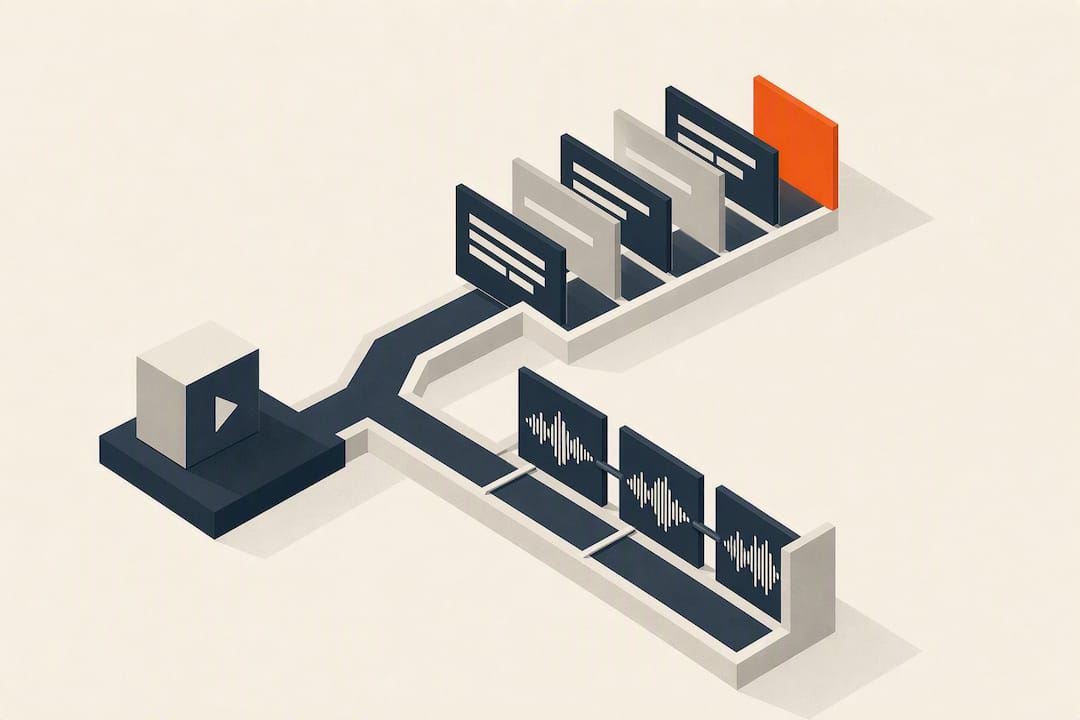
Subtitling moves fast because the workflow is linear: transcribe the source audio, translate the script, time each line to the video, then run a quality check for reading speed and line breaks. No casting, no studio booking, no audio mixing. That's why subtitles stay the cheapest and fastest localization option.
Dubbing workflow adds several stages before you even get to recording:
- Casting voice talent that matches the character's age, tone, and accent.
- Script adaptation so translated lines fit the actor's mouth movements and timing, not just the meaning.
- Studio recording and direction, often with multiple takes per line.
- Audio mixing to blend the new dialogue track with existing music and sound effects.
Costs scale fastest with two variables: the number of target languages and how strict the lip-sync requirement is. A single-language subtitle pass on a short video might take a day. A multi-language dub with tight lip-sync for a theatrical release can take weeks per language. Voiceover projects like e-learning modules, corporate training, and IVR scripts sit in a faster middle lane. You can review sample workflows and rate ranges for professional voice-over services before committing to a full production.
Pro Tip: Pilot one language and one platform first. Test how your subtitle timing or dubbed audio actually performs on the specific device and app your audience uses before you scale to ten languages and find out the lip-sync breaks on mobile.
What the Research Says About Subtitles and Viewing Habits
The comprehension research is consistent across decades: subtitled and captioned content measurably helps viewers understand and retain what they watch. The PMC review's over 100 studies span age groups, native and non-native speakers, and both entertainment and educational content.
The generational shift toward sound-off viewing has made this evidence practically urgent. Usage data cited by accessibility researchers shows up to 80% of viewers aged 18 to 24 use subtitles some or all of the time, often regardless of whether they need them for hearing access. An eye-tracking study in PLOS ONE found that younger viewers frequently choose subtitles specifically for focus in noisy environments or when sound simply isn't an option, and that this changes gaze patterns and cognitive load compared with sound-on viewing.
- Subtitled content supports vocabulary growth and listening comprehension in learners acquiring a second language.
- Younger audiences treat subtitles as a functional tool for attention, not just a translation aid.
- Captioned video shows measurable gains in reach and completion rate on social and streaming platforms.
For anyone building a language-learning habit around video, pairing subtitled shows with active listening is a well-documented approach worth exploring through resources like this guide on learning a language through music videos. The practical implication for creators: if your audience skews under 25 or watches primarily on mobile, subtitles aren't optional. They're the default viewing mode.
How to Choose Between Subtitles and Dubbing
Run through these questions before committing budget to either method.
- Who is the audience, and how do they watch? If viewers are mobile-first, commuting, or under 25, default to subtitles. Older, home-viewing audiences in markets with a strong dubbing culture may prefer dubbed audio.
- What platform and device dominate distribution? Social feeds and muted autoplay favor subtitles. Streaming platforms and broadcast TV can support either, depending on regional norms.
- What's the budget and timeline? Tight budgets and fast deadlines point to subtitles or AI-assisted dubbing. Full studio dubbing needs real lead time and a bigger line item.
- Does accessibility or legal compliance apply? If so, subtitles are close to mandatory, and they pair well with any dubbed version rather than replacing it.
- Does the content depend on performance nuance? Emotionally complex drama or comedy timing often survives better with subtitles preserving the original performance, while action and children's content tolerate dubbing well.
Pro Tip: Before greenlighting a full-scale dub, produce one scene both ways and show it to a small sample of your actual target audience. Their reaction will tell you more than any production estimate.
Final Verdict: Matching Method to Content Type
Subtitles remain the safer, faster default for most digital content, especially where accessibility and sound-off viewing dominate. Dubbing earns its higher cost when immersion, cultural nativeness, or a low-literacy audience matters more than speed. Think accessibility-first, then layer in dubbing where the audience and budget genuinely support it.
- Social and short-form video: Subtitles, for reach and sound-off viewing.
- E-learning and corporate training: Subtitles or professional voiceover narration.
- Documentaries and interviews: Subtitles, to preserve authentic voices.
- Theatrical film and TV for mass markets: Dubbing, often paired with subtitle options.
- Kids' programming: Dubbing, since young viewers can't reliably read fast subtitles.
What Subtitles and Dubbing Actually Are
Subtitles are timed text overlays that display translated or transcribed dialogue on screen while the original audio track keeps playing. The viewer reads the words and hears the original actors' real voices, accents, and emotional delivery at the same time.
Dubbing replaces the original audio track entirely. Voice actors record new dialogue in the target language, and audio engineers sync that new track to the actors' mouth movements as closely as possible, then mix it against the existing music and sound effects.
That distinction explains most of the pros and cons already covered. Subtitles preserve the source performance but demand reading. Dubbing sacrifices the original voice but removes the reading burden entirely. A third category worth naming clearly: voiceover. Voiceover narration adds a new audio track over or alongside the original, common in documentaries and corporate videos, without attempting full lip-sync. It's a distinct discipline from dubbing, even though people sometimes use the terms interchangeably.
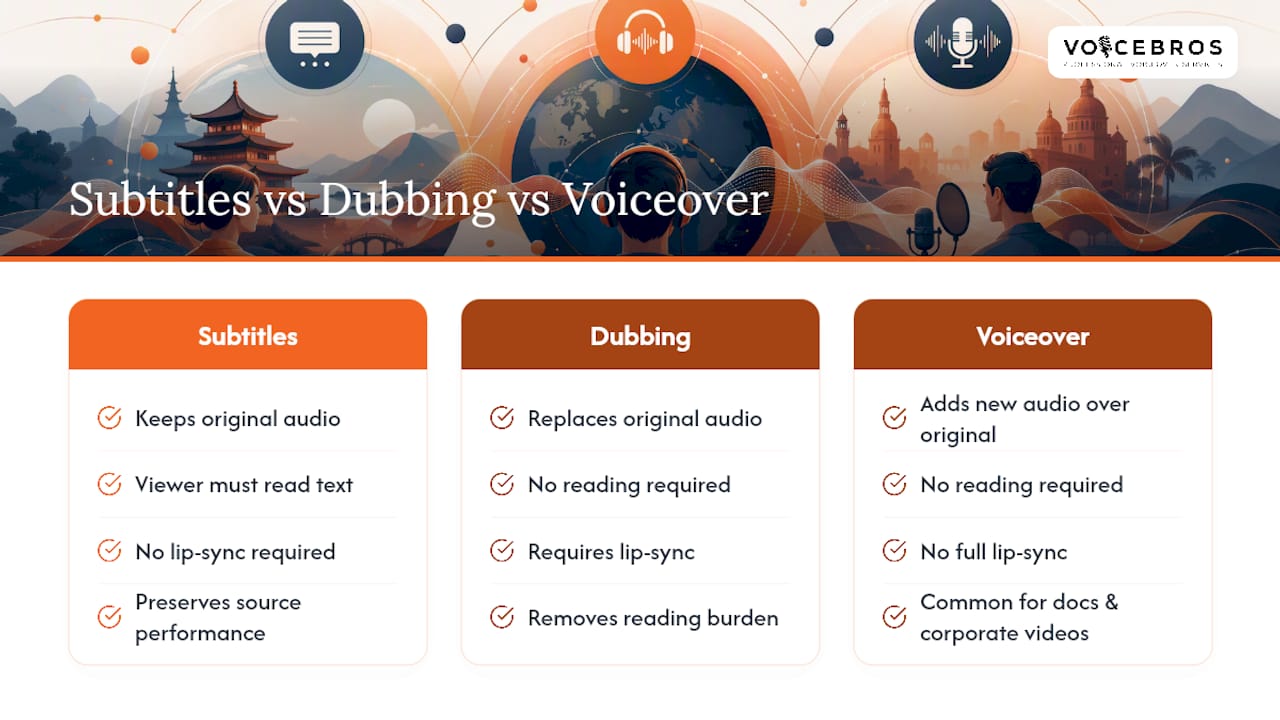
Understanding which category a project actually needs, subtitles, dubbing, or voiceover, is the first real decision point in any localization plan, well before anyone discusses vendors, cost, or timeline.
A Publisher's View on Choosing the Right Method
Every format has a job it does better than the others, and the mistake most teams make is picking one method for every project instead of matching the method to the content. Subtitles are the right default when speed and reach matter most. Dubbing earns its cost when a story needs to disappear into a new language rather than sit visibly translated on screen.
The platform connects clients with a large pool of professional voice actors, filterable by language and accent, to streamline the search for the right voice. Every actor on the platform goes through a vetting process, which is part of why Voicebros maintains a 98% satisfaction rate across thousands of completed projects. Pricing runs transparently through a per-word calculator, so budgeting doesn't require guesswork.
As a practical rule: use an automated tool for quick drafts or internal reviews, but hire a professional voice actor whenever the final product represents your brand publicly.
— Onur
Get Professional Voice Talent for Your Next Project
If you've decided dubbing or voiceover is the right call, the next question is where to find talent that won't blow your timeline or your budget. The platform functions as a marketplace of vetted voice actors filterable by language, accent, category, and budget, simplifying the process of finding suitable talent.
Whether you need a full dubbing cast, a single narrator for e-learning, or an IVR script recorded in three languages, the platform's voice-over services cover commercials, audiobooks, corporate training, and dubbing projects side by side. Compare demos directly, check rates with the pricing calculator, and get a quote before you commit to a production timeline.
Sources
- Video captions benefit everyone — PMC
- Watching subtitled videos with the sound off affects viewers’ comprehension, cognitive load, immersion — PLOS ONE
- Benefits of captions | USU accessibility
- AI dubbing vs subtitles vs voiceover | sync. labs blog
Recommended
Need a voice over for your project?
Browse 1,500+ professional voice artists in 50+ languages, hear real demos and get instant word-based pricing on VoiceBros.
Related Posts
 General
Audiobook Narrator Rates for Authors: PFH Math & 40k–120k Sample Budgets
Learn the PFH formula, see 40k–120k sample budgets, and get vetted VoiceBros narrator quotes so authors can estimate audiobook production costs quickly.
 General
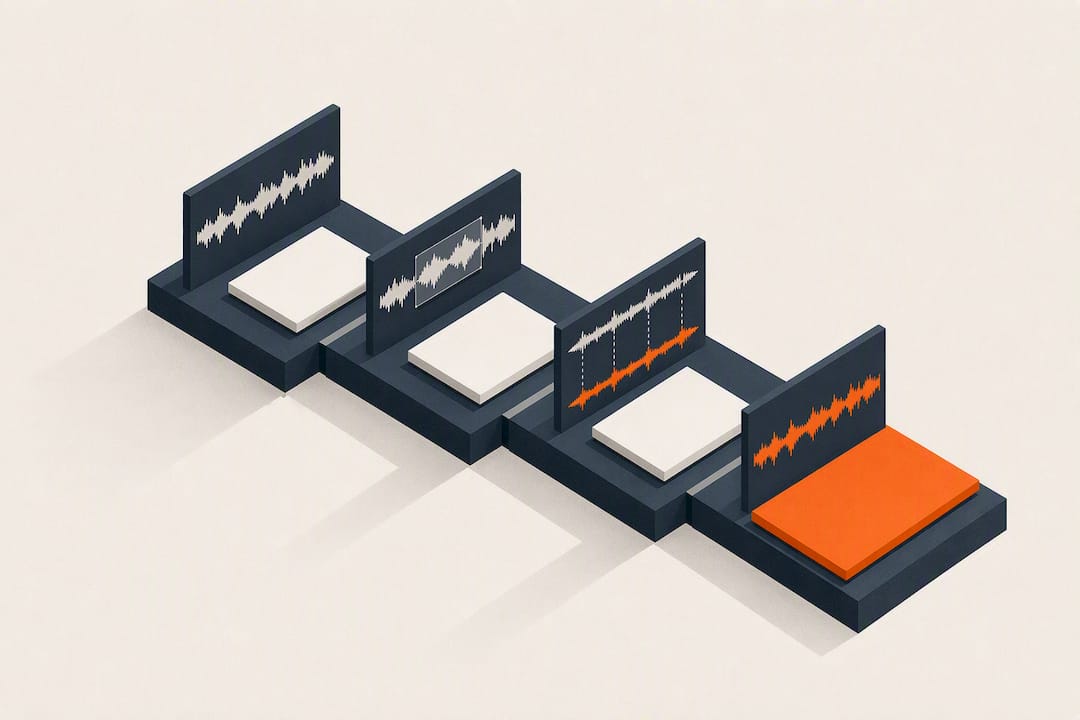
Ship Clean Dubs Fast: 4 Lip Sync Dubbing Steps for Producers
A producer's guide to lip sync dubbing. Use four production stages: adaptation, casting, directed recording, and mixing to avoid visible sync errors and...
 General
4 Projects Hiring Managers Should Hire a Neutral Accent Voice Over
Hire the right neutral accent voice over: demo check criteria, a ready to paste brief, and a filtered marketplace to find vetted talent fast.
VoiceBros Team
The VoiceBros team is dedicated to providing high-quality voice over services and industry insights. With years of experience connecting voice artists with clients worldwide, we're passionate about helping you find the perfect voice for any project.
Back to Blog →