
Creators: 150 WPM Timing and Formatting for Voice Over Script Writing
Write for the ear, not the eye: pick one core message and shape every line so it sounds natural out loud, not just readable on a page. Before you type a word of dialogue, run through a short pre-writing checklist covering your audience, your message, your call to action, and your target length. Everything else in this guide builds on that one habit.
TL;DR:
- Scripts should be timed to about 65-70 words for a 30-second spot to allow natural pacing and pauses, rather than aiming for an exact word count.
- Use clear pronunciation cues, emphasis markers, and short parentheticals to guide voice actors without micromanaging their performance.
- Perform a read-aloud test to catch awkward phrasing, pacing issues, and to confirm the timing aligns with the intended delivery duration before studio recording.
- Format scripts in a straightforward, two-column audiovisual layout for videos with visuals or simple narration for audio-only projects to improve accuracy and reduce revisions.
- Always connect with vetted voice actors through specialized platforms, providing well-formatted, thoroughly timed scripts for higher-quality, first-take recordings.
Table of Contents
- What Belongs in Your Pre-Writing Checklist?
- How Do You Write a Voice Over Script People Actually Want to Hear?
- How Many Words Per Minute Should a Voice Over Script Target?
- How Should You Format a Script for Voice Actors?
- What Should You Check Before Booking Studio Time?
- How Does a Vetted Marketplace Turn a Script Into a Finished Recording?
- The One Habit That Fixes Most Script Problems
- Where to Hire Voice Talent or Test Your Script
- Sources
What Belongs in Your Pre-Writing Checklist?
A voice over script goes wrong long before the first sentence gets written. It goes wrong when the writer skips the planning stage and starts typing whatever comes to mind. Identifying the core message, the audience, and a single call to action before drafting keeps a script from getting overstuffed with competing ideas.
Run through these four questions before you open a blank document:
- Audience and emotional target: Who is listening, and what do you want them to feel by the end? A calming e-learning module and a hyped-up product launch need entirely different emotional arcs.
- One takeaway, one CTA: Pick the single thing you want the listener to remember and the one action you want them to take. Scripts that try to sell three benefits usually sell zero.
- Tone: Warm and conversational, brisk and energetic, or measured and authoritative. Choose one and stay there.
- Length and platform: A 15-second pre-roll ad and a 5-minute training module are different writing problems. Know the runtime and where the audience will hear it (headphones, a phone speaker, a hold queue) before you draft a single line.
Skip this stage and you'll be rewriting the whole script later, after a voice actor points out that it says three different things at once.
How Do You Write a Voice Over Script People Actually Want to Hear?
Good voice over script writing sounds like a person talking, not a document being read. That distinction sounds obvious until you sit down and start writing "utilize" instead of "use," or stacking three subordinate clauses into one sentence because it looked fine on the page.
Here's the tactical playbook that separates scripts actors love to read from scripts that get flagged for revisions:
- Write like you speak. Use contractions. Use "you" and "we." Read your draft out loud and notice every spot where you'd naturally say it differently than you wrote it. That gap is where the script needs editing.
- Hook fast, then get to the point. Listeners decide whether to keep paying attention within the first few seconds, so open with the benefit or the surprise, not a throat-clearing setup. This matters even more in short-form audio, where attention spans research consistently shows a hook-first opening outperforms a slow build.
- Aim for 15 to 20 words per sentence, then break the pattern. That range reads naturally at a conversational pace. But if every sentence lands at 17 words, the read turns into a metronome. Mix in a four-word punch line after a longer sentence.
- Use pauses and transitions instead of over-explaining. A beat of silence after a key line does more work than another sentence restating the same point. Cut any line that just repeats what the visuals or the previous sentence already said.
- Keep one consistent voice. Decide whether the script is friendly, urgent, or clinical, and don't let it drift halfway through. A script that opens breezy and closes with legal-disclaimer stiffness reads like two different writers handed off mid-paragraph.
Pro Tip: Read your script into your phone's voice memo app and play it back before you send it anywhere. Your ear will catch clunky phrasing that your eyes glide right past.
How Many Words Per Minute Should a Voice Over Script Target?
Timing is where most first drafts fall apart. Writers often draft to a word count that feels right on the page, then discover in the booth that it runs 15 seconds over. The standard benchmark: a typical read pace lands around 150 words per minute, which means a 60-second commercial script should land close to 150 words, and a 30-second spot closer to 75.
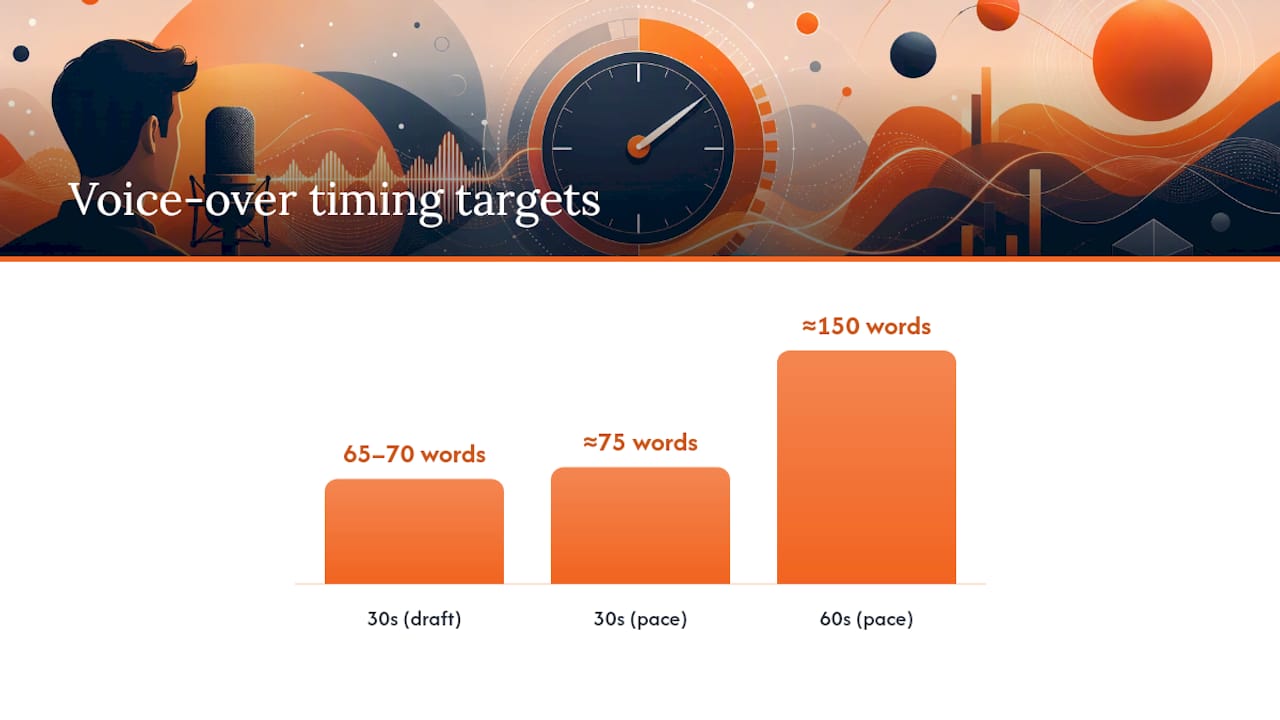
That 150 WPM figure is a starting point, not a fixed rule. Delivery style shifts the math:
Use these ranges as targets, then write slightly under them. A voice actor needs room to breathe, land emphasis, and let a pause do its job, and a script timed to the exact second leaves zero room for any of that. If your 30-second slot allows 75 words at pace, draft to 65 or 70. Segment templates that follow this logic: 15 seconds runs roughly a moderate number of words, 90 seconds runs a substantial range appropriate for the duration, and anything past two minutes should be broken into scenes with its own mini-arc, so pacing doesn't sag in the middle.
How Should You Format a Script for Voice Actors?
Formatting isn't decoration. A well-formatted script, with pronunciation guides, emphasis cues, and pause indicators, cuts down on studio revisions and saves production costs. A voice actor who has to guess how to say a brand name or where a joke lands will guess wrong at least once, and that's a re-record.
The choice between formats depends on whether visuals exist:
- Single-column narration works for audiobooks, podcast intros, and IVR prompts, where there's no picture to sync against.
- Two-column A/V format is the standard whenever visuals matter, because it lines up what's on screen against what's being said at that exact moment, which is essential for keeping audio locked to picture beats in explainers, product demos, and ads.
- Mark pronunciation with simple phonetic spelling in parentheses right after the tricky word, not in a footnote the actor has to hunt for.
- Use bolding or italics for emphasis, sparingly, rather than ALL CAPS, which reads as shouting and actually confuses pacing more than it clarifies it.
- Add short parentheticals for tone or pause like (beat) or (warmly), and trust the actor to interpret them rather than scripting every breath.
Direction should guide performance without micromanaging it. One or two words of tone cue beats a paragraph of stage direction every time.
What Should You Check Before Booking Studio Time?
The read-aloud pass is the single most effective quality check in the entire process. Reading a script out loud exposes tongue-twisters, awkward pacing, and phrasing that looked fine on the page but trips over itself in the mouth, and it does it in minutes, before anyone's booked studio time.
Before you send a script to talent, work through this:
- Read every segment aloud and time it against your WPM target for that delivery style.
- Cut any sentence that repeats a point already made. If it doesn't earn its place, it's dead to weight the actor has to carry.
- Confirm the call to action is specific and impossible to misread. "Visit us today" is weaker than naming the exact action you want taken.
- Label script versions clearly (v1, v2, "client revision") so nobody records from a stale draft.
- Attach a reference clip or tonal exemplar if you have one. Describing "friendly but confident" in words leaves more room for misinterpretation than a 20-second audio clip does.
Pro Tip: Time yourself reading the script cold, without rehearsing it first. That first, unpolished read is the closest simulation of what a voice actor will do on their first take.
How Does a Vetted Marketplace Turn a Script Into a Finished Recording?
A script is only half the job. The other half is getting it into the hands of someone who can perform it well, on the first take. Voicebros connects clients with more than 1,500 vetted voice actors, filterable by language, accent, category, and budget, so a script written for a calm e-learning module doesn't end up read by someone who only does hard-sell retail spots.
The formatting work you just did pays off directly here. A script with pronunciation notes, timestamps, and clear tonal direction gives an actor everything needed to nail a take without a round of clarifying emails first. That's the difference between a same-day turnaround and a week of back-and-forth. It's also worth knowing when a quick AI-generated read is enough for an internal draft versus when the project needs a professional actor's timing and emotional range, particularly for anything client-facing or brand-critical.
The One Habit That Fixes Most Script Problems
Most weak scripts fail for the same three reasons: they cram too many messages into too little time, they read like copy instead of speech, and the tone drifts halfway through. I've found that a single habit catches nearly all of it: after your first draft, do a timed read-aloud pass before you touch anything else. Don't edit while reading. Just read, time it, and notice where you stumble. Every stumble is a rewrite waiting to happen. Writers who skip this step are the ones sending scripts back for a second and third revision.
— Onur
Where to Hire Voice Talent or Test Your Script
Once your script is timed, formatted, and read-aloud tested, the next decision is who performs it. AI-generated voices can be useful for a rough internal draft or a quick pacing test, but human actors still bring the timing, emphasis, and emotional read that scripts for commercials, narration, and brand work depend on, especially anywhere your audience is meant to feel something.
Voicebros is built for exactly this handoff. Instead of auditioning blind, you filter 1,500+ vetted voice actors by language, accent, category, and budget, then compare demo reads side by side before you commit. That side-by-side comparison is what most freelance marketplaces skip, and it's the difference between guessing at a fit and hearing it before you book. Browse voice over services for commercials, e-learning, and IVR projects, check the pricing calculator to budget your project, or if your script is a phone prompt, look at ready-made IVR scripts built for that exact format. Upload your finished, formatted script and start comparing actor demos today.
Sources
For deeper formatting reference, ScriptReaderPro's breakdown of voiceover notation explains how professional scripts mark (V.O.) cues. If you want practice material, Voicebros keeps a library of sample scripts across categories, and Edge Studio's free training scripts are useful for rehearsal, though not for commercial reuse. For syncing narration to visuals, Kudoflix's video editing tools for independent creators are worth a look once your two-column A/V script is locked.
- How to write a voiceover script for your brand — Trevor O'Hare
- How to write a voiceover script that reduces revisions and saves money — RealVOTalent
- How to write a voice over script that truly connects — Project Aeon
Recommended
Need a voice over for your project?
Browse 1,500+ professional voice artists in 50+ languages, hear real demos and get instant word-based pricing on VoiceBros.
Related Posts
 General
Nail 3 Brief Details Before Hiring a Voice Actor
Define audience, placement, and rights first. Follow a five-step workflow and use a vetted marketplace for targeted auditions and delivery protection.
 General
Marketers: 5 Questions to Choose Translation vs Transcreation for VO
Five quick questions for marketers to choose translation or transcreation, with hybrid workflows and voice over guidance for ads and scripts.
 General
Choose Human, AI, or Hybrid Voice Over Translation in Days, Not Weeks
Production guide to voice over translation: five key production stages, when to pick human, AI, or hybrid workflows, plus a vendor checklist.
VoiceBros Team
The VoiceBros team is dedicated to providing high-quality voice over services and industry insights. With years of experience connecting voice artists with clients worldwide, we're passionate about helping you find the perfect voice for any project.
Back to Blog →