Budget Corporate Narration Rates: 3 Scenarios & SAG‑AFTRA Floors
Most corporate narration typically costs a few hundred dollars for a short internal video and several hundred to several thousand dollars for external, brand-facing content, with e-learning usually priced per finished minute. The real swing factor isn't recording time. It's usage: SAG-AFTRA's daily minimums set a union floor, but market rates for licensing and reach move the price far more than the script length does. Check the quick reference table below before you request a quote.
TL;DR:
- Most corporate narration costs are driven by usage scope, distribution reach, and licensing terms rather than script length alone.
- Prices vary significantly between internal use, external marketing, and broadcast, with additional costs for language, exclusivity, and quick turnaround requests.
- Voice actor rates depend on the pricing model, often with per-finished-minute or usage-based fees, where licensing costs can outweigh the recording fee.
- Union minimums set by SAG-AFTRA start around $1,223 per day but are rarely the market rate for non-union projects, which can be higher or lower depending on experience and rights.
- Obtaining comparable quotes requires clear scope definitions, including script details, usage rights, territories, and delivery specifics, to avoid unexpected costs.
Table of Contents
- Price-at-a-Glance: Rate Ranges by Corporate Project Type
- How Voice Actors Price Corporate Narration Work
- What Factors Raise or Lower Corporate Narration Rates
- Union Minimums and What They Mean for Buyers
- Worked Examples: Estimating Your Own Corporate Narration Budget
- How to Request Comparable Quotes
- When to Invest in Premium Talent vs. Cost-Effective Options
- Get a Firm Quote With Vetted Corporate Narrators
- Rate Sheets and Guides Worth Bookmarking
- Sources
- FAQ
Price-at-a-Glance: Rate Ranges by Corporate Project Type
Budgets vary by how far the content travels and who sees it, not just how long the script runs. A 90-second script read once for an internal training deck costs a fraction of the same script licensed for a public investor presentation or a paid ad campaign.
Here's a working reference for the project types buyers ask about most:
| Project type | Typical range | Pricing unit | Licensing notes |
|---|---|---|---|
| Short internal video (1 to 3 min) | $150–$450 | Per project | Internal use only, usually unlimited term |
| External brand/marketing video | $900–$2,000 | Per project | Usage tied to platform, territory, term |
| E-learning module | $100–$300 | Per finished minute | Often includes minor internal revisions |
| IVR/phone prompts | $100–$250 | Per project or per prompt | Perpetual internal use is standard |
| Documentary-style narration | $200–$450 | Per finished minute or project | Depends on distribution scale |
These bands echo what industry pricing guides report for internal versus external corporate work, and they line up with the banded estimates on public voice-over rate calculators that buyers use to sanity-check quotes.
A few things push any of these numbers well past the top of the range:
- Multi-language versions of the same script, priced per language rather than bundled
- Exclusivity clauses that block the voice from competing brands for a set period
- Broadcast or paid social distribution, which behaves like an ad buy rather than a corporate video
- Extremely tight turnaround windows that require rush scheduling
How Voice Actors Price Corporate Narration Work
Two quotes for the same script can differ by hundreds of dollars, and it's rarely because one actor talks faster. The gap almost always comes down to which pricing model is being used and what usage rights are baked into the number.
Four models dominate corporate work:
- Per word: A flat rate multiplied by script length, common for straightforward internal narration and IVR scripts.
- Per finished minute (PFM) or per finished hour (PFH): The recorded output, not the script, sets the price. This is the default for e-learning and long-form narration because it accounts for pacing, pauses, and edited runtime.
- Session fee plus usage buyout: A base fee covers the recording session; a separate usage fee scales with how widely and how long the content will run.
- Retainer or library pricing: A set monthly or quarterly fee for ongoing narration needs, which trades flexibility for predictability on high-volume accounts.
Ads and public-facing brand videos almost always use the session-plus-usage model, since the value of the voice scales with audience size. E-learning and internal training lean on per-finished-minute pricing because the deliverable is long-form and the audience is fixed.
Usage and licensing terms typically make up the largest share of the total invoice, not the recording session itself. According to pricing guidance from voice-over industry sources, the same 60 seconds of recorded audio can carry a session fee of a few hundred dollars for internal use, or several times that once broadcast rights, territory, and exclusivity get added. Buyers who fixate on the per-word rate and ignore the usage line are comparing the wrong number.
What Factors Raise or Lower Corporate Narration Rates
Price moves on a handful of levers, and most of them are decisions your team makes before the quote request even goes out.
- Usage scope. Internal-only content costs less than anything meant for customers, investors, or the public. Broadcast and paid social distribution push rates up further because reach multiplies value.
- Term and exclusivity. A campaign licensed for six months costs less than the same script bought out in perpetuity. Exclusivity, where the talent can't voice a competitor's work, adds a premium on top.
- Territory and audience size. A single-market internal training video is priced differently than a multinational rollout translated into six languages.
- Script complexity and specialty accents. Technical scripts, heavy jargon, or a specific regional accent narrow the available talent pool and raise the rate.
- Turnaround time. Same-day or next-day delivery typically carries a rush surcharge industry guides list as a standard add-on, alongside fees for extra revisions and multiple languages.
- Direction and casting time. Live-directed sessions cost more upfront but usually cut down on re-records, since the performance gets locked in correctly the first time.
Pro Tip: Ask for a rate that separates the session fee from the usage fee on every quote. It's the fastest way to spot whether you're overpaying for reach you don't need, or underpaying for rights you'll need to renew later.
Union Minimums and What They Mean for Buyers
SAG-AFTRA sets contractual floors for corporate and non-broadcast narration when the project is union-covered, but those floors aren't the market rate most buyers will actually pay.
Under the current SAG-AFTRA corporate, educational, and non-broadcast rate sheet, minimum daily session rates for some corporate categories run around $1,223, with Category II reaching roughly $1,451 per day. Employers also owe pension and health contributions on top of the base fee, adding a meaningful percentage to the total labor cost.
A few things to keep straight about what that number actually represents:
- These are contractual minimums for union talent, not what experienced non-union voice actors typically charge for comparable corporate work.
- A SAG-AFTRA day rate covers the session, not the usage. Licensing terms still get negotiated separately, on top of the daily minimum.
- Union terms become mandatory only when the production signs a SAG-AFTRA agreement or hires union-affiliated talent; most corporate marketplace transactions happen outside that structure entirely.
- Non-union market rates for comparable quality can land above or below the union minimum, depending on the talent's experience and the project's usage terms.
Treat the SAG-AFTRA figure as a useful floor for what skilled talent is worth, not as the number you should expect to pay on every quote.
Worked Examples: Estimating Your Own Corporate Narration Budget
Abstract ranges are only useful once you can plug your own project into them. Here are three scenarios that show how the math actually plays out.
Scenario A: 3-minute internal onboarding video. A 450-word script, internal use only, no exclusivity, standard turnaround. Expect a project fee in the $200 to $450 range, priced per word or as a flat internal-use package.
Scenario B: 90-second external brand video. A tightly written 150-word script for a public-facing marketing piece, licensed for one year across web and social. Budget $900 to $2,000, split between a session fee and a usage buyout that scales with the licensing term.
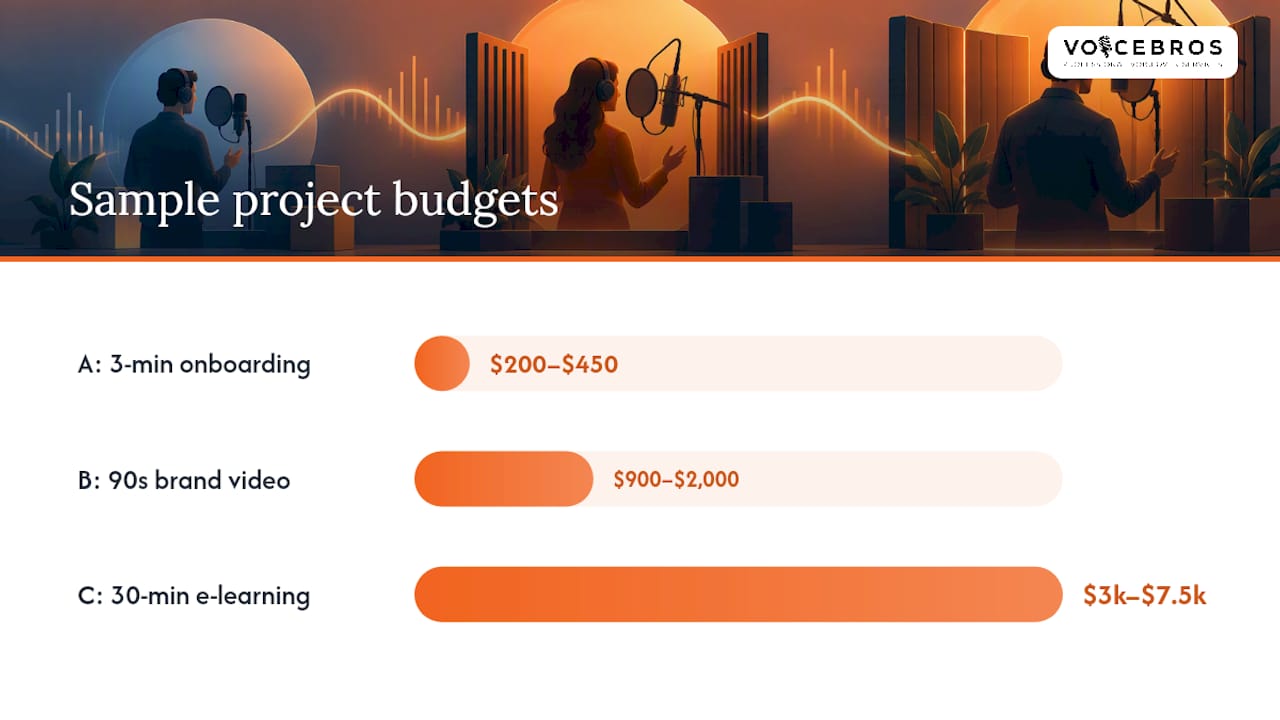
Scenario C: 30-minute e-learning module. Priced per finished minute at $100 to $250, a 30-minute module lands between $3,000 and $7,500, often with one or two rounds of minor revisions included.
A simple formula covers most of these situations:
- Convert the script to finished minutes (roughly 150 words per minute at a natural pace) or use the raw word count.
- Multiply by your per-word or per-finished-minute baseline from the ranges above.
- Add a usage multiplier for anything beyond internal, single-territory use, since licensing typically scales cost faster than recording time does.
That third step is where most first-time buyers underbudget. A script that costs $300 to record internally can double or triple once it's licensed for external distribution, even though nothing about the recording itself changed.
How to Request Comparable Quotes
Getting three quotes back that actually mean the same thing requires asking every vendor the same questions, in the same order, before anyone names a price.
Build your request around this checklist:
- Full script or a firm word count, plus target finished-minute length if it's long-form
- Every language and accent variant you need, listed individually
- Usage scope: internal, external, broadcast, or paid, plus territory and term
- Exclusivity requirements, if any
- Exact deliverables: file formats, stems, number of revision rounds included
- Turnaround deadline and whether rush pricing applies
When bids come back in different formats, normalize them. Convert a per-word bid to its per-finished-minute equivalent (or vice versa) so you're comparing apples to apples, and confirm in writing exactly what usage rights the quoted price includes.
Watch for a few warning signs: vague or missing licensing terms, no itemized list of deliverables, or a price so far below the market range that it likely means an unclear studio setup, minimal editing, or no revision allowance at all. Clear scope and defined deliverables are the single best defense against surprise re-record fees later.
When to Invest in Premium Talent vs. Cost-Effective Options
The instinct to save money on every narration project is understandable, and wrong about half the time. Internal training modules, compliance videos, and IVR prompts rarely need a premium voice. Nobody's brand perception hinges on the tone of a password-reset menu.
Investor presentations, product launches, and anything customer-facing are a different calculation entirely. That's where a flat, inconsistent read costs more in the long run than the higher fee would have. Consistent casting across a library of corporate content also pays for itself: switching narrators mid-series forces re-records and confuses the brand voice. A vetting process that filters for range and reliability before you ever hit "hire" reduces exactly that kind of expensive rework.
— Onur
Get a Firm Quote With Vetted Corporate Narrators
Guessing at price bands only gets you so far. The platform provides access to a marketplace of numerous vetted human voice actors, filterable by language, accent, category, and budget, with transparent pricing shown upfront on profiles.
All artists listed are human, and pricing includes usage rights clearly indicated before booking, helping prevent renegotiations after invoicing. To receive a quote, provide your script length, target usage, territory, and turnaround deadline. Compare demos before ordering, with typical turnaround times provided. Start by checking current per-word and per-minute rates or browse the full narrator roster to shortlist voices for your next corporate video.
Rate Sheets and Guides Worth Bookmarking
A few primary sources back most of the numbers in this guide, and they're worth keeping on hand for your next negotiation:
- SAG-AFTRA corporate/non-broadcast rate sheet, for verified union daily minimums and employer contribution rules.
- Industry pricing examples for corporate clients, for internal versus external project ranges.
- Rate and negotiation guidance, for pricing structures and questions to ask before you sign.
Sources
- SAG‑AFTRA corporate/educational & non-broadcast rate sheet (2025)
- What to charge corporate clients for voice over (industry examples)
- Rates & negotiation guidance (GVAA)
FAQ
How much should a 30-second corporate voiceover cost?
A 30-second internal script typically runs $100 to $250 as a flat project fee. The same 30 seconds licensed for external advertising or broadcast can run several times higher once usage and territory are added, since licensing drives the price difference far more than the short runtime does.
What is corporate narration?
Corporate narration is professional voice work recorded for business content: training videos, onboarding modules, investor presentations, IVR systems, and internal or external explainer videos. It's distinct from commercial voiceover in that the goal is usually clarity and trust rather than persuasion or entertainment.
How much should I charge for voiceover work?
Rates depend on whether the work is per word, per finished minute, or session-plus-usage, and on how the content will be used. Most guides recommend pricing recording time separately from licensing, since usage terms typically account for the bulk of the total fee on any job beyond strictly internal use.
What are the SAG-AFTRA voiceover rates for corporate work?
Under the current SAG-AFTRA corporate and non-broadcast rate sheet, minimum daily session rates for some corporate categories run around $1,223, with Category II reaching roughly $1,451, plus required health and retirement contributions. These are contractual floors for union-covered work, not the standard market rate for non-union corporate narration.
How does Voicebros price corporate narration projects?
Pricing on Voicebros varies by the individual voice actor, since each artist sets their own rate visible on their profile before you book. Check current pricing and calculators for the most accurate numbers based on your specific project scope.
Recommended
Need a voice over for your project?
Browse 1,500+ professional voice artists in 50+ languages, hear real demos and get instant word-based pricing on VoiceBros.
Related Posts
 General
Buyers: $250 to $3,500 Japanese Voice Over Rates and Line Item Budgets
See sample Japanese voice over budgets from $250 to $3,500, learn which license and production fees drive price, and get transparent line-item quotes from...
 General
48kHz/24 bit Recordings: Voice Over File Formats Talent Should Send
Record a 48kHz, 24 bit WAV master and send a WAV plus MP3 preview. Clear specs, format guidance, and a delivery checklist for voice talent and producers.
 General
Ship Ads Faster: 24 Hour Commercial Voice Casting for Marketing Teams
Production first commercial voice casting for marketers. Nail the brief, get editor ready auditions, lock rights, and book 24 hour delivery.
VoiceBros Team
The VoiceBros team is dedicated to providing high-quality voice over services and industry insights. With years of experience connecting voice artists with clients worldwide, we're passionate about helping you find the perfect voice for any project.
Back to Blog →