
Buyers: $250 to $3,500 Japanese Voice Over Rates and Line Item Budgets
Expect to pay from a few hundred dollars for a small local-use commercial read, several hundred to a couple thousand for regional or e-learning work, and several thousand or more for national broadcast campaigns with celebrity-caliber Japanese talent. The real variable isn't the actor's booth time. It's the license: where the ad runs, for how long, and what deliverables you need. Before you compare two quotes, make sure both cover the same usage scope and file package.
TL;DR:
- Licensing scope, reach, and license duration significantly influence the rate differences between local and national Japanese voice-over projects.
- Costs vary from about $250 for short local ads to over $3,500 for extended national campaigns with broad rights.
- Quotes can differ greatly depending on talent experience, production scope, and additional extras like revisions or rushed turnaround times.
- Comparing quotes requires clear, identical briefs with specified usage rights, deliverables, and scope to avoid surprises and inflated costs.
- VoiceBros offers transparent, itemized pricing and demos for over 1,500 vetted Japanese voice actors to simplify the comparison process.
Table of Contents
- What Do Japanese Voice Over Rates Look Like by Project Type?
- What Actually Drives a Japanese Voice Over Quote?
- What Do Real Japanese Voice Over Budgets Look Like?
- How Do You Get an Apples-to-Apples Quote?
- How Does VoiceBros Make Japanese Voice Over Pricing Transparent?
- What Buyers Get Wrong About Negotiating Japanese Voice-Over Rates
- Get a Transparent Japanese Voice-Over Quote
- Where These Rate Figures Come From
- Sources
- FAQ
What Do Japanese Voice Over Rates Look Like by Project Type?
Rates split into two worlds: what Western agencies quote in dollars, and what Japan-based studios and talent quote in yen, usually by the hour or by character count. Both systems land in similar territory once you convert them, but the pricing logic differs enough to trip up buyers who assume one script equals one flat number.
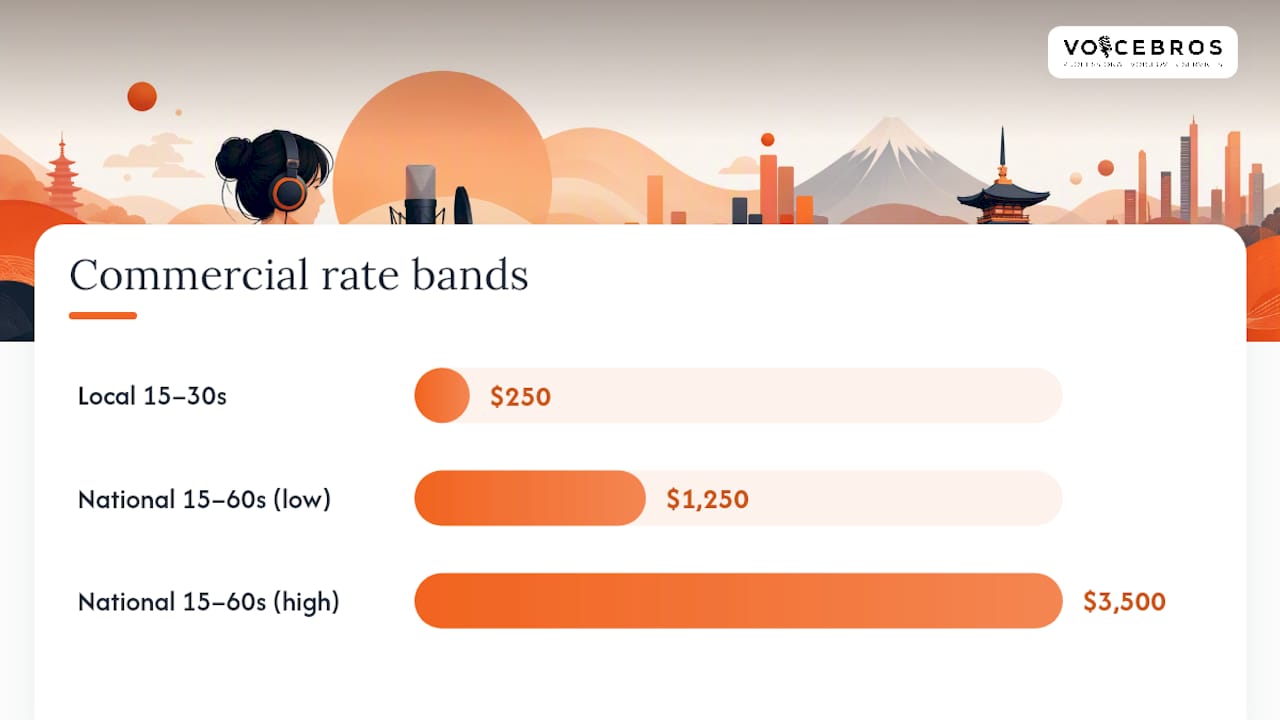
A 15 to 30-second commercial for local, short-term use can run as low as $250, while national broadcast campaigns push into the $1,250 to $3,500 range once you factor in usage and duration, according to RealVOTalent's rate guide. Ads cost more per second than almost any other format, because the client is paying for reach and shelf life, not just recorded audio.
E-learning and corporate training modules typically price by the finished minute, with rates climbing when the module includes tight sync to on-screen actions or multiple character voices. Audiobooks and long-form narration price by the finished hour or occasionally per word, and most narrators enforce a minimum project fee regardless of length.
On the Japan side, some suppliers list narrator fees by the hour with studio and production charges billed in half-hour increments, and hourly narrator rates shift depending on whether you book a newcomer or a veteran, per i-pairs' narration pricing page. One Japan-focused talent directory lists broader bands: voiceover talent around 20,000 to 70,000 JPY per hour, with studio booking starting near 13,000 JPY per hour on top of that.
- Commercial (15 to 60 sec): $250 low end, $1,250 to $3,500 for national broadcast usage
- E-learning: priced per finished minute, with a project minimum regardless of runtime
- Audiobook/narration: priced per finished hour or per word, with a standard minimum fee
- Studio/engineer time: often billed separately in 30- to 60-minute blocks
What Actually Drives a Japanese Voice Over Quote?
Two identical scripts can generate wildly different quotes, and licensing is almost always the reason. A read for a company's internal training video and the same script running as a national TV spot are not the same job, even if the audio file sounds nearly identical.
Usage and license scope is the single biggest lever. Buyout rights, national reach, and multi-year terms all push price up, while a single internal use with a short expiration date keeps it down. Short ad copy is often more expensive than a much longer explainer video, because ads demand alternate takes, tighter direction, and explicit buyout language that a training video never needs.
Talent tier matters just as much. A newcomer voice actor, a working mid-career professional, and a veteran with agency representation occupy three different price brackets, and agency-repped talent usually adds a booking fee on top of the base rate.
Production scope changes the invoice too. Remote home-studio recording costs less than a supervised session in a professional studio with an engineer present, and anything requiring ADR, precise lip sync, or a director on the call adds line items.
Extras stack quickly:
- Script translation or cultural adaptation (billed separately from the voice work itself)
- Rush turnaround fees for anything under standard lead time
- Revision rounds beyond what the contract includes
- Extra deliverable formats (broadcast WAV plus a compressed MP3, for example)
Pro Tip: Ask every vendor to break the license scope into its own line item on the quote. If a vendor doesn't separate usage rights from the recording fee, that's usually a sign the rate will balloon later when you actually need broader usage.
What Do Real Japanese Voice Over Budgets Look Like?
Numbers mean more with a scenario attached. Here's how four common briefs typically shake out once usage and production scope are factored in.
- 30-second commercial, local retail campaign: A budget read for a single-market, three-month run lands near the low end, roughly $250 to $600. The same script cleared for national broadcast with a one-year license jumps to $1,250 to $3,500, per the same RealVOTalent benchmarks, purely because of reach and duration.
- 2-minute explainer video: Priced per finished minute or per word depending on the vendor, this typically runs a few hundred dollars total for internal or website use, with the biggest swing factor being whether the client wants multiple takes per line.
- 10-minute e-learning module: Per-finished-minute pricing usually includes one round of editing and sync to slide timing. Multiple character voices or an interactive branching script raise the per-minute rate noticeably.
- Short audiobook chapter or narration sample: Priced per finished hour or per word, with most narrators setting a minimum fee so a five-minute sample doesn't undercut an hour-long booking. On the Japan side, script adaptation runs around 3,000 JPY per page when the source material needs localization before recording.
How Do You Get an Apples-to-Apples Quote?
Vague requests get vague quotes. The fastest way to compare vendors fairly is to send the exact same brief to each one, with every variable spelled out up front.
A solid request for proposal includes the final script (or a clear word/character count if it isn't finished), the intended markets and how long the license needs to run, the deliverable file formats you need, whether you want alternate takes, and any sync or timing requirements tied to video, according to the checklist RealVOTalent recommends for getting comparable bids. If you don't have a Japanese script yet, most vendors can estimate from an English word count or approximate runtime in minutes, though the final number usually firms up once the Japanese character count is locked.
- Standard turnaround for short scripts: 24 to 72 hours
- Rush delivery: available for an added fee, usually same-day or next-day
- Payment terms: confirm deposit requirements and whether invoicing happens before or after delivery
- File formats: specify broadcast-quality WAV versus compressed formats before booking, not after
How Does VoiceBros Make Japanese Voice Over Pricing Transparent?
Quoting confusion usually comes from vendors who won't itemize their pricing until after you've committed. VoiceBros works from a catalog of more than 1,500 vetted voice actors, filtered by language, accent, category, and budget, so you can compare Japanese talent side by side before spending anything.
Every listing shows per-word rates through a pricing calculator, and you can preview live demos before committing to a booking. That means the license scope and deliverables show up in the quote itself, not buried in a follow-up email.
What Buyers Get Wrong About Negotiating Japanese Voice-Over Rates
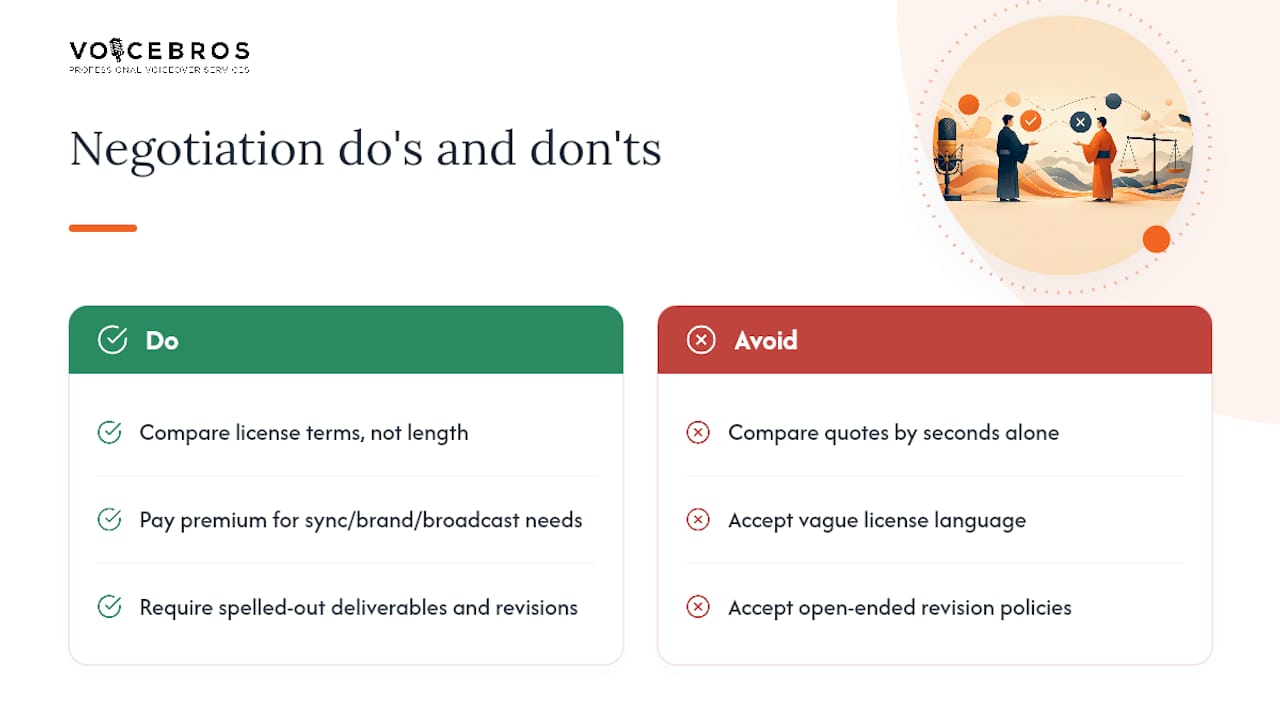
Comparing quotes by seconds of audio alone is the most common mistake I see. Two 30-second scripts with different license terms are not the same purchase, and treating them that way guarantees a nasty surprise later.
Paying a premium for a veteran or celebrity-tier voice makes sense when the project involves complex sync work, brand recognition, or a long broadcast run. What doesn't make sense is accepting a quote with vague license language, open-ended revision policies, or deliverables that aren't spelled out. Those are the three red flags worth walking away from before you sign anything.
— Onur
Get a Transparent Japanese Voice-Over Quote
VoiceBros gives you what most Japanese voice-over sourcing lacks: line-item pricing you can see before you commit, not after. Every one of the 1,500-plus vetted voice actors on the platform comes with filters for accent, category, and budget, plus live demos so you're not booking blind.
Head to the pricing calculator with your script length, target markets, and license duration ready, and you'll get a per-word estimate before you talk to a single agent. Browse the voice artist catalog to shortlist talent by demo, or check the service categories if you're still deciding between commercial, e-learning, or narration work. Typical bookings have turnaround and invoicing terms that remove hidden fees, so the number you see going in reflects the expected cost.
Where These Rate Figures Come From
Pricing benchmarks in this guide draw from RealVOTalent's voiceover rate guide, Japan-based supplier pages including i-pairs and Japan Voice Talent's pricing page. Local market practice varies, so confirm current terms directly with any vendor before booking.
Sources
- How Much Does a Voiceover Cost? (2026 Rates) | RealVOTalent
- Narration/Announcement Audio Production Service Advanced Plan | i-pairs
FAQ
How much should you charge for a 30-second voiceover?
A 30-second voiceover for local, limited-run use typically starts around $250, while national broadcast usage pushes the same script to $1,250 to $3,500, according to RealVOTalent's rate data. The gap comes almost entirely from license scope, not recording time.
How much do Japanese voice actors get paid?
Japan-based narrator fees commonly run by the hour and scale with experience, from newcomer rates up to veteran pricing, as shown on i-pairs' pricing page. Some Japan-focused talent directories list broader hourly bands, roughly 20,000 to 70,000 JPY, depending on rank and project scope.
How much does it typically cost to hire a Japanese voice actor for a commercial project?
Costs depend heavily on where the ad runs and for how long, with local use starting near $250 and national campaigns reaching $1,250 to $3,500 per the same RealVOTalent benchmarks. Studio booking and engineer time in Japan are often billed separately, in half-hour increments.
What's the best way to compare voice-over quotes fairly?
Send every vendor the same script, license terms, and deliverable list so quotes reflect identical scope rather than different assumptions. VoiceBros displays per-word pricing alongside license details upfront, which removes most of the guesswork buyers face when comparing bids.
Does script length or word count determine the final price?
Word count matters, but license scope and production complexity usually matter more. A short ad script with national broadcast rights can cost far more than a longer e-learning module licensed for internal use only.
Recommended
Need a voice over for your project?
Browse 1,500+ professional voice artists in 50+ languages, hear real demos and get instant word-based pricing on VoiceBros.
Related Posts
 General
Ship Ads Faster: 24 Hour Commercial Voice Casting for Marketing Teams
Production first commercial voice casting for marketers. Nail the brief, get editor ready auditions, lock rights, and book 24 hour delivery.
 General
Budget Corporate Narration Rates: 3 Scenarios & SAG‑AFTRA Floors
Buyer’s playbook for corporate narration rates: market ranges, SAG‑AFTRA floors, three budgeted scenarios, and how to get firm quotes fast.
 General
5 Factors That Set Voice Over Usage Rights for Hirers and Talent
Practical, cross-audience guidance: the five factors that determine voice over usage rights and fees plus exact contract clauses for medium, territory,...
VoiceBros Team
The VoiceBros team is dedicated to providing high-quality voice over services and industry insights. With years of experience connecting voice artists with clients worldwide, we're passionate about helping you find the perfect voice for any project.
Back to Blog →