

Paste Ready Voice Over Brief: 8 Fields to Prevent a Second Session
A voice over brief needs eight things to work: audience, tone plus reference audio, language and accent, usage rights and territory, script length and target duration, pronunciation notes, budget range, and deadline with delivery format. Miss any of these and you're paying for a second session. A concise brief covering these fields produces better casting and fewer re-records than a vague one, no matter how well written the script itself is. The checklist below turns that verdict into something you can paste directly into an email or casting form.
TL;DR:
- Clear and specific audience, tone, language, and usage details ensure accurate voice talent matching and reduce the need for re-records.
- Attaching reference audio and pronunciation guides minimizes session time and prevents multiple revisions caused by ambiguity.
- Defining media, territory, term length, and budget upfront helps set realistic expectations and prevents unexpected costs.
- Precise pacing and emotional direction embedded in the script lead to more natural deliveries and better alignment with project goals.
- Using vetted platforms with detailed briefs speeds up casting, filters talent appropriately, and provides demo comparisons based on exact project needs.
Table of Contents
- Voice Over Brief Checklist: What to Copy and Paste
- How Do You Describe the Tone You Actually Want?
- Who Is the Voice Talking To?
- What Usage and Budget Details Belong in a Brief?
- Script, Timing, and Delivery Specs That Prevent Re-Records
- Setting Deadlines and a Fair Revisions Policy
- The Briefing Mistakes That Cost You a Second Session
- How Do You Ask for a Specific Emotional Tone?
- Getting Pacing and Emphasis Right in the Script Itself
- Should You Mention Music or Sound Effects in the Brief?
- What a Small Habit Taught Me About Directing Sessions
- Get a Vetted Shortlist for Your Next Project
- Sources
- FAQ
Voice Over Brief Checklist: What to Copy and Paste
Every field below answers a question a director or voice actor would otherwise have to guess at. Skip one, and you're either fielding follow-up emails or listening to an audition that misses the mark entirely.
- Audience: Who's listening? Example: "Small business owners aged 35 to 55 evaluating accounting software."
- Tone and references: Two or three adjectives plus a sample. Example: "Warm, confident, slightly conversational. Reference: the narrator in [attach link]."
- Language and accent: Be specific. "US English, General American" is not the same casting pool as "UK English, Received Pronunciation."
- Media and usage: Where will this run, and for how long? Example: "Paid social and YouTube pre-roll, 12-month term, North America only."
- Script length and duration: Word count and target runtime. Example: "180 words, targeting 60 seconds at a natural pace."
- Pronunciations: Any brand names, technical terms, or names that aren't obvious. Example: "Nuvara rhymes with 'Sahara.'"
- Budget range: Even a rough band helps. Example: "$300 to $600 for the finished spot."
- Deadline and delivery: Due date plus file specs. Example: "Draft by Friday, final WAV 48kHz/24-bit by the following Wednesday."
A single-line version might read: "60-second explainer video for a fintech app, warm and confident female voice, US English, web and social use for 12 months, script attached, need pronunciation of 'Nuvara,' budget $400 to $600, final files needed in 10 days." That's a complete voiceover brief in one sentence, and any casting director can act on it immediately.
How Do You Describe the Tone You Actually Want?
"Professional" tells a voice actor almost nothing. So does "friendly," "energetic," or "engaging" on their own. Every actor in your shortlist has a different mental picture of what those words mean, and you'll get four wildly different auditions back for the price of one clear brief.
The fix is specificity plus a reference point, as explained in articles about content creation and production planning that are useful for commissioning professionals planning integrated campaigns. Adjectives like "warm, reassuring" paired with a short reference clip give a performer something concrete to match, rather than a mood they have to invent from scratch. Pick two or three adjectives, never more than four, and attach an example: a competitor ad, a podcast intro, a previous campaign you liked the sound of.
- Weak: "We want something professional and friendly."
- Better: "Warm and unhurried, like a trusted advisor explaining something simple. Reference: [attached clip]."
- Also useful: "Confident but not salesy, similar to the tone in this 30-second spot [link]."
Pro Tip: Attach the reference audio as a file or link directly in the brief, not as a separate follow-up email. Actors audition based on what's in front of them, and a brief without a sound example gets read four different ways by four different performers.
Leave room for the performer's own instincts once the tone is set. A brief that dictates every inflection produces a stiff read; a brief that sets the emotional target and lets the actor find the path there usually sounds more natural.
Who Is the Voice Talking To?
Audience definition changes who gets cast before a single audition happens. A brief aimed at retirees evaluating a medical alert device needs a different voice than one aimed at gamers deciding between two subscription tiers, and casting directors sort talent by exactly these signals.
- Age and life stage determine vocal register and pacing; a voice built for a children's app doesn't automatically work for a B2B software demo.
- Industry familiarity decides how much explanation the read needs to carry versus how much can be delivered as shorthand to an audience that already knows the jargon.
- Locale and cultural context affect accent, idiom, and even sentence rhythm, since a script written for American listeners can land oddly when read with British cadence.
If your project needs the actor to embody a character (a mascot, a recurring brand voice, a game NPC), say so explicitly and give a short character note. If it's a straightforward informational read, an actor doing a natural, unaffected delivery usually serves the message better than a performance. A corporate training module for new hires calls for clear, measured pacing; a 15-second app ad aimed at teenagers calls for something faster and more casual, cast from a completely different pool of talent.
What Usage and Budget Details Belong in a Brief?
Usage terms decide the price more than almost anything else in the brief, and they're the detail commissioning teams forget most often. Media, territory, and term length materially change pricing, so a national TV campaign running for two years costs differently than the same script used only on an internal training portal.
Define four things clearly:
- Media: Broadcast, web, social, in-store, internal use, or some combination.
- Territory: One country, North America, worldwide, or a specific list of markets.
- Term: How long the audio can run, in months or years, before it needs to be re-licensed.
- Exclusivity: Whether the talent is restricted from voicing competing brands during that term.
Why this matters for your number: Including a budget range up front accelerates realistic shortlists and prevents the mismatch where a client expects a $150 read but the usage terms actually call for a $2,000 buyout rate. Sample phrasing: "This is for paid digital and social use, 12-month term, US and Canada, non-exclusive. Please quote based on those terms." Checking a current rate guide before you set your range keeps expectations grounded on both sides.
Script, Timing, and Delivery Specs That Prevent Re-Records
Attach the final script whenever possible. If it's still in draft, give a firm word count and target duration instead of leaving the actor to guess pacing. As a rough rule, 150 words reads in about 60 seconds at a natural conversational pace, though tone and pauses shift that number.
Pronunciation notes matter more than most briefs give them credit for. Providing pronunciation guidance and reference clips reduces both session time and the number of re-records needed after the fact. List brand names, product terms, and any name that isn't phonetically obvious, and spell out the pronunciation the way you'd say it out loud.
- List every non-obvious word with a phonetic spelling ("Nuvara: noo VAR ah").
- Attach reference audio for tone, even a 10 to 15 second clip.
- Specify delivery format: WAV or MP3, sample rate (48kHz/24-bit is a common broadcast standard), and whether you need stems (voice isolated) or a full mix.
- State if you need multiple takes or alt reads for A/B testing.
Getting these specs right the first time is the difference between a one-round approval and three rounds of notes.
Setting Deadlines and a Fair Revisions Policy
Lead time protects quality. A same-day turnaround forces a casting director to skip auditions and hand you whoever's available, not whoever's best. Give at least two to three business days for casting on a straightforward project, longer for anything requiring a specific accent or a niche vetting process.
- State your hard deadline and whether it's flexible.
- Clarify how many rounds of revisions or pickups are included before extra fees apply.
- Note your timezone and any live-direction session needs, since coordinating a real-time recording session across time zones takes advance planning.
- Flag if the project needs the same voice for future updates, which affects how the talent is booked and billed.
Most professional voice actors build one or two rounds of pickups into their standard rate. Anything beyond that, especially changes driven by late script edits, typically comes with an additional fee, and it's worth stating that expectation before the session, not after.
The Briefing Mistakes That Cost You a Second Session
- Vague tone words with no reference. "Professional but approachable" without an example forces the actor to guess, and vague tone descriptors are one of the most common causes of extra sessions and higher costs. Fix: attach a clip, always.
- No usage or licensing terms stated up front. This either inflates your quote unexpectedly or, worse, gets you a rate that doesn't legally cover how you plan to use the audio. Fix: state media, territory, and term in the first draft of the brief, not after the quote comes back.
- Script changes after casting has started. A brief that answers the questions a director would ask, kept short and specific, beats a long document with the script still in flux. Fix: lock the script, or at minimum the word count and structure, before you send the brief out.
Pro Tip: A phonetic pronunciation list and one reference audio clip attached to the initial brief will cut more revision rounds than almost anything else you could add.
How Do You Ask for a Specific Emotional Tone?
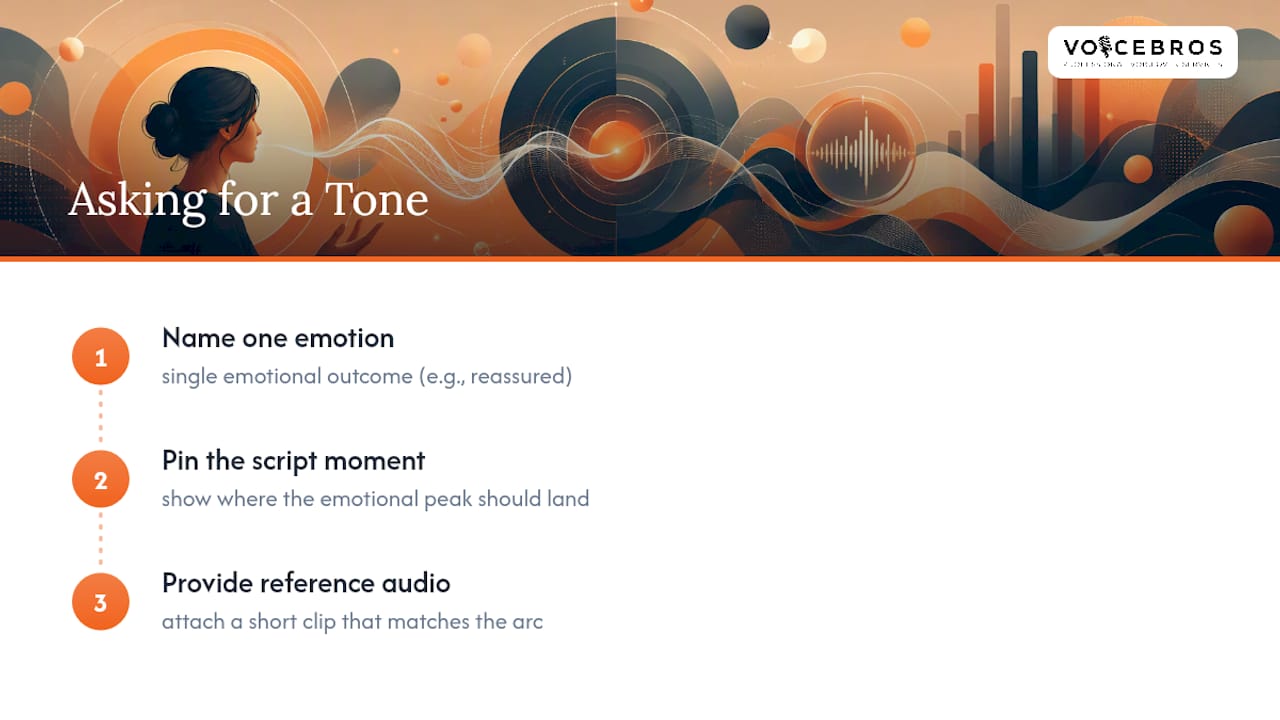
Emotional impact separates a forgettable read from one that actually moves someone to act, and it's the piece of a voiceover brief most commissioning teams under-specify. Naming the emotion you want isn't the same as naming the style. Style is warm, urgent, or playful. Emotion is what you want the listener to feel by the end: reassured, curious, motivated to click, comforted.
Start by naming the single emotional outcome the audio needs to produce. A hospital appointment reminder needs to land as calm and trustworthy, not exciting. A flash sale ad needs urgency without sounding frantic or pushy. A meditation app intro needs to slow the listener's breathing down, almost literally, through pacing and warmth rather than through word choice alone.
Once you've named the target emotion, connect it to a concrete moment in the script. Tell the actor where the emotional peak should land: "the shift happens at 'but there's a better way,' where the tone should lift from concerned to hopeful." That's far more actionable than a general note like "make it emotional" pinned to the whole script.
Reference audio does more work here than adjectives ever will. If you've heard a spot, a podcast moment, or even a film scene that captures the emotional arc you're after, attach it. Actors interpret emotional direction through example far more reliably than through description, which is exactly why a short reference clip belongs in nearly every field of a strong brief, not just the tone section.
Getting Pacing and Emphasis Right in the Script Itself
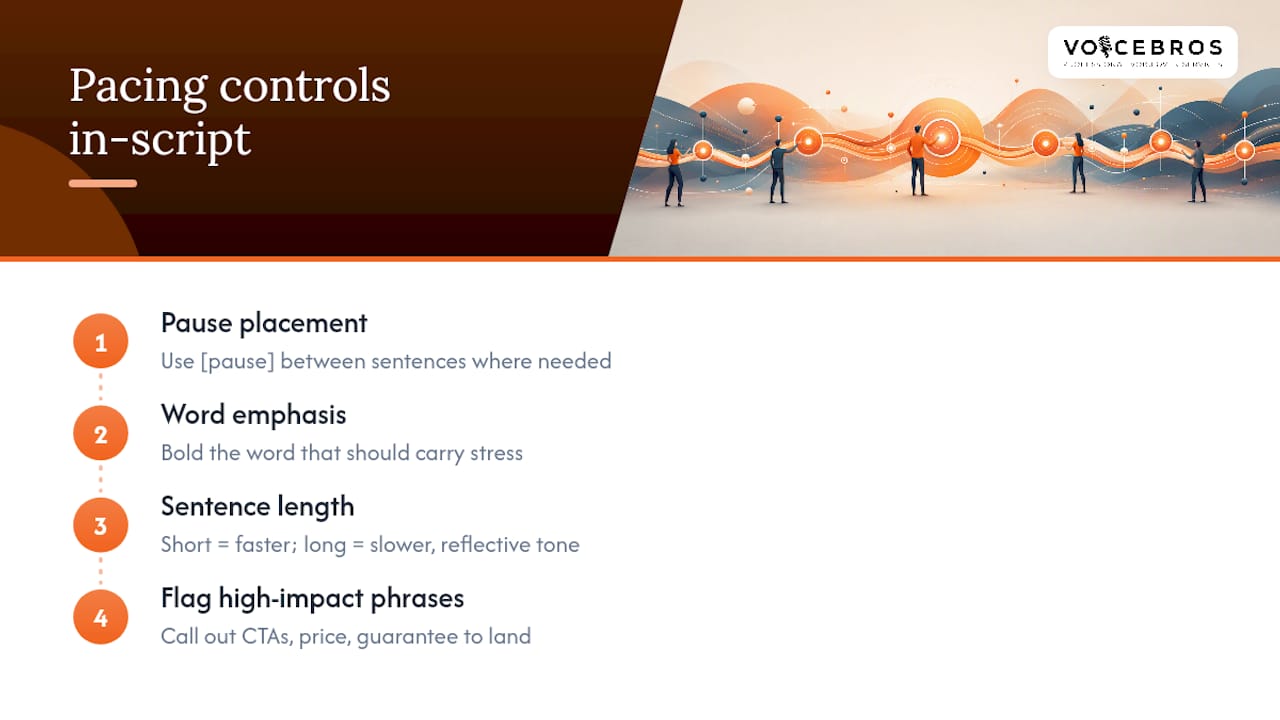
Pacing instructions belong in the script, not just in a cover note, because an actor reading cold needs cues embedded where they'll actually use them. Mark where you want a pause, where the read should slow down, and which words in a sentence carry the meaning.
A simple bracketed note works well: "[pause]" between sentences where you want a beat, or bold on the word that should carry stress. For example: "This isn't just software. It's peace of mind." Bolding the emphasis point tells the actor exactly where the sentence's weight should land, rather than leaving it to interpretation.
Sentence length in the script itself also shapes pacing more than most people realize. Short sentences read faster and punchier by default. Long, comma-heavy sentences naturally slow a reader down, which works well for a reflective or premium-feeling brand voice but badly for a high-energy 15-second promo.
If specific phrases need to land with extra weight, such as a call to action, a price, or a guarantee, flag them directly: "Slow down slightly on 'no contracts, ever' and let it land before moving to the next line." Actors deliver a far cleaner first take when pacing direction sits inside the script rather than buried in a separate paragraph of notes they have to cross-reference while reading.
Should You Mention Music or Sound Effects in the Brief?
Yes, even if the voice actor isn't the one adding the music. Knowing whether the final mix will include background music, sound effects, or neither changes how an actor paces and energizes their read. A voice recorded to sit under an upbeat music bed needs more rhythmic consistency than one delivered as a standalone narration.
If you already know the music style, mention it: "This will sit under an upbeat, mid-tempo track, so keep the pacing tight and avoid long dramatic pauses." If sound effects will follow specific lines, such as a doorbell, a notification chime, or a whoosh transition, flag where those moments fall so the actor can leave natural space for them rather than talking over where the effect needs room.
Conversely, if the voice track will run completely dry, with no music or effects at all, say that too. A narration meant to stand alone, like an audiobook chapter or a phone system prompt, needs a fuller vocal presence and clearer enunciation than dialogue destined to sit underneath a busy sound design.
Whether stems (voice isolated from music and effects) or a final mixed file is the required deliverable belongs in this same conversation. A post-production team layering music separately needs a dry stem; a client with no further mixing to do needs a mixed, ready-to-publish file. State which one you need before the session, since re-exporting after the fact sometimes means going back to the recording engineer entirely.
What a Small Habit Taught Me About Directing Sessions
Years of watching sessions run long always trace back to the same gap: a director assumes the brief was clear, and the actor interpreted it a different way. The habit that fixes this isn't complicated. Attach a short reference clip and a pronunciation list to every brief, even when the project feels too simple to need one.
That single habit routinely cuts a two-hour session down to thirty minutes, because it removes the guessing before the microphone ever turns on. Ambiguity is what costs time, not talent.
— Onur
Get a Vetted Shortlist for Your Next Project
A vetted voice actor service offers an alternative to sifting through open casting calls or agency retainers: submit a detailed brief and receive a shortlist of voice actors matched to your project fields, rather than unrelated auditions. The platform filters voice actors by language, accent, category, gender, and budget to create a relevant shortlist tailored to the tone and audience details in your brief, avoiding a generic submission process.
After submitting your brief, you can expect side-by-side demos to compare, accompanied by a quote based on the usage terms specified, such as for a commercial or an e-learning module. This process helps avoid negotiating rates blindly or guessing whether a voice fits before committing to a session. Browse the vetted voice actor pool and submit your brief today to get demos back from actors matched to your project, not a stack of unrelated auditions to sort through yourself.
Sources
For deeper templates and rate benchmarks beyond this guide, GoLocalise's brief checklist covers field-by-field examples, Red Facilities breaks down tone direction in more depth, and the Gravy For The Brain rate guide offers current industry pricing benchmarks worth checking before you finalize a budget range.
- How to Write a Voiceover Brief | Voiceover Casting Edinburgh — Red Facilities
- GVA rate guide — Global Voice Academy
- Rates — Gravy For The Brain
FAQ
What Does a Voice Over Script Look Like?
A voice over script is typically formatted as plain, conversational text with the word count and target duration noted at the top, sometimes with pacing cues like pauses or emphasis marked in brackets or bold. It avoids complex sentence structures meant for reading rather than speaking aloud, and it often includes pronunciation notes for brand names or technical terms alongside the copy.
How Much Does a 1-Minute Voice Over Cost?
Pricing depends heavily on usage terms, since media, territory, and license length all materially affect the rate a voice actor quotes. Rather than a single fixed number, it's more useful to state your intended use case and request a quote against it; current rate benchmarks are available through resources like the Gravy For The Brain guide or on VoiceBros's pricing page.
Is It VO or VA?
"VO" stands for voice over and refers to the recorded audio or the discipline itself, while "VA" typically stands for voice actor, referring to the performer. Industry usage varies by region and context, but "VO" is the more common shorthand when discussing the work, script, or brief, while "VA" refers to the person delivering it.
How Do You Write VO Directions Into a Script?
Voice over directions are usually written in brackets or a different font style directly above or beside the line they apply to, such as "[pause]" or "[urgent]" before a sentence. Keep directions short and specific rather than descriptive paragraphs, since actors read scripts in real time and need cues they can act on instantly rather than interpret.
What Should I Include if I'm Requesting a Quote From VoiceBros?
Include the same fields as any strong brief: audience, tone with reference audio, language and accent, media and usage terms, script length, and your deadline. Submitting these details through VoiceBros's voice artist marketplace lets the platform match your project to a shortlist and return demos and a quote based on your actual usage terms rather than a generic rate.
Recommended
Need a voice over for your project?
Browse 1,500+ professional voice artists in 50+ languages, hear real demos and get instant word-based pricing on VoiceBros.
Related Posts
 General
Hire Securely: 7 Point Voice Actor NDA Checklist & Template for Hirers
Practical hiring playbook for businesses and agencies: clauses, timing, a 7 point checklist and starter NDA template to protect scripts, release dates,...
 General
Book Better Voices in 20 Minutes: Voice Over Casting Brief for Producers
Draft a voice over casting brief in 20 minutes using a production tested checklist and two copy paste templates to attract auditions that actually fit...
 General
2026 update for Creators & Platforms: 3 Legal Anchors for Voice Cloning
2026 update for creators & platforms: three anchors, ELVIS Act, Lehrman v. Lovo, GDPR, decide voice cloning liability and next steps.
VoiceBros Team
The VoiceBros team is dedicated to providing high-quality voice over services and industry insights. With years of experience connecting voice artists with clients worldwide, we're passionate about helping you find the perfect voice for any project.
Back to Blog →